
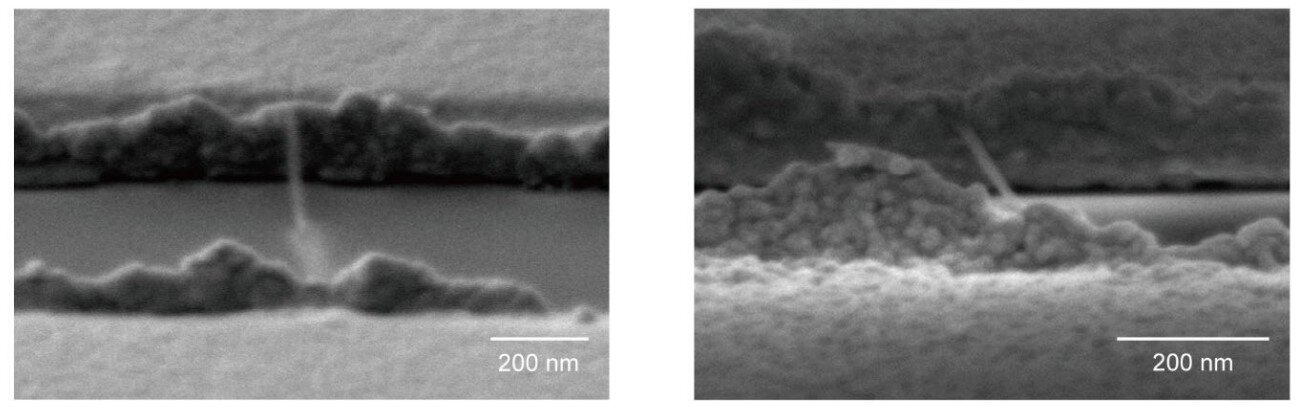
A research team has successfully developed the technology to fabricate high-sensitive biosensors by simply spraying, like an inkjet printer. The technology enables the fabrication of sensitive and precise sensors without expensive and complex equipment, and is expected to contribute to improving the fabrication scale and speed of biosensors in the future.
The work is published in the journal ACS Applied Materials & Interfaces. The team was led by Yoonhee Lee (Well Aging Research Center) in the Division of Biomedical Technology at the Daegu Gyeongbuk Institute of Science & Technology.
Carbon nanotube (CNT)-based field-effect transistors (FET) have emerged as next-generation biosensors, as they have high electric conductivity and sensitive surfaces and can capture even very small substances. For optimal sensor performance, however, single CNTs should be aligned consistently between electrodes, which requires complex equipment and expensive processes.
Traditional methods, such as lithography, chemical vapor deposition, and spin coating, have tricky fabrication processes and tend to be impractical when dealing with large areas. Hence, there have been limitations with their commercialization.
In this context, DGIST Senior Researcher Yoonhee Lee’s research team has successfully developed a drop-and-spread inkjet printing technique based on surface tension. The drop-and-spread technique drops picoliter (pL) droplets of CNT ink on electrodes, and then the ink naturally spreads owing to surface tension and aligns nanotubes consistently. With this technique, the research team successfully fabricated devices without additional processes. They achieved fabrication stability and reproducibility, with 72% of the devices fabricated in the desired shape.
Furthermore, the research team successfully captured serotonin, a neurotransmitter in the brain, by attaching DNA fragments (aptamers) that only bind to specific molecules in the fabricated device.
More importantly, the aptamers showed sufficiently high sensitivity to detect amounts much smaller than a single strand of hair (42 picomoles).
The findings demonstrate that this technology has potential for a variety of applications, including early diagnosis or real-time monitoring of neurological diseases, such as depression and Parkinson’s disease.
“This study holds significance as the resulting technique can fabricate high-performance sensors based on a simple method like inkjet printing,” said Senior Researcher Yoonhee Lee. “In the future, we will expand this technology into a platform to fabricate customized high-sensitive biosensors for detecting different disease biomarkers.”
Senior Researcher Yoonhee Lee, from the Division of Biomedical Technology, participated in this study as the first author along with Professor Hongki Kang from the Department of Biomedical Engineering, College of Medicine, Seoul National University, as the co-corresponding author. Postdoctoral Researcher Soohyun Park from the Division of Biomedical Technology served as first author. Minhye Shin and Eunui Kim from the Department of Electrical Engineering and Computer Science, DGIST, served as co-first author and co-author, respectively.
More information:
Soohyun Park et al, Surface Tension-Guided Drop-and-Spread Inkjet Printing for Additive Fabrication of CNT Field-Effect Transistor Biosensors, ACS Applied Materials & Interfaces (2025). DOI: 10.1021/acsami.5c13445
Citation:
Inkjet-style technique developed to produce high-sensitivity biosensors (2025, September 8)
retrieved 20 September 2025
from https://phys.org/news/2025-09-inkjet-style-technique-high-sensitivity.html
This document is subject to copyright. Apart from any fair dealing for the purpose of private study or research, no
part may be reproduced without the written permission. The content is provided for information purposes only.