
Close Menu
  • News
    • Medical
    • Nanomaterials
    • AI & Robotics
    • 2D Materials
    • Metamaterials
    • Nanoelectronics
    • ETF’s
    • Medicine
  • Environment
    • Earth.com
    • TreeHugger
    • Nanomuscle
  • Beauty
    • Makeupanalysis
What's Hot

NY Creates Begins Installation of First Major Tool for High NA EUV Lithography Center at Albany Nanotech Complex

May 7, 2026

Orange Leaf Extract Produces Greener Antibacterial Nanoparticles

April 9, 2026

Pittcon’s First San Antonio Experience a Roaring Success

April 8, 2026
Facebook X (Twitter) Instagram
  • Contact Us
  • Privacy Policy
  • Terms & Conditions
Facebook X (Twitter) Instagram
Elnano – Global Innovative Nanotechnology SolutionsElnano – Global Innovative Nanotechnology Solutions
  • News
    • Medical
    • Nanomaterials
    • AI & Robotics
    • 2D Materials
    • Metamaterials
    • Nanoelectronics
    • ETF’s
    • Medicine
  • Environment
    • Earth.com
    • TreeHugger
    • Nanomuscle
  • Beauty
    • Makeupanalysis
Elnano – Global Innovative Nanotechnology SolutionsElnano – Global Innovative Nanotechnology Solutions
Home » Ultra-Thin Filters Could Help Improve Production of Medicines and Dyes
Nanomaterials

Ultra-Thin Filters Could Help Improve Production of Medicines and Dyes

October 24, 2025No Comments3 Mins Read
Share
Facebook Twitter LinkedIn Pinterest Email

Scientists in Australia have developed new ultra-thin filters that can separate valuable chemicals from liquid mixtures fast and efficiently to make medicines, dyes and other products, which could help industries cut waste, save energy and lower costs.
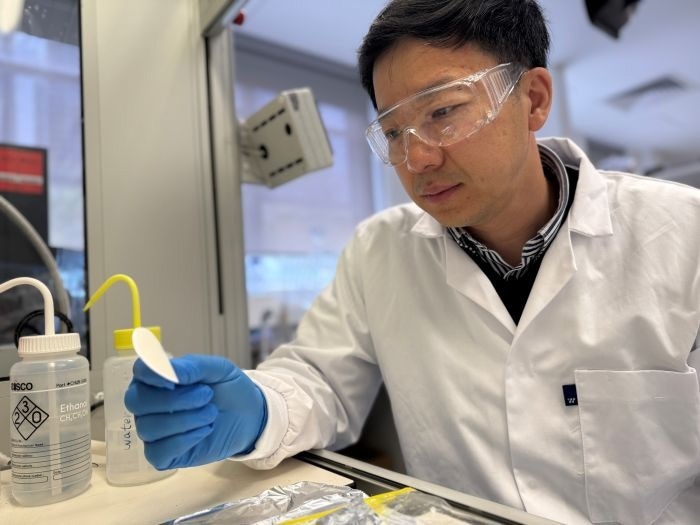
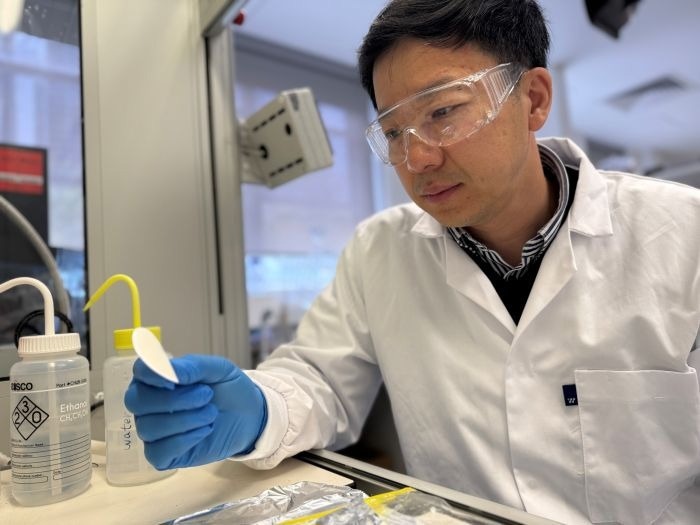
Professor Weiwei Lei in the lab at RMIT University, holding one of the team’s new ultra-thin hybrid filters. Image Credit: Will Wright, RMIT University

Led by RMIT University’s PhD scholar Yuxi Ma and senior researcher Professor Weiwei Lei, the team created hybrid filters that combine super-thin layers of boron nitride – a stable compound material – with tough synthetic fibers called aramid.

The result is a flexible but robust filter that stays stable even under high pressure.

“Boron nitride normally repels water, which makes it hard to combine with other materials,” Ma said.

“We altered its surface so that it attracts water instead. That allowed us to form a stable, even mix with the fibers and create a much stronger composite filter.”

Ma said the innovation could pave the way for cleaner, more efficient chemical manufacturing and recycling.

“Many industrial processes rely on solvents to produce or purify products, but separating out those solvents and re-using them can be slow and energy-intensive,” he said.

“Our filters let solvents pass through quickly while holding back larger molecules, offering a faster and more sustainable way to recover useful chemicals.”

In laboratory tests, the filters worked effectively with common solvents such as ethanol, methanol and acetone. They maintained stability under pressures up to 10 bar – around 10 times the pressure in a car tyre – and continued to perform consistently during 24 hours of continuous use.

See also  Ultrafast photothermal process achieves 3,000°C in 0.02 seconds, boosting hydrogen production efficiency sixfold

By adjusting the thickness of the active layer, the researchers could control how selective the filter was. About 1 micrometer gave the best balance between fast flow and strong blocking performance, filtering out up to 96 per cent of larger dye molecules.

Ma said the simplicity of the design was one of its strengths.

“Because the layers bond through natural hydrogen interactions, we can fine-tune the structure without needing complex chemical treatments,” he said.

“That makes the process easier to scale and more adaptable for different solvents or applications.”

While the filters held up well in mild conditions, the team found that very alkaline environments reduced performance and some harsh solvents caused gradual swelling. They are now refining the chemistry to boost durability and testing larger sheets under real-world flow conditions.

Lei said the research brought advanced nanomaterials a step closer to industrial use.

“We’ve shown it’s possible to create an ultra-thin, pressure-resistant filter using materials that are lightweight and easy to handle,” said Lei, from the School of Science.

“Our next goal is to work with industry partners to scale up production and test the technology in chemical recycling and purification systems.”

He said potential applications range from pharmaceutical and dye production to wastewater treatment.

“Improving filtration efficiency isn’t just about saving time – it’s about cutting waste and enabling circular manufacturing,” Lei said.

“With further development, we see strong potential for these filters to help industries transition to more sustainable processes.”

Source link

Dyes Filters improve medicines Production Ultrathin
Share. Facebook Twitter Pinterest LinkedIn Tumblr Email

Related Posts

NY Creates Begins Installation of First Major Tool for High NA EUV Lithography Center at Albany Nanotech Complex

May 7, 2026

Ultrafast Electron Microscopy Captures the Intricate Dynamics of Plasmonic Nanostructures

April 7, 2026

Researchers Call for Help with Reproducibility Crisis

April 6, 2026

Explore PI’s Brochure on Motion Control & Piezo Solutions

April 6, 2026
Add A Comment

Comments are closed.

Top Posts

Novel Polyphenol-Metal Nanocarrier for Antibody Delivery

September 18, 2025

Research Boosts Graphene’s Potential to Unprecedented Heights

September 19, 2025

PI Introduces Versatile Modular Precision Linear Stages

April 3, 2026

Subscribe to Updates

Get the latest sports news from SportsSite about soccer, football and tennis.

Explore the future with our Nanotech blog—covering innovations, research, applications, and breakthroughs shaping science, medicine, and modern technology.

We're social. Connect with us:

Facebook X (Twitter) Instagram YouTube
Top Insights

NY Creates Begins Installation of First Major Tool for High NA EUV Lithography Center at Albany Nanotech Complex

May 7, 2026

Orange Leaf Extract Produces Greener Antibacterial Nanoparticles

April 9, 2026

Pittcon’s First San Antonio Experience a Roaring Success

April 8, 2026

Subscribe to Updates

Get the latest creative news from FooBar about art, design and business.

  • Contact Us
  • Privacy Policy
  • Terms & Conditions

© 2026 elnano.com - All rights reserved.

Type above and press Enter to search. Press Esc to cancel.