
Close Menu
  • News
    • Medical
    • Nanomaterials
    • AI & Robotics
    • 2D Materials
    • Metamaterials
    • Nanoelectronics
    • ETF’s
    • Medicine
  • Environment
    • Earth.com
    • TreeHugger
    • Nanomuscle
  • Beauty
    • Makeupanalysis
What's Hot

Biomass-Derived Nanomaterials Offer a Greener Route to Pollution Cleanup

September 1, 2026

Nanozyme Aptasensors Show Promise for Faster Food, Health, and Environmental Testing

September 1, 2026

Researchers Solve Two Major Problems Holding Back SiC Electronics

September 1, 2026
Facebook X (Twitter) Instagram
  • Contact Us
  • Privacy Policy
  • Terms & Conditions
Facebook X (Twitter) Instagram
Elnano – Global Innovative Nanotechnology SolutionsElnano – Global Innovative Nanotechnology Solutions
  • News
    • Medical
    • Nanomaterials
    • AI & Robotics
    • 2D Materials
    • Metamaterials
    • Nanoelectronics
    • ETF’s
    • Medicine
  • Environment
    • Earth.com
    • TreeHugger
    • Nanomuscle
  • Beauty
    • Makeupanalysis
Elnano – Global Innovative Nanotechnology SolutionsElnano – Global Innovative Nanotechnology Solutions
Home » Researchers Solve Two Major Problems Holding Back SiC Electronics
AI & Robotics

Researchers Solve Two Major Problems Holding Back SiC Electronics

September 1, 2026No Comments2 Mins Read
Share
Facebook Twitter LinkedIn Pinterest Email
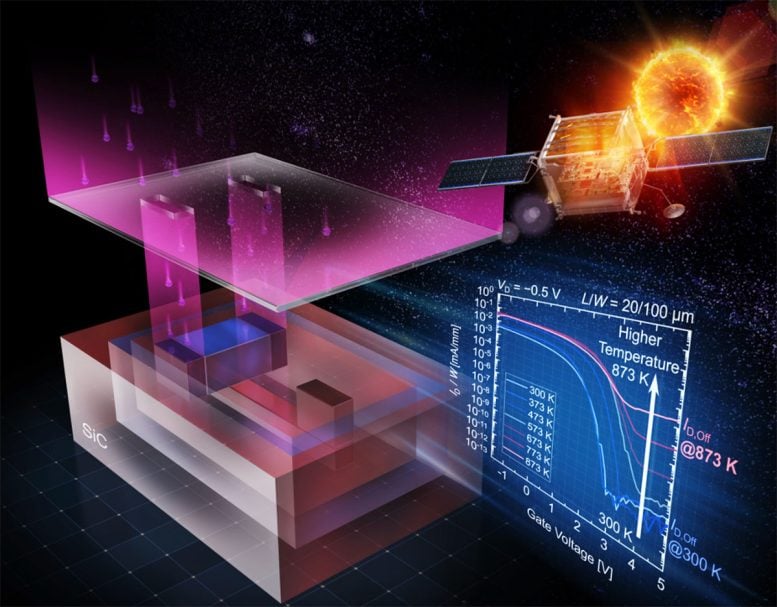
The newly created SiC junction transistor and its electrical characteristics from room temperature to 600°C. Credit: Science Graphics

A new bottom gate design takes advantage of the intrinsic properties of SiC.

For more than 20 years, silicon carbide – SiC – has been viewed as a promising material for electronics that must function in extreme environments. Yet despite years of research, that promise has rarely translated into practical devices. Researchers at Kyoto University are now trying to move the field beyond that barrier.

“We believe the lack of development is because the research community has been trying to apply silicon-era thinking to a fundamentally different material,” says first author Mitsuaki Kaneko.

Conventional designs limited SiC performance

The researchers focused on junction field-effect transistors, or JFETs. Earlier work suggested that complementary circuits built from SiC JFETs could provide low-power integrated electronics capable of operating under extreme conditions.

But the group’s previous JFETs, which used conventional top-gate structures fabricated in semi-insulating SiC substrates, had two major shortcomings: poor controllability and substantial leakage current at high temperatures. Solving both problems was considered essential for practical applications.

“Our goal is to open a new path forward with complementary JFETs designed to harness the intrinsic properties of SiC itself,” says Kaneko.

Instead of creating an entirely new manufacturing process, the researchers used industry-standard fabrication methods. They adopted a bottom-gate structure to improve control over the transistor’s threshold voltage and replaced the semi-insulating substrate approach with well-based isolation to reduce leakage current at high temperatures.

The transistor operated at 600°C

The redesigned SiC transistor worked on the team’s first attempt. Testing showed that the device could continue operating at 600°C. The bottom-gate architecture substantially improved threshold voltage control and sharply lowered leakage current to a level close to the theoretical limit expected from the intrinsic properties of SiC.

See also  New Open-Source Tool Makes Complex Data Easily Understandable

The results show that SiC is already a mature power device material and highlight the potential of the new bottom-gate structure for building reliable SiC-based integrated circuits capable of operating at extreme temperatures.

Significant challenges remain before the technology can be used in practical systems. The researchers plan to develop more complex circuits, expand fabrication to wafer-level production, and ensure that complete device packages can withstand extreme environments.

Reference: “Over 600 °C operation of ion-implantation-based SiC bottom-gate JFETs” by Mitsuaki Kaneko, Shunya Shibata and Tsunenobu Kimoto, 17 August 2026, APL Electronic Devices.
DOI: 10.1063/5.0346734

Never miss a breakthrough: Join the SciTechDaily newsletter.
Follow us on Google and Google News.

Source link

Electronics Holding Major Problems Researchers SiC Solve
Share. Facebook Twitter Pinterest LinkedIn Tumblr Email

Related Posts

Tiny Hidden Vibrations Could Make Aircraft More Fuel Efficient

August 31, 2026

AI Searched 150 Million Materials – and Found Two Promising Candidates for Future Electronics

August 31, 2026

NY Creates Begins Installation of First Major Tool for High NA EUV Lithography Center at Albany Nanotech Complex

May 7, 2026

Researchers Call for Help with Reproducibility Crisis

April 6, 2026
Add A Comment
Leave A Reply Cancel Reply

Top Posts

Self-Heating Nanopores Turn Salt Precipitation Into Neuromorphic Memory

August 31, 2026

Physicists maneuver DNA molecules using electrical fields, offering real-time control

October 3, 2025

6-Channel Piezo Driver for Precision Actuators & Transducers

April 6, 2026

Subscribe to Updates

Get the latest sports news from SportsSite about soccer, football and tennis.

Explore the future with our Nanotech blog—covering innovations, research, applications, and breakthroughs shaping science, medicine, and modern technology.

We're social. Connect with us:

Facebook X (Twitter) Instagram YouTube
Top Insights

Biomass-Derived Nanomaterials Offer a Greener Route to Pollution Cleanup

September 1, 2026

Nanozyme Aptasensors Show Promise for Faster Food, Health, and Environmental Testing

September 1, 2026

Researchers Solve Two Major Problems Holding Back SiC Electronics

September 1, 2026

Subscribe to Updates

Get the latest creative news from FooBar about art, design and business.

  • Contact Us
  • Privacy Policy
  • Terms & Conditions

© 2026 elnano.com - All rights reserved.

Type above and press Enter to search. Press Esc to cancel.