
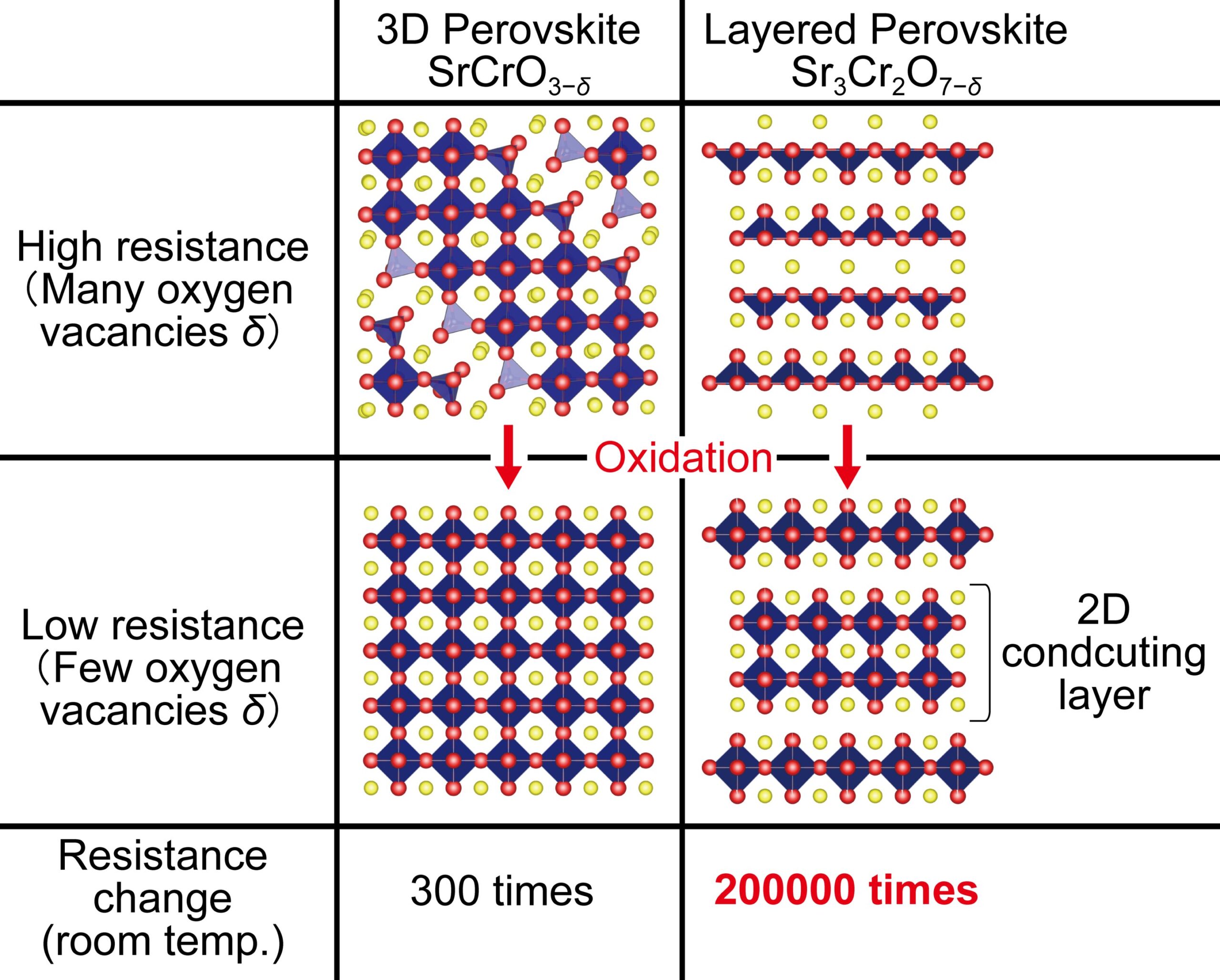
Researchers from Tokyo Metropolitan University have developed a new atomically layered material which experiences a five order of magnitude resistivity reduction when oxidized, more than a hundred times the reduction seen in similar, non-layered materials.
By analyzing the structure, the team discovered a synergy between oxidation and structural modification which drives dramatic changes in physical properties. The new material promises more power efficient next-generation devices, like memristors in AI computing.
The work is published in the journal Chemistry of Materials.
While AI revolutionizes science, industry, and society, there is a quiet revolution in developing next-gen materials to build the chips and devices necessary to keep up with the demand for greater computing power. There is a particular focus on materials for memristors, electronic elements which encode a “memory” of previous states; resembling synapses in the brain, they may see application in new AI chips.
One of the key requirements is something that can have its resistivity drastically changed at will. A team led by Associate Professor Daichi Oka from Tokyo Metropolitan University has been working with transition metal oxide materials, known to experience a resistivity reduction when oxidized.
By using a technology known as pulsed laser deposition (PLD), the team have succeeded in creating a high-quality thin layered crystalline film of Sr3Cr2O7−δ, a so-called perovskite-type structure for its similarity to the mineral of the same name.
By simply treating the film with heat in air, they found that the resistivity was reduced by five orders of magnitude. This is more than a hundred times what is expected for a similar material, SrCrO3, which is not layered but has a three-dimensional structure.
To understand why this had happened, the team delved into the crystalline structure. The material contained a large number of oxygen vacancies, sites in the structure which should be occupied by oxygen atoms. When the film was heated and annealed, oxygen made its way into the film, leading to a change in the structure.
The nature of the chromium atoms, or their “oxidation state,” also changes simultaneously. Interestingly, they found that the structural changes they saw were different in the layered film and its 3D counterpart.
They were able to conclude that the synergy between the changes in the film structure and the shift in the chromium oxidation state created a scenario where conduction electrons were able to make their way through the material much easier.
While the work focused on one material, the combination of oxidation and layered atomic structure is a new design principle by which a whole range of other films can be made.
The team hope that their method inspires new research directions and materials for memristors as well as power-efficient, bleeding edge chips to power future computing revolutions.
More information:
Zhaochen Ma et al, Oxidation-Induced Giant Resistivity Change Associated with Structural and Electronic Reconstruction in Layered Sr3Cr2O7−δ Epitaxial Thin Films, Chemistry of Materials (2025). DOI: 10.1021/acs.chemmater.5c00810
Citation:
Giant resistivity reduction in thin film provides key step towards next-gen AI electronics (2025, November 3)
retrieved 4 November 2025
from https://phys.org/news/2025-11-giant-resistivity-reduction-thin-key.html
This document is subject to copyright. Apart from any fair dealing for the purpose of private study or research, no
part may be reproduced without the written permission. The content is provided for information purposes only.