
Close Menu
  • News
    • Medical
    • Nanomaterials
    • AI & Robotics
    • 2D Materials
    • Metamaterials
    • Nanoelectronics
    • ETF’s
    • Medicine
  • Environment
    • Earth.com
    • TreeHugger
    • Nanomuscle
  • Beauty
    • Makeupanalysis
What's Hot

NY Creates Begins Installation of First Major Tool for High NA EUV Lithography Center at Albany Nanotech Complex

May 7, 2026

Orange Leaf Extract Produces Greener Antibacterial Nanoparticles

April 9, 2026

Pittcon’s First San Antonio Experience a Roaring Success

April 8, 2026
Facebook X (Twitter) Instagram
  • Contact Us
  • Privacy Policy
  • Terms & Conditions
Facebook X (Twitter) Instagram
Elnano – Global Innovative Nanotechnology SolutionsElnano – Global Innovative Nanotechnology Solutions
  • News
    • Medical
    • Nanomaterials
    • AI & Robotics
    • 2D Materials
    • Metamaterials
    • Nanoelectronics
    • ETF’s
    • Medicine
  • Environment
    • Earth.com
    • TreeHugger
    • Nanomuscle
  • Beauty
    • Makeupanalysis
Elnano – Global Innovative Nanotechnology SolutionsElnano – Global Innovative Nanotechnology Solutions
Home » How nanographene transforms through oxidation
Nanotech

How nanographene transforms through oxidation

October 28, 2025No Comments2 Mins Read
Share
Facebook Twitter LinkedIn Pinterest Email
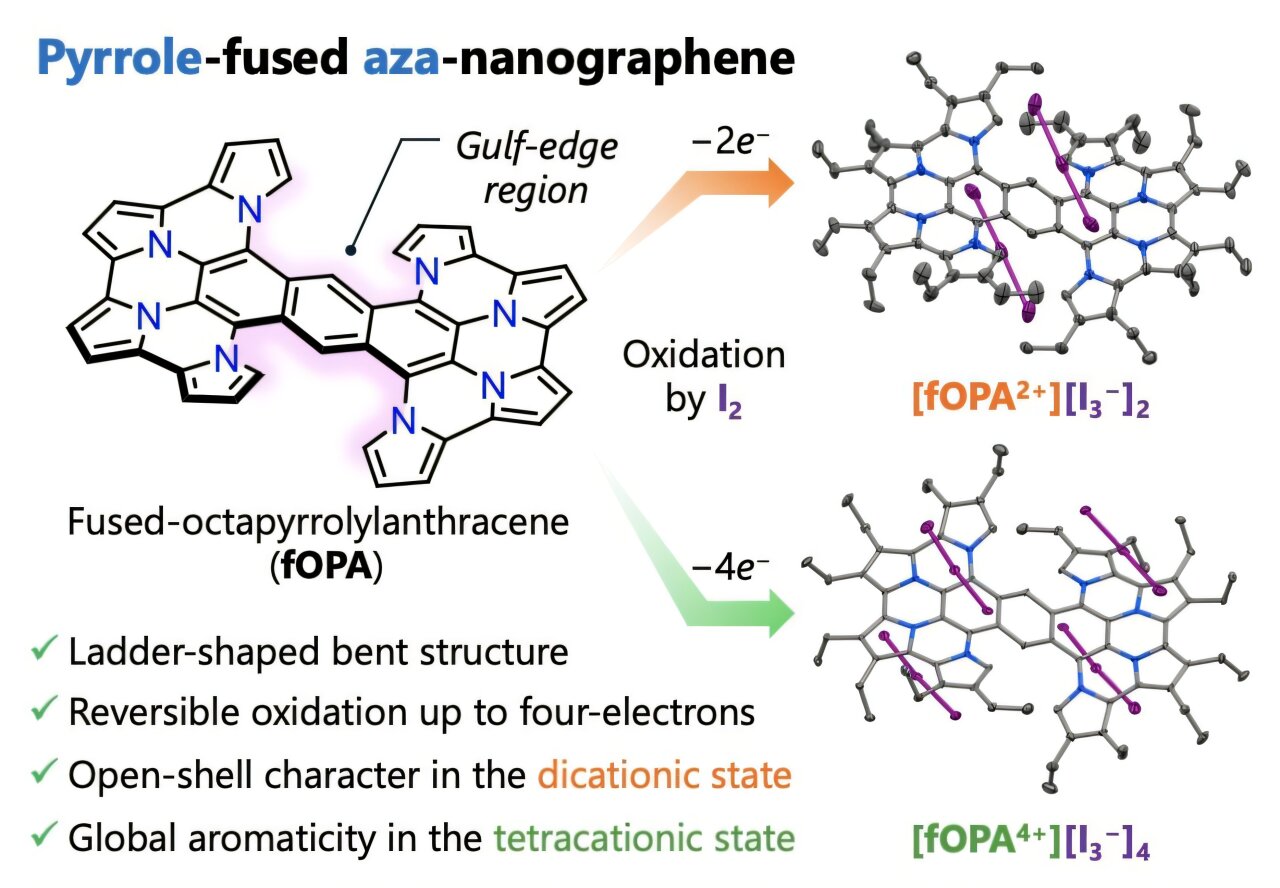
A pyrrole-fused aza-nanographene (fOPA) adopts a curved ladder-shaped structure and reversibly transforms from an open-shell diradical to a globally aromatic closed-shell state upon oxidation. Credit: Organic Letters (2025). DOI: 10.1021/acs.orglett.5c03278

Graphene and its molecular fragments, known as nanographenes, are key materials for next-generation organic electronics due to their tunable π-electron frameworks. The physical and electronic properties of nanographenes are highly sensitive to molecular size, shape, and especially edge topology. Among the various edge types, “gulf edges”—deep concave sites on the molecular boundary—have remained largely unexplored despite their potential to induce strong curvature and unique electronic behavior.

The collaborative research group led by Ehime University designed and synthesized a nitrogen-containing nanographene derivative, fused octapyrrolylanthracene (fOPA), by introducing eight pyrrole rings onto an anthracene skeleton.

This new molecule was obtained in only two synthetic steps. X-ray crystallographic analysis revealed that steric repulsion between hydrogen atoms at the gulf-edge regions induces a natural bending of the molecule, leading to a ladder-like conformation. Quantum chemical calculations further confirmed that this nonplanar structure is more stable than the twisted alternative.

Electrochemical studies showed that fOPA undergoes up to four reversible oxidation processes. Upon stepwise oxidation, the molecule’s electronic character changes dramatically. The dicationic species (fOPA2+) adopts a singlet diradical configuration with two spatially separated spins localized at the gulf-edge regions, while the tetracationic species (fOPA4+) exhibits a closed-shell aromatic structure accompanied by global diatropic ring currents. These features were verified through ESR and NMR spectroscopy, along with ACID and NICS computational analyses.

The discovery of such oxidation-dependent switching between open-shell and closed-shell electronic states within a single curved π-framework demonstrates a new concept in molecular electronics—where structural flexibility and redox activity are inherently coupled. This could open pathways to novel organic conductors, molecular switches, and responsive optoelectronic materials.

See also  Scientists see shape memory activation in 'smart' plastic

The findings are published in the journal Organic Letters.

More information:
Takayuki Matsunaga et al, Pyrrole-Fused Aza-Nanographene with Two Gulf-Edge Regions as Flexible Sites, Organic Letters (2025). DOI: 10.1021/acs.orglett.5c03278

Provided by
Ehime University


Citation:
Molecules bend, properties change: How nanographene transforms through oxidation (2025, October 28)
retrieved 28 October 2025
from https://phys.org/news/2025-10-molecules-properties-nanographene-oxidation.html

This document is subject to copyright. Apart from any fair dealing for the purpose of private study or research, no
part may be reproduced without the written permission. The content is provided for information purposes only.


Source link

nanographene oxidation transforms
Share. Facebook Twitter Pinterest LinkedIn Tumblr Email

Related Posts

Orange Leaf Extract Produces Greener Antibacterial Nanoparticles

April 9, 2026

Pittcon’s First San Antonio Experience a Roaring Success

April 8, 2026

Silver-Coated Microrobots Break Down Antibiotics in Water

April 7, 2026

PI Earns Gold in MassEcon Economic Impact Awards

April 6, 2026
Add A Comment

Comments are closed.

Top Posts

Magnetic nanoparticles that successfully navigate complex blood vessels may be ready for clinical trials

November 14, 2025

Scientists create nanofluidic chip with ‘brain-like’ memory pathways

October 10, 2025

Protein nanorings designed to detect and neutralize SARS-CoV2 virus

October 8, 2025

Subscribe to Updates

Get the latest sports news from SportsSite about soccer, football and tennis.

Explore the future with our Nanotech blog—covering innovations, research, applications, and breakthroughs shaping science, medicine, and modern technology.

We're social. Connect with us:

Facebook X (Twitter) Instagram YouTube
Top Insights

NY Creates Begins Installation of First Major Tool for High NA EUV Lithography Center at Albany Nanotech Complex

May 7, 2026

Orange Leaf Extract Produces Greener Antibacterial Nanoparticles

April 9, 2026

Pittcon’s First San Antonio Experience a Roaring Success

April 8, 2026

Subscribe to Updates

Get the latest creative news from FooBar about art, design and business.

  • Contact Us
  • Privacy Policy
  • Terms & Conditions

© 2026 elnano.com - All rights reserved.

Type above and press Enter to search. Press Esc to cancel.