
A research team has developed an approach to significantly reduce the risk of cancer recurrence and metastasis after surgery, by targeting both bulk cancer cells and the elusive cancer stem cells (CSCs) responsible for relapse.
The paper is published in the journal Nature Nanotechnology. The researchers are from the Yong Loo Lin School of Medicine, National University of Singapore (NUS Medicine) and National Center for Nanoscience and Technology, the Chinese Academy of Sciences (CAS).
One of the biggest challenges in cancer treatment is preventing the disease from returning or spreading to other parts of the body. Cancer recurrence happens when some cancer cells survive treatment (such as surgery, chemotherapy, or radiation) and begin to grow again at the original site or nearby.
What makes cancer recurrence especially problematic is the presence of CSCs—a small but powerful subset of cells within a tumor. These cells are more resistant to conventional treatments and are thought to be the root cause of both recurrence and metastasis. They can lie dormant for a period of time, evade detection by the immune system, and then reignite tumor growth later on.
“This nanovaccine approach is especially exciting because it tackles one of the biggest hurdles in cancer therapy—the ability of stem-like tumor cells to cause cancer relapse,” said Professor Shawn Chen Xiaoyuan, Nasrat Muzayyin Professor in Medicine and Technology from the Department of Diagnostic Radiology, and Director of the Nanomedicine Translational Research Program at NUS Medicine.
“Our results show that our nanovaccine not only activates the immune system to attack these cells, but also creates lasting memory to help prevent the cancer from returning.” Prof Chen is also from the Department of Diagnostic Radiology at NUS Medicine.

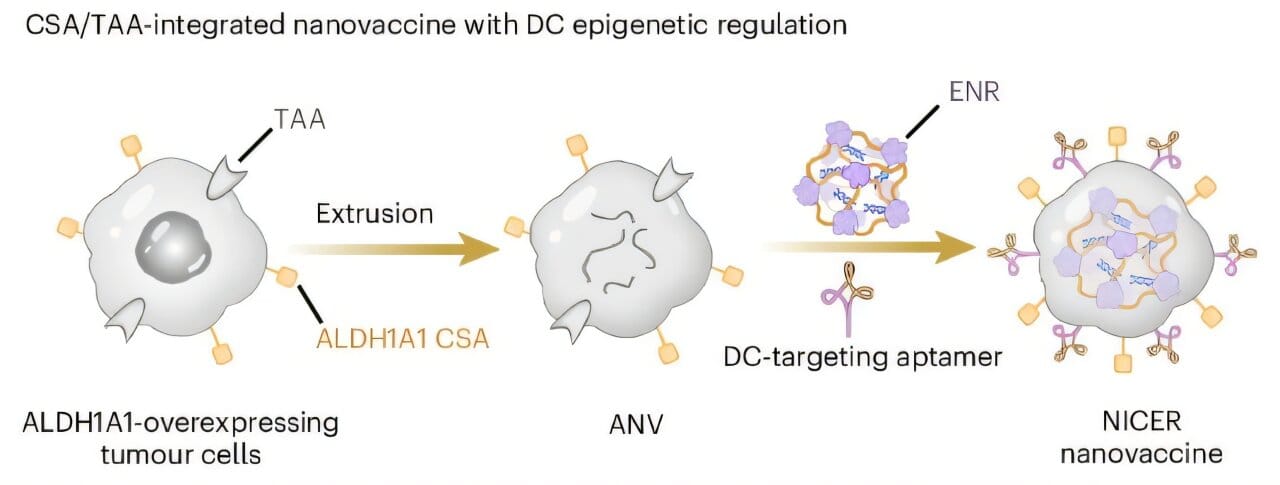
The Nature Nanotechnology study describes a nanovaccine named NICER (Nanovesicle Integrating CSC-specific antigen display and epigenetic nano-regulator encapsulation), which delivers a dual blow to cancer: eradicating both the main tumor mass and the residual CSCs post-surgery.
“Cancer stem cells are a key reason why tumors can return and spread after treatment. They’re resistant to most therapies and hard to eliminate. NICER changes that,” said Dr. Yanlian Yang, CAS Key Laboratory of Standardization and Measurement for Nanotechnology, CAS Key Laboratory for Biological Effects of Nanomaterials and Nanosafety, National Center for Nanoscience and Technology, Beijing, China.
The NICER nanovaccine helps the immune system destroy cancers more effectively by eradicating both CSCs and cancer cells. The result is a potentially stronger and longer-lasting immune response that could help stop the cancer from coming back.
“In laboratory models which included breast cancer, melanoma, and highly invasive CSC-enriched tumors, NICER not only halted tumor growth but also reduced recurrence and lung metastasis following surgical tumor removal,” said first author Dr. Qing You, Department of Diagnostic Radiology, NUS Medicine.
“When combined with immune checkpoint inhibitors, the vaccine demonstrated synergistic effects, enhancing tumor control and survival outcomes.”
“While these findings are promising, further studies are needed to assess long-term safety across diverse laboratory models,” added Prof Chen. “Next-generation enhancements could further boost efficacy through precision immune cell targeting and improved antigen design.”
The study marks a major step forward in post-operative cancer immunotherapy, offering hope for more eventual, durable treatment outcomes and a new frontier in personalized cancer vaccines.
More information:
Qing You et al, A nanovaccine targeting cancer stem cells and bulk cancer cells for postoperative cancer immunotherapy, Nature Nanotechnology (2025). DOI: 10.1038/s41565-025-01952-x
Citation:
Nanovaccine halts tumor growth and reduces cancer recurrence in lab models (2025, September 24)
retrieved 24 September 2025
from https://phys.org/news/2025-09-nanovaccine-halts-tumor-growth-cancer.html
This document is subject to copyright. Apart from any fair dealing for the purpose of private study or research, no
part may be reproduced without the written permission. The content is provided for information purposes only.