
Close Menu
  • News
    • Medical
    • Nanomaterials
    • AI & Robotics
    • 2D Materials
    • Metamaterials
    • Nanoelectronics
    • ETF’s
    • Medicine
  • Environment
    • Earth.com
    • TreeHugger
    • Nanomuscle
  • Beauty
    • Makeupanalysis
What's Hot

NY Creates Begins Installation of First Major Tool for High NA EUV Lithography Center at Albany Nanotech Complex

May 7, 2026

Orange Leaf Extract Produces Greener Antibacterial Nanoparticles

April 9, 2026

Pittcon’s First San Antonio Experience a Roaring Success

April 8, 2026
Facebook X (Twitter) Instagram
  • Contact Us
  • Privacy Policy
  • Terms & Conditions
Facebook X (Twitter) Instagram
Elnano – Global Innovative Nanotechnology SolutionsElnano – Global Innovative Nanotechnology Solutions
  • News
    • Medical
    • Nanomaterials
    • AI & Robotics
    • 2D Materials
    • Metamaterials
    • Nanoelectronics
    • ETF’s
    • Medicine
  • Environment
    • Earth.com
    • TreeHugger
    • Nanomuscle
  • Beauty
    • Makeupanalysis
Elnano – Global Innovative Nanotechnology SolutionsElnano – Global Innovative Nanotechnology Solutions
Home » Attaching ‘fake targets’ to tumor cells enables antigen-independent immunotherapy
Medical

Attaching ‘fake targets’ to tumor cells enables antigen-independent immunotherapy

October 17, 2025No Comments3 Mins Read
Share
Facebook Twitter LinkedIn Pinterest Email
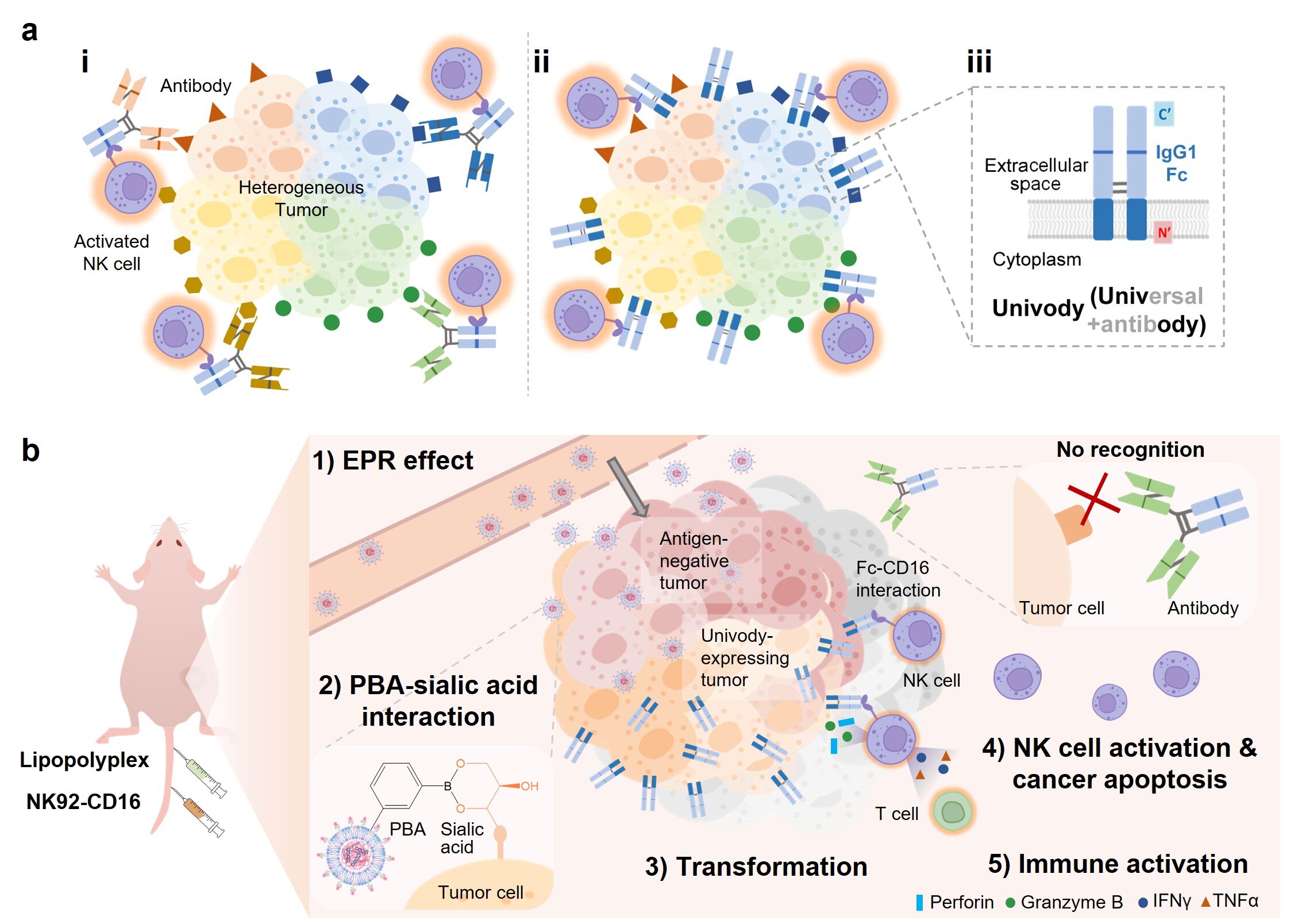
The research scheme of the Univody platform in action. Credit: POSTECH

A research team has introduced a novel cancer immunotherapy strategy. This approach involves attaching “fake targets” to tumor cells to guide immune cell attacks, overcoming the limitations of conventional antibody-based therapies. The study is published in ACS Nano.

The team was led by Professor Won Jong Kim from the Department of Chemistry and POSTECH–Catholic biomedical engineering institute at POSTECH, along with Ph.D. candidate Seonwoo Kang, and collaborated with Dr. Junseok Lee’s team at UCLA on this work.

One of the major challenges in cancer treatment is the ability of tumors to evade immune surveillance. Traditional antibody therapies rely on the recognition of specific antigens expressed on the tumor cell surface. However, antigen expression is often low or heterogeneous in real tumors. Some tumors even lack the specific antigen—so-called “antigen-negative tumors”—greatly limiting the therapeutic efficacy.

To address this, the research team developed a novel “universal antibody” (Univody) technology, enabling immune cells to attack tumors regardless of antigen presence. By genetically engineering a construct that allows the stable expression of antibody Fc fragments on the tumor surface, the researchers effectively marked tumor cells for immune recognition.

A specialized delivery system, termed LPP-PBA (lipopolyplex modified with phenylboronic acid), was designed to selectively deliver this genetic material. PBA moieties on the surface of LPPs specifically interact with overexpressed sialic acid residues on cancer cells, ensuring tumor-specific delivery and expression of the antibody fragments.

The engineered tumor cells expressing Fc fragments became immediate targets for immune attack. Experimental results confirmed that NK (natural killer) cells recognized the Fc-tagged tumor cells, launched cytotoxic responses, and triggered broader immune activation. In animal models of triple-negative breast cancer and melanoma, the Univody system significantly suppressed tumor growth.

See also  Soft microrobots can manipulate individual cells

Unlike conventional antibody therapies, the Univody platform does not rely on tumor-specific antigens, offering a universal and flexible immunotherapeutic approach.

“Because it functions independently of antigen type, this platform holds promise for broad application across various cancers,” said Professor Kim. Dr. Junseok Lee from UCLA emphasized the innovation of the strategy. “Directly tagging antibody fragments onto tumor cells represents a transformative approach that can overcome key limitations in current cancer immunotherapies.”

More information:
Seonwoo Kang et al, In Situ Tumor Surface Modification with Antibody Fragments for Antigen-Independent Versatile Cancer Immunotherapy, ACS Nano (2025). DOI: 10.1021/acsnano.5c08128

Provided by
Pohang University of Science and Technology


Citation:
Attaching ‘fake targets’ to tumor cells enables antigen-independent immunotherapy (2025, October 16)
retrieved 17 October 2025
from https://phys.org/news/2025-10-fake-tumor-cells-enables-antigen.html

This document is subject to copyright. Apart from any fair dealing for the purpose of private study or research, no
part may be reproduced without the written permission. The content is provided for information purposes only.


Source link

antigenindependent Attaching cells enables fake immunotherapy targets tumor
Share. Facebook Twitter Pinterest LinkedIn Tumblr Email

Related Posts

Inulin-Butyrate Nanogel Enhances Colitis Treatment in Mice

April 6, 2026

Enhancing RNA Therapy with Ultrasound-Activated Nanobubbles

April 3, 2026

Enhancing RNA Therapy with Ultrasound-Activated Nanobubbles

April 3, 2026

A Breakthrough in S. aureus Diagnostics

April 3, 2026
Add A Comment

Comments are closed.

Top Posts

Scientists Pioneer Next-Generation ‘Nano’ Drug Delivery System

September 24, 2025

AI Cracks the Code for the Next Generation of Solar Power

September 25, 2025

Innovative Nanoparticle Technology Promises Long-Lasting Protection for Dental Restorations

September 19, 2025

Subscribe to Updates

Get the latest sports news from SportsSite about soccer, football and tennis.

Explore the future with our Nanotech blog—covering innovations, research, applications, and breakthroughs shaping science, medicine, and modern technology.

We're social. Connect with us:

Facebook X (Twitter) Instagram YouTube
Top Insights

NY Creates Begins Installation of First Major Tool for High NA EUV Lithography Center at Albany Nanotech Complex

May 7, 2026

Orange Leaf Extract Produces Greener Antibacterial Nanoparticles

April 9, 2026

Pittcon’s First San Antonio Experience a Roaring Success

April 8, 2026

Subscribe to Updates

Get the latest creative news from FooBar about art, design and business.

  • Contact Us
  • Privacy Policy
  • Terms & Conditions

© 2026 elnano.com - All rights reserved.

Type above and press Enter to search. Press Esc to cancel.