
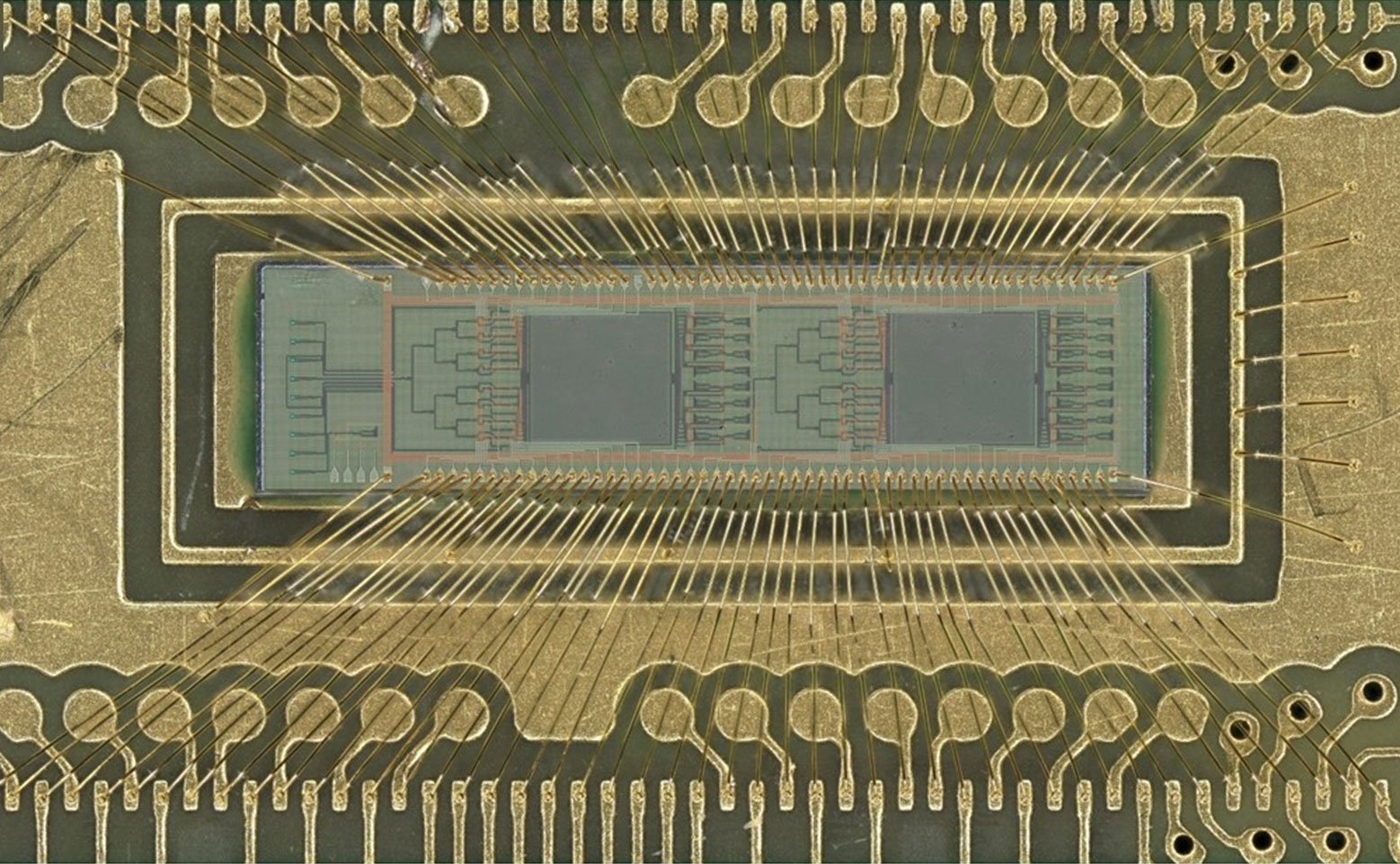
A new AI chip powered by light, not electricity, delivers massive energy savings while matching conventional performance.
A group of engineers has created a breakthrough computer chip that relies on light rather than electricity to carry out one of the most energy-demanding functions in artificial intelligence: identifying images and detecting patterns.
By shifting to light, the chip requires far less energy, achieving efficiencies that are 10 to 100 times greater than today’s chips running the same types of calculations. This innovation could ease the massive strain AI places on power grids while also supporting the development of more advanced and capable AI models.
The key operation involved is known as “convolution,” a process central to how AI interprets photos, videos, and even written language. At present, convolution is highly resource-intensive and time-consuming. The new design solves this by integrating lasers and tiny lenses directly onto circuit boards, allowing the chip to complete these computations with significantly less energy and greater speed.
In early trials, the chip achieved about 98% accuracy when recognizing handwritten digits, matching the performance of conventional electronic chips.
A Leap Forward in AI Efficiency
“Performing a key machine learning computation at near-zero energy is a leap forward for future AI systems,” said study leader Volker J. Sorger, Ph.D., the Rhines Endowed Professor in Semiconductor Photonics at the University of Florida. “This is critical to keep scaling up AI capabilities in years to come.”
“This is the first time anyone has put this type of optical computation on a chip and applied it to an AI neural network,” said Hangbo Yang, Ph.D., a research associate professor in Sorger’s group at UF and co-author of the study.
Sorger’s team collaborated with researchers at UF’s Florida Semiconductor Institute, the University of California, Los Angeles and George Washington University on study. The team published their findings on September 8 in the journal Advanced Photonics.
The prototype chip uses two sets of miniature Fresnel lenses using standard manufacturing processes. These two-dimensional versions of the same lenses found in lighthouses are just a fraction of the width of a human hair. Machine learning data, such as from an image or other pattern-recognition tasks, are converted into laser light on-chip and passed through the lenses. The results are then converted back into a digital signal to complete the AI task.
Advantages of Optical Computing
This lens-based convolution system is not only more computationally efficient, but it also reduces the computing time. Using light instead of electricity has other benefits, too. Sorger’s group designed a chip that could use different colored lasers to process multiple data streams in parallel.
“We can have multiple wavelengths, or colors, of light passing through the lens at the same time,” Yang said. “That’s a key advantage of photonics.”
Chip manufacturers, such as industry leader NVIDIA, already incorporate optical elements into other parts of their AI systems, which could make the addition of convolution lenses more seamless.
“In the near future, chip-based optics will become a key part of every AI chip we use daily,” said Sorger, who is also deputy director for strategic initiatives at the Florida Semiconductor Institute. “And optical AI computing is next.”
Reference: “Near-energy-free photonic Fourier transformation for convolution operation acceleration” by Hangbo Yang, Nicola Peserico, Shurui Li, Xiaoxuan Ma, Russell L. T. Schwartz, Mostafa Hosseini, Aydin Babakhani, Chee Wei Wong, Puneet Gupta and Volker J. Sorger, 8 September 2025, Advanced Photonics.
DOI: 10.1117/1.AP.7.5.056007
Never miss a breakthrough: Join the SciTechDaily newsletter.