
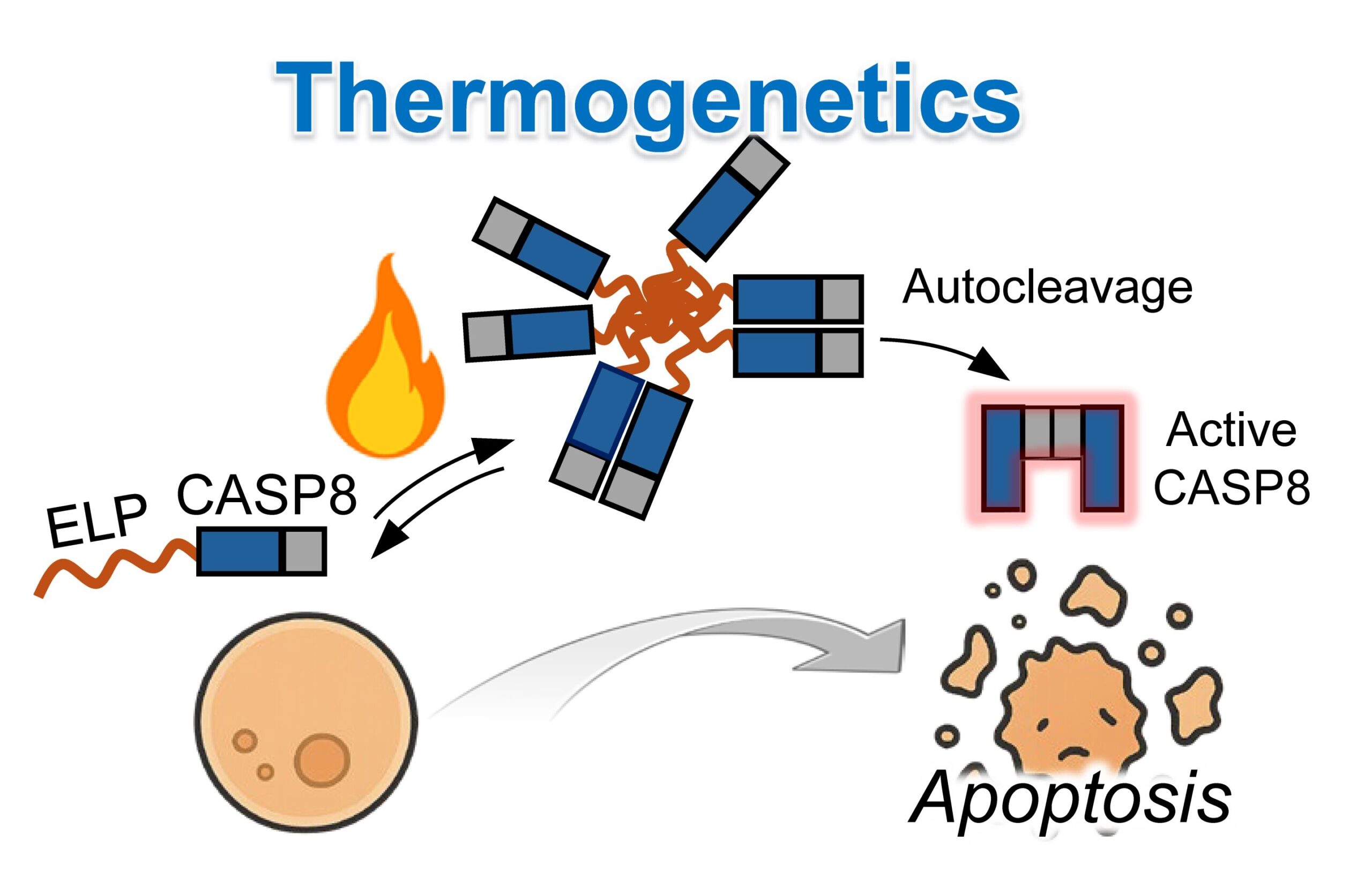
Researchers at the Nano Life Science Institute (WPI-NanoLSI), Kanazawa University, report in ACS Nano, how proteins in cells can be controllably activated through heating, an effect that can be used to initiate programmed cell death.
Cellular processes are governed by the activity of proteins. Being able to control the functioning of proteins is therefore highly relevant for the development of biotechnological tools. Doing so with high-enough spatial and temporal precision is hugely challenging, however. One approach for tackling this challenge, called thermogenetics, is based on the thermal response of certain proteins, with slight heating or cooling resulting in (de)activation.
Now, Cong Quang Vu and Satoshi Arai from Kanazawa University have developed a thermogenetic tool based on polypeptides that enables easy regulation of a protein’s activation temperature and used it to achieve programmed cell death of human-derived cells.
The scientists worked with so-called elastin-like polypeptides (ELPs), biopolymers composed of repeated amino acid building blocks. ELPs are soluble below a certain temperature; above the temperature threshold, they group into coacervate droplets.
An ELP’s transition temperature depends on the precise composition of its monomer building block, as well as on its number of monomers. By changing these characteristics, the transition temperature of an ELP can be fine-tuned, which offers the possibility of designing temperature-responsive biomolecular systems that can be thermally activated and deactivated.
The researchers coupled ELPs to a protein called caspase-8 (CASP8), which is found in humans and other mammals. When activated, CASP8 undergoes structural transformations that ultimately lead to the host cell’s death, a process referred to as apoptosis.
Vu and Arai aimed to design an ELP with a transition temperature of a few degrees above body temperature, so that only mild heating was required for inducing the solution-to-coacervate-droplet transition. This ELP was then fused to CASP8. Above the transition temperature, the ELP-CASP8 complexes formed coacervate droplets, causing the CASP8 parts to align in a way that triggers activation.
To be able to monitor whether CASP8 activation actually happens, the scientists developed a CASP8 indicator. The indication mechanism involves fluorescent proteins that, as soon as CASP8 gets activated, translocate from outside to inside nucleus in a cell. Measuring the fluorescence intensity of the fluorescent proteins in the nucleus of the cell then made it possible to distinguish between activated and non-activated CASP8.
To check the feasibility of the proposed thermogenetic CASP8 activation scheme, Vu and Arai applied it to cells derived from a human kidney. They found that the heat-responsive CASP8 system indeed led to induced cell death upon increasing temperature. The researchers also performed experiments with local heating, by means of an infrared laser, demonstrating that their thermogenetically controlled apoptosis approach works on the single-cell level too.
Vu and Arai suggest that their thermogenetic tool may also be applied to cellular processes other than apoptosis, paving the way for various biotechnological applications. The scientists explain, “By replacing CASP8 with other biomolecules, additional thermogenetic tools can be developed to modulate various cellular functions, such as enzyme activity, protein–protein interactions, and gene expression.”
More information:
Cong Quang Vu et al, A Thermogenetic Tool Employing Elastin-like Polypeptides for Controlling Programmed Cell Death, ACS Nano (2025). DOI: 10.1021/acsnano.5c07332
Citation:
Thermal trigger: Scientists develop heat-activated protein control for targeted cell death (2025, September 18)
retrieved 21 September 2025
from https://phys.org/news/2025-09-thermal-trigger-scientists-protein-cell.html
This document is subject to copyright. Apart from any fair dealing for the purpose of private study or research, no
part may be reproduced without the written permission. The content is provided for information purposes only.