
Today’s high-tech electronics and green energy technologies would not function without rare earth elements (REEs). These 17 metals possess unique properties essential to creating items like the phosphors that illuminate our mobile phone displays and the powerful magnets used in electric vehicles and wind turbines. But extracting these substances from raw materials is a dirty process that relies on toxic chemicals and leaves behind polluted waste.
Now, a team of UC Berkeley-led researchers may have solved this problem—thanks to a tiny virus.
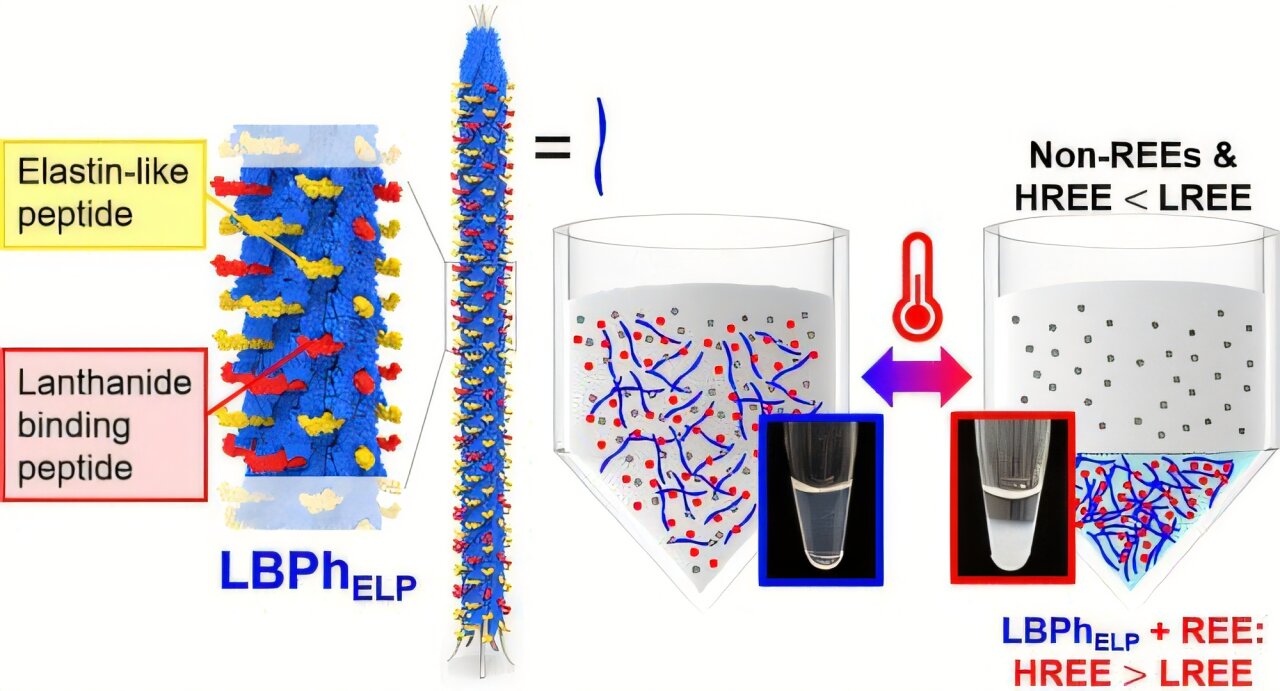
As reported in Nano Letters, the researchers genetically engineered a harmless virus to act like a “smart sponge” that grabs rare earth metals from water, and, with a gentle change in temperature and acidity (pH), releases them for collection. Their unusual, groundbreaking approach could lead to a “clean” biological alternative to traditional extraction methods for REEs and other critical elements.
“This is a significant move toward more sustainable mining and resource recovery,” said principal investigator Seung-Wuk Lee, professor of bioengineering at UC Berkeley and faculty scientist at Lawrence Berkeley National Laboratory. “Our biological solution offers a greener, low-cost and recyclable way to secure the critical materials we need for a clean energy future while helping to protect the environment.”
He added, “Our work also has the potential to solve a huge supply chain problem for this country. By making rare earth element mining environmentally sound and scalable on American soil, this technology could help secure a domestic supply of these critical minerals, boosting our national and economic security.”
The key to their approach was transforming the bacteriophage—a virus that infects only bacteria and is harmless to humans and the environment—into a “highly selective recycling machine.”
The researchers achieved this by adding two specialized proteins to the virus’s surface. One protein, lanthanide-binding peptide, acts like a molecular claw, tuned to grab REEs. The other, an elastin motif peptide, acts as a simple, non-toxic, temperature-sensitive switch: when the virus is gently warmed, it drops out of the solution, along with the REEs.
“This new approach, known as biomining, shows that we can use a programmable, biological tool to perform a complex industrial task that currently requires toxic chemicals and a lot of energy,” said Lee. “Our method is not only ecofriendly, but also incredibly simple, requiring little more than a mixing tank and a heater.”
As part of this study, the researchers successfully tested the effectiveness of this system by adding the engineered viruses to acid mine drainage. The viruses immediately attached themselves to rare-earth element ions in the drainage, ignoring all other metals.
By gently warming the solution, the researchers caused the viruses to clump together and sink to the bottom of the tank. After draining the liquid, the researchers were left with a concentrated sludge of viruses and captured metals. As a final step, they adjusted the pH of this stew, causing the viruses to release the pure metal ions for harvesting.
The researchers also discovered that the viruses didn’t lose their effectiveness after completing the job, making them reusable. In addition, researchers can easily and cheaply grow vast quantities of the virus simply by infecting bacteria with them, as they will then self-replicate.
This innovative work is a “natural extension” of prior research conducted by Lee and his lab. Up to now, they have used this virus-based framework to create highly sensitive biosensors, electric generators and molecular “Legos” that act as scaffolding to help regrow human tissues.
“For the last 20 years, we have been developing a novel toolkit based on engineered viruses as powerful, programmable tools for new technologies,” he said. “This latest project expands our virus-based toolkit to address the critical need for sustainable resource recovery.”
In addition to extracting REEs from mining wastewater, the researchers envision this platform being used for other critical applications, including harvesting REEs from e-waste, such as old phones or laptops, and for environmental remediation.
“By changing the virus’s genetic instructions, we can tune it to selectively capture other vital elements like lithium and cobalt for batteries, platinum group metals for catalysts, or even to remove toxic heavy metals like mercury and lead from our water supply,” said Lee.
“Ultimately, this work is a foundational step toward a new generation of smart virus-based materials that can help us build a truly circular and sustainable economy.”
More information:
Inseok Chae et al, Virus-Based Thermoresponsive Separation of Rare-Earth Elements, Nano Letters (2025). DOI: 10.1021/acs.nanolett.5c04468
Citation:
Genetically engineered virus acts as ‘smart sponge’ to extract rare earth elements from water (2025, November 13)
retrieved 14 November 2025
from https://phys.org/news/2025-11-genetically-virus-smart-sponge-rare.html
This document is subject to copyright. Apart from any fair dealing for the purpose of private study or research, no
part may be reproduced without the written permission. The content is provided for information purposes only.