
Close Menu
  • News
    • Medical
    • Nanomaterials
    • AI & Robotics
    • 2D Materials
    • Metamaterials
    • Nanoelectronics
    • ETF’s
    • Medicine
  • Environment
    • Earth.com
    • TreeHugger
    • Nanomuscle
  • Beauty
    • Makeupanalysis
What's Hot

NY Creates Begins Installation of First Major Tool for High NA EUV Lithography Center at Albany Nanotech Complex

May 7, 2026

Orange Leaf Extract Produces Greener Antibacterial Nanoparticles

April 9, 2026

Pittcon’s First San Antonio Experience a Roaring Success

April 8, 2026
Facebook X (Twitter) Instagram
  • Contact Us
  • Privacy Policy
  • Terms & Conditions
Facebook X (Twitter) Instagram
Elnano – Global Innovative Nanotechnology SolutionsElnano – Global Innovative Nanotechnology Solutions
  • News
    • Medical
    • Nanomaterials
    • AI & Robotics
    • 2D Materials
    • Metamaterials
    • Nanoelectronics
    • ETF’s
    • Medicine
  • Environment
    • Earth.com
    • TreeHugger
    • Nanomuscle
  • Beauty
    • Makeupanalysis
Elnano – Global Innovative Nanotechnology SolutionsElnano – Global Innovative Nanotechnology Solutions
Home » Engineered extracellular vesicles halt lung cancer growth by silencing key protein
Medical

Engineered extracellular vesicles halt lung cancer growth by silencing key protein

October 28, 2025No Comments3 Mins Read
Share
Facebook Twitter LinkedIn Pinterest Email
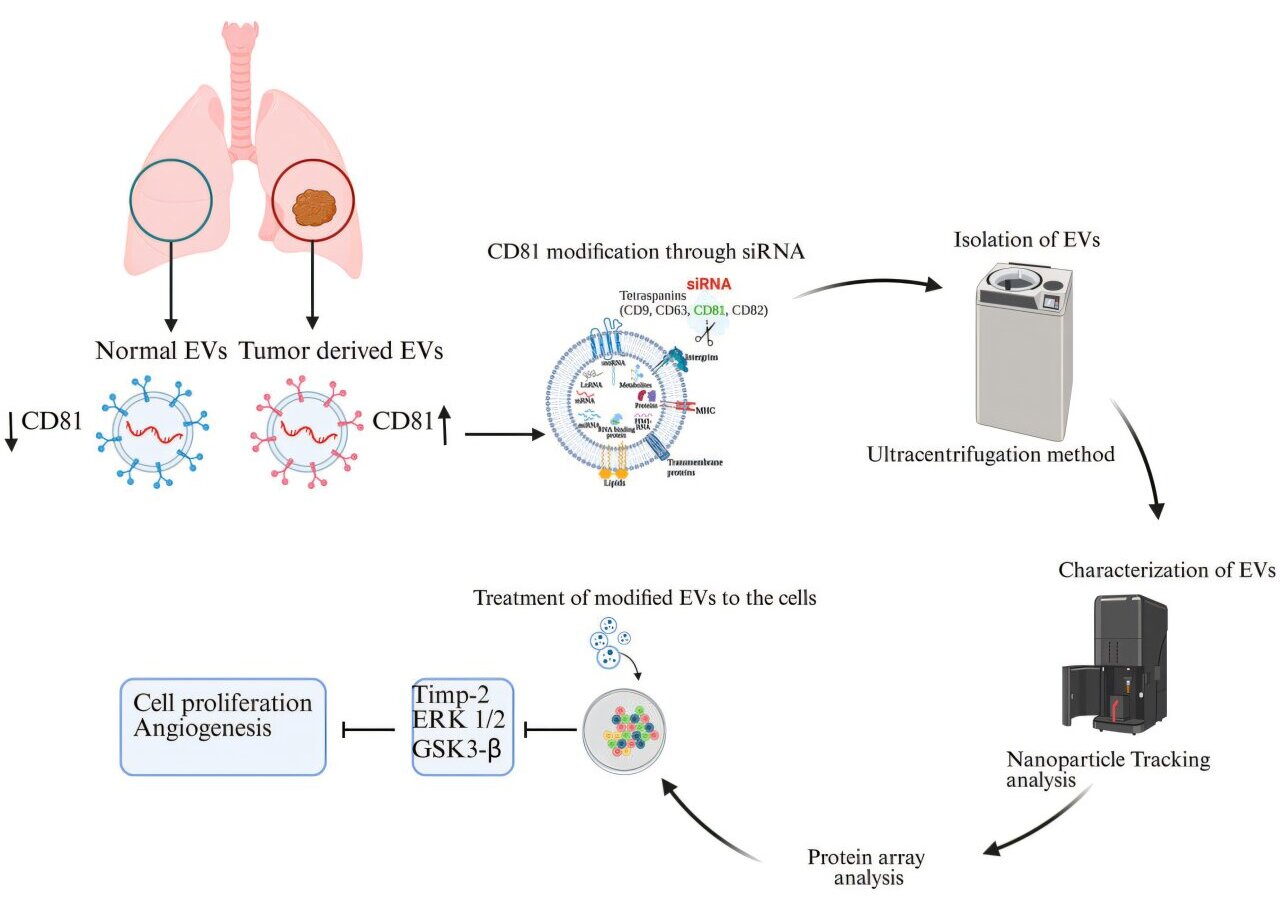
Credit: Molecular Therapy Oncology (2025). DOI: 10.1016/j.omton.2025.201037

In the quest for more targeted lung cancer treatments, a researcher at the University of Missouri thinks the solution may lie in tiny bubble-shaped packages that cells use to talk to each other.

These microscopic messengers, called extracellular vesicles (EVs), are about 3,000 times thinner than a human hair and are released in the billions by nearly every cell in the body, including cancer cells. While EVs from healthy cells carry helpful instructions to keep the body healthy, EVs from cancer cells can spread harmful signals that drive tumor growth and resistance to treatment.

In a recent study, Akhil Srivastava, an assistant professor in the University of Missouri School of Medicine, found that EVs produced by cancer cells contain higher levels of a protein called CD81 compared to EVs produced by healthy cells, indicating that CD81 may play a role in helping cancer tumors spread. So, Srivastava put tiny pieces of genetic material called siRNA into lung cancer cells with instructions to stop producing the CD81 protein.

The findings are published in the journal Molecular Therapy Oncology.

By “silencing” this protein, the EVs these cancer cells produced actually helped shrink tumors, confirming that CD81 was likely playing a role in helping cancer tumors spread in the first place.

“Once we discover more about all the biomolecular information these EVs carry from one cell to another, we can engineer them to deliver the information we want them to deliver to certain cells,” Srivastava said. “Since chemotherapy kills both healthy cells and cancer cells, and expensive immunotherapy doesn’t work for all patients, there is a big desire for more targeted cancer therapies. We believe tiny EVs can play a huge role in the solution.”

See also  Nasal spray with gold nanoparticles delivers targeted treatment to the brain

Srivastava believes EVs do not just play a role in helping cancer spread, they can also be engineered to help treat cancer. Similar to labeling a package with a specific delivery address, Srivastava wants to harness EVs as a drug delivery system so that new cancer drugs can target cancer cells without harming healthy cells.

In a related study, Srivastava recently demonstrated this idea by loading tiny pieces of siRNA into modified EVs. These snippets of genetic code carried specific instructions to kill lung cancer cells without significantly harming healthy ones. In a preclinical model, the approach worked, highlighting the potential promise of EV manipulation as a new kind of treatment.

More information:
Anjugam Paramanantham et al, Perturbed CD81 in lung-cancer-derived extracellular vesicles modifies its function in cancer pathophysiology, Molecular Therapy Oncology (2025). DOI: 10.1016/j.omton.2025.201037

Provided by
University of Missouri


Citation:
Engineered extracellular vesicles halt lung cancer growth by silencing key protein (2025, October 28)
retrieved 28 October 2025
from https://phys.org/news/2025-10-extracellular-vesicles-halt-lung-cancer.html

This document is subject to copyright. Apart from any fair dealing for the purpose of private study or research, no
part may be reproduced without the written permission. The content is provided for information purposes only.


Source link

Cancer Engineered extracellular Growth halt key lung protein silencing vesicles
Share. Facebook Twitter Pinterest LinkedIn Tumblr Email

Related Posts

Inulin-Butyrate Nanogel Enhances Colitis Treatment in Mice

April 6, 2026

Enhancing RNA Therapy with Ultrasound-Activated Nanobubbles

April 3, 2026

Enhancing RNA Therapy with Ultrasound-Activated Nanobubbles

April 3, 2026

A Breakthrough in S. aureus Diagnostics

April 3, 2026
Add A Comment

Comments are closed.

Top Posts

Shark-Proof Wetsuits Tested Against Great Whites. The Results Could Save Lives

October 1, 2025

Metamolecule metamaterial fabrication with 3D co-assembly

September 18, 2025

Electrons Flow Like Liquid in Graphene: New Study Insights

September 19, 2025

Subscribe to Updates

Get the latest sports news from SportsSite about soccer, football and tennis.

Explore the future with our Nanotech blog—covering innovations, research, applications, and breakthroughs shaping science, medicine, and modern technology.

We're social. Connect with us:

Facebook X (Twitter) Instagram YouTube
Top Insights

NY Creates Begins Installation of First Major Tool for High NA EUV Lithography Center at Albany Nanotech Complex

May 7, 2026

Orange Leaf Extract Produces Greener Antibacterial Nanoparticles

April 9, 2026

Pittcon’s First San Antonio Experience a Roaring Success

April 8, 2026

Subscribe to Updates

Get the latest creative news from FooBar about art, design and business.

  • Contact Us
  • Privacy Policy
  • Terms & Conditions

© 2026 elnano.com - All rights reserved.

Type above and press Enter to search. Press Esc to cancel.