
Close Menu
  • News
    • Medical
    • Nanomaterials
    • AI & Robotics
    • 2D Materials
    • Metamaterials
    • Nanoelectronics
    • ETF’s
    • Medicine
  • Environment
    • Earth.com
    • TreeHugger
    • Nanomuscle
  • Beauty
    • Makeupanalysis
What's Hot

NY Creates Begins Installation of First Major Tool for High NA EUV Lithography Center at Albany Nanotech Complex

May 7, 2026

Orange Leaf Extract Produces Greener Antibacterial Nanoparticles

April 9, 2026

Pittcon’s First San Antonio Experience a Roaring Success

April 8, 2026
Facebook X (Twitter) Instagram
  • Contact Us
  • Privacy Policy
  • Terms & Conditions
Facebook X (Twitter) Instagram
Elnano – Global Innovative Nanotechnology SolutionsElnano – Global Innovative Nanotechnology Solutions
  • News
    • Medical
    • Nanomaterials
    • AI & Robotics
    • 2D Materials
    • Metamaterials
    • Nanoelectronics
    • ETF’s
    • Medicine
  • Environment
    • Earth.com
    • TreeHugger
    • Nanomuscle
  • Beauty
    • Makeupanalysis
Elnano – Global Innovative Nanotechnology SolutionsElnano – Global Innovative Nanotechnology Solutions
Home » Ultra-thin sodium films offer low-cost alternative to gold and silver in optical technologies
Nanotech

Ultra-thin sodium films offer low-cost alternative to gold and silver in optical technologies

October 4, 2025No Comments3 Mins Read
Share
Facebook Twitter LinkedIn Pinterest Email
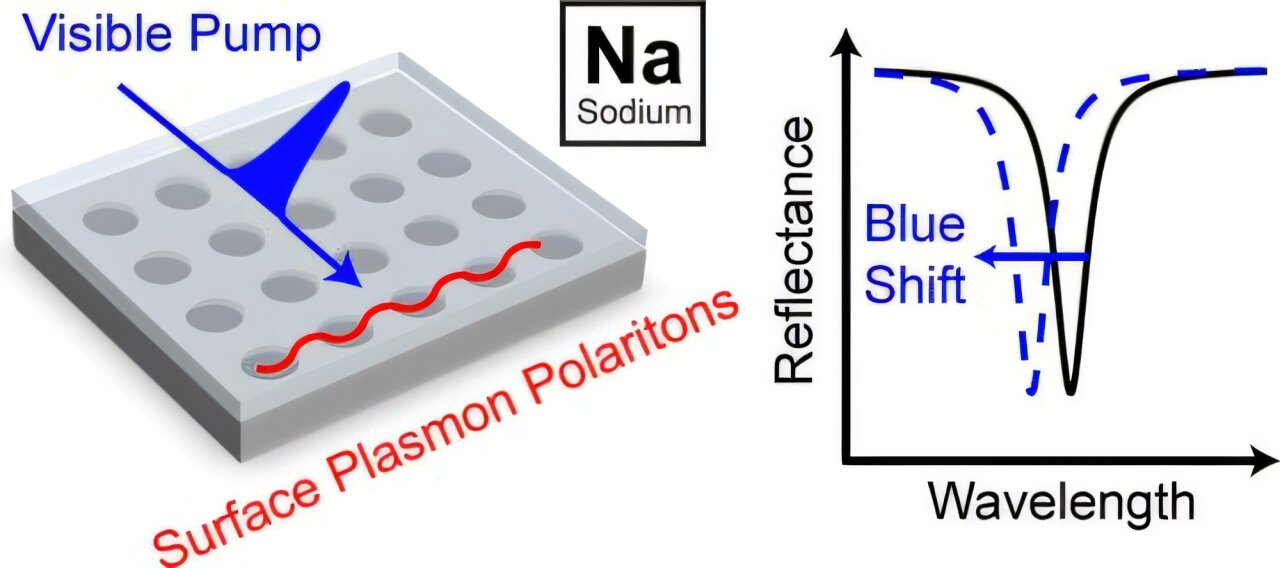
Graphical abstract. Credit: ACS Nano (2025). DOI: 10.1021/acsnano.5c04946

From solar panels to next-generation medical devices, many emerging technologies rely on materials that can manipulate light with extreme precision. These materials—called plasmonic materials—are typically made from expensive metals like gold or silver. But what if a cheaper, more abundant metal could do the job just as well or better?

That’s the question a team of researchers set out to explore. The challenge? While sodium is abundant and lightweight, it’s also notoriously unstable and difficult to work with in the presence of air or moisture—two unavoidable parts of real-world conditions. Until now, this has kept it off the table for practical optical applications.

Researchers from Yale University, Oakland University, and Cornell University have teamed up to change that. By developing a new technique for structuring sodium into ultra-thin, precisely patterned films, they found a way to stabilize the metal and make it perform exceptionally well in light-based applications.

Their approach, published in the journal ACS Nano, involved combining thermally-assisted spin coating with phase-shift photolithography—essentially using heat and light to craft nanoscopic surface patterns that trap and guide light in powerful ways.

Even more impressively, the team used ultrafast laser spectroscopy to observe what happens when these sodium surfaces interact with light on time scales measured in trillionths of a second. The results were surprising: sodium’s electrons responded in ways that differ from traditional metals, suggesting it could offer new advantages for light-based technologies like photocatalysis, sensing, and energy conversion.

Shining a new light on low-cost materials
Co-author and Ph.D. candidate Conrad A. Kocoj works with ultrafast laser spectroscopy equipment used to observe how sodium interacts with light at trillionth-of-a-second timescales. Credit: Omar Khalifa

The study was led by Conrad A. Kocoj, Shunran Li, and Peijun Guo at Yale Engineering (Guo is also a member of the Yale Energy Sciences Institute); Xinran Xie, Honyu Jiang, and Ankun Yang at Oakland University; and Suchismita Sarker at Cornell University.

See also  Ultrathin racetrack memory devices now work without insulating buffer layers

Their collaboration brought together expertise in nanofabrication, ultrafast optics, and materials science.

More information:
Conrad A. Kocoj et al, Ultrafast Plasmon Dynamics of Low-Loss Sodium Metasurfaces, ACS Nano (2025). DOI: 10.1021/acsnano.5c04946

Provided by
Yale University


Citation:
Ultra-thin sodium films offer low-cost alternative to gold and silver in optical technologies (2025, October 3)
retrieved 4 October 2025
from https://phys.org/news/2025-10-ultra-thin-sodium-alternative-gold.html

This document is subject to copyright. Apart from any fair dealing for the purpose of private study or research, no
part may be reproduced without the written permission. The content is provided for information purposes only.


Source link

alternative films Gold lowcost offer optical Silver Sodium technologies Ultrathin
Share. Facebook Twitter Pinterest LinkedIn Tumblr Email

Related Posts

Orange Leaf Extract Produces Greener Antibacterial Nanoparticles

April 9, 2026

Pittcon’s First San Antonio Experience a Roaring Success

April 8, 2026

Silver-Coated Microrobots Break Down Antibiotics in Water

April 7, 2026

PI Earns Gold in MassEcon Economic Impact Awards

April 6, 2026
Add A Comment

Comments are closed.

Top Posts

Mechanical Metamaterials and Other 3D Printing Tech from CHI 2017

October 9, 2025

Floquet Chern insulators based on nonlinear photonic crystals achieved

October 2, 2025

Tiny nanoparticles conquer the big three in polymer glasses: Strength, toughness and processability

October 1, 2025

Subscribe to Updates

Get the latest sports news from SportsSite about soccer, football and tennis.

Explore the future with our Nanotech blog—covering innovations, research, applications, and breakthroughs shaping science, medicine, and modern technology.

We're social. Connect with us:

Facebook X (Twitter) Instagram YouTube
Top Insights

NY Creates Begins Installation of First Major Tool for High NA EUV Lithography Center at Albany Nanotech Complex

May 7, 2026

Orange Leaf Extract Produces Greener Antibacterial Nanoparticles

April 9, 2026

Pittcon’s First San Antonio Experience a Roaring Success

April 8, 2026

Subscribe to Updates

Get the latest creative news from FooBar about art, design and business.

  • Contact Us
  • Privacy Policy
  • Terms & Conditions

© 2026 elnano.com - All rights reserved.

Type above and press Enter to search. Press Esc to cancel.