
From breath analysis to explosive detection, many applications require reliable electronic “noses.” Unfortunately, current technology often falls short. That is why researchers at KU Leuven have developed a flexible sensor platform that not only detects gases, but also records their speed—like a speed camera.
The technology, published in Nature Communications and has since been patented, measures how fast molecules move through a special nanomaterial. This opens the door to a wide range of applications.
Traditional chemical sensors usually measure how much of a specific substance adheres to a surface. But the air contains hundreds of volatile organic compounds (VOCs), often in low concentrations and all mixed together. To make things even more complex, water vapor is often a thousand times more abundant than the target substances, making it difficult for many sensors to take accurate measurements. The result: poor reliability and precision.
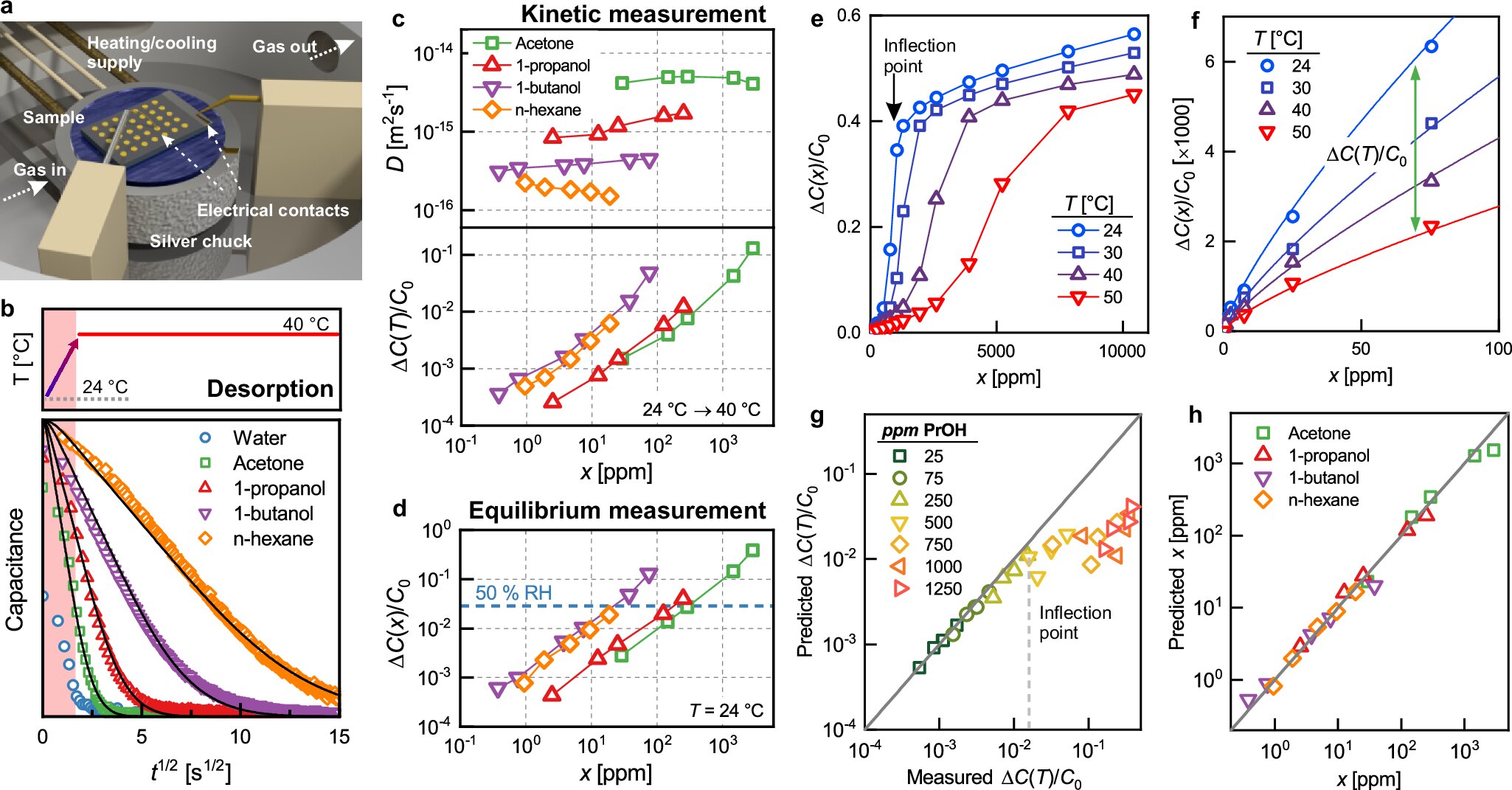
KU Leuven’s new sensor platform uses metal-organic frameworks (MOFs): materials with a network of nanopores that are all exactly the same size. These act like molecular speed cameras. When gas molecules move through the pores at a slightly elevated temperature, they do so at different, specific speeds depending on their structure. That speed acts like a fingerprint. By measuring the speed, researchers can distinguish between different gases, even under challenging conditions where traditional sensors fail.
“You could compare our approach to speed monitoring for molecules,” says Margot Verstreken, bioscience engineer and postdoctoral researcher at the Ameloot research group at KU Leuven. “We do not just look at how many molecules move through the nanopores, but also at the differences in speed. We call that kinetic selectivity. That extra information makes all the difference.”
Scalable platform
What makes the KU Leuven approach unique is that it is a scalable platform. “By adjusting the metal-organic framework, we can tailor the sensor to specific gases without changing the underlying technology,” Verstreken explains. “The system remains compact, energy-efficient and high-performing. Even in humid environments or with complex gas mixtures and low concentrations, it outperforms commercial electronic noses.”
A patent application has been submitted for the specific sensor structure, as there is a broad range of potential applications for this technology. Think of a breath test for early diabetes diagnosis; or detecting leaks in the chemical industry and faults in Li-ion batteries, monitoring indoor or outdoor air quality; or tracking the freshness of fruits and vegetables in storage. Even concealed explosives or drugs can be detected more quickly and accurately with this technology. Because of its modular design, the sensor can be adapted to each task: choose the right MOFs, and the platform makes it work.
“This is not a sensor built for one specific task, but a modular platform,” Verstreken emphasizes. “By selecting the right MOF or combination of MOFs, you can tailor the sensor to what you want to detect. That flexibility makes our platform suitable for a wide range of sectors, from health care to security.”
With this research, Margot Verstreken won the Belgian edition of Falling Walls, an international science communication competition. In November, she will represent Belgium at the world final in Berlin, competing against young researchers from over a hundred countries.
More information:
Aleksander Matavž et al, Kinetic selectivity in metal-organic framework chemical sensors, Nature Communications (2025). DOI: 10.1038/s41467-025-64199-z
Citation:
Sensor platform uses nanopore ‘speed cameras’ to pinpoint gases in complex mixtures (2025, September 29)
retrieved 30 September 2025
from https://phys.org/news/2025-09-sensor-platform-nanopore-cameras-gases.html
This document is subject to copyright. Apart from any fair dealing for the purpose of private study or research, no
part may be reproduced without the written permission. The content is provided for information purposes only.