
For the first time, researchers at the Technical University of Munich (TUM) have succeeded in using nanorobots to stimulate stem cells with such precision that they are reliably transformed into bone cells. To achieve this, the robots exert external pressure on specific points in the cell wall. The new method offers opportunities for faster treatments in the future.
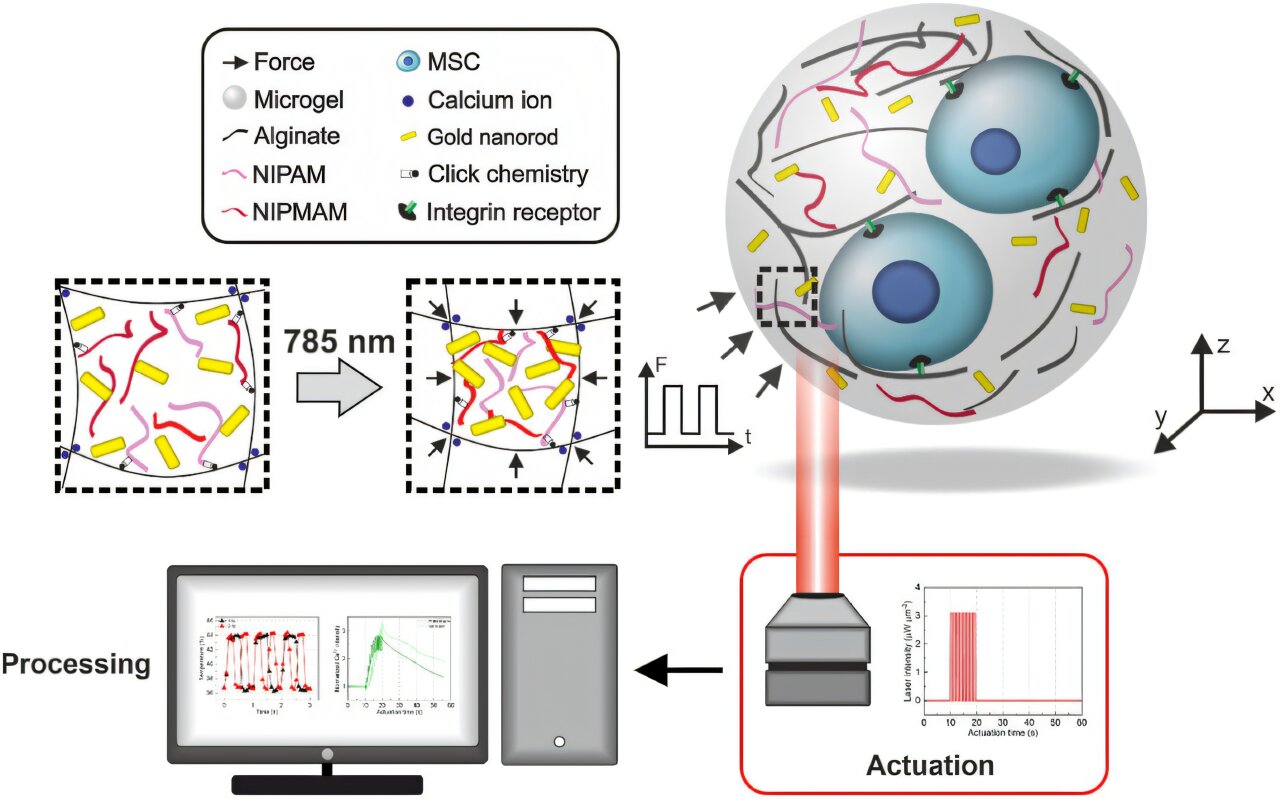
Prof. Berna Özkale Edelmann’s nanorobots consist of tiny gold rods and plastic chains. Several million of them are contained in a gel cushion measuring just 60 micrometers, together with a few human stem cells. Powered and controlled by laser light, the robots, which look like tiny balls, mechanically stimulate the cells by exerting pressure.
“We heat the gel locally and use our system to precisely determine the forces with which the nanorobots press on the cell—thereby stimulating it,” explains the professor of nano- and microrobotics at TUM. This mechanical stimulation triggers biochemical processes in the cell. Ion channels change their properties, and proteins are activated, including one that is particularly important for bone formation.
The research has been published in Advanced Materials and Small Science.
Heart and cartilage cells: Finding the correct stress pattern
If stimulation is carried out at the right rhythm and with the right (low) force, a stem cell can be reliably triggered to develop into a bone cell within three days. This process can be completed within three weeks.
“The corresponding stress pattern can also be found for cartilage and heart cells,” says Prof. Özkale Edelman. “It’s almost like at the gym: We train the cells for a particular area of application. Now we just have to find out which stress pattern suits each cell type,” says the head of the Microbiotic Bioengineering Lab at TUM.
Mechanical forces pave the way for transformation into bone cells
The research team produces bone cells using mesenchymal stem cells. These cells are considered to be the body’s “repair cells.” They are approximately 10 to 20 micrometers in size and are generally capable of developing into bone, cartilage or muscle cells, for example. The challenge: The transformation into differentiated cells is complex and has been difficult to control until now.
“We have developed a technology that allows forces to be applied to the cell very precisely in a three-dimensional environment,” says Prof. Özkale Edelmann. “This represents an unprecedented advance in the field.” The researchers believe that this method can even be used to produce cartilage and heart cells from human stem cells.
For treatments, doctors will ultimately need far more differentiated cells—about 1 million. “That’s why the next step is to automate our production process so that we can produce more cells more quickly,” says Prof. Özkale Edelmann.
More information:
Chen Wang et al, Photothermally Powered 3D Microgels Mechanically Regulate Mesenchymal Stem Cells Under Anisotropic Force, Advanced Materials (2025). DOI: 10.1002/adma.202506769
Nergishan İyisan et al, Hydrostatic Pressure Induces Osteogenic Differentiation of Single Stem Cells in 3D Viscoelastic Microgels, Small Science (2025). DOI: 10.1002/smsc.202500287
Citation:
Nanorobots guide stem cells to become bone cells via precise pressure (2025, November 11)
retrieved 12 November 2025
from https://phys.org/news/2025-11-nanorobots-stem-cells-bone-precise.html
This document is subject to copyright. Apart from any fair dealing for the purpose of private study or research, no
part may be reproduced without the written permission. The content is provided for information purposes only.