
Close Menu
  • News
    • Medical
    • Nanomaterials
    • AI & Robotics
    • 2D Materials
    • Metamaterials
    • Nanoelectronics
    • ETF’s
    • Medicine
  • Environment
    • Earth.com
    • TreeHugger
    • Nanomuscle
  • Beauty
    • Makeupanalysis
What's Hot

Biomass-Derived Nanomaterials Offer a Greener Route to Pollution Cleanup

September 1, 2026

Nanozyme Aptasensors Show Promise for Faster Food, Health, and Environmental Testing

September 1, 2026

Researchers Solve Two Major Problems Holding Back SiC Electronics

September 1, 2026
Facebook X (Twitter) Instagram
  • Contact Us
  • Privacy Policy
  • Terms & Conditions
Facebook X (Twitter) Instagram
Elnano – Global Innovative Nanotechnology SolutionsElnano – Global Innovative Nanotechnology Solutions
  • News
    • Medical
    • Nanomaterials
    • AI & Robotics
    • 2D Materials
    • Metamaterials
    • Nanoelectronics
    • ETF’s
    • Medicine
  • Environment
    • Earth.com
    • TreeHugger
    • Nanomuscle
  • Beauty
    • Makeupanalysis
Elnano – Global Innovative Nanotechnology SolutionsElnano – Global Innovative Nanotechnology Solutions
Home » Cells coated with magnetic nanoparticles could transform future of fertility
Medical

Cells coated with magnetic nanoparticles could transform future of fertility

September 19, 2025No Comments3 Mins Read
Share
Facebook Twitter LinkedIn Pinterest Email
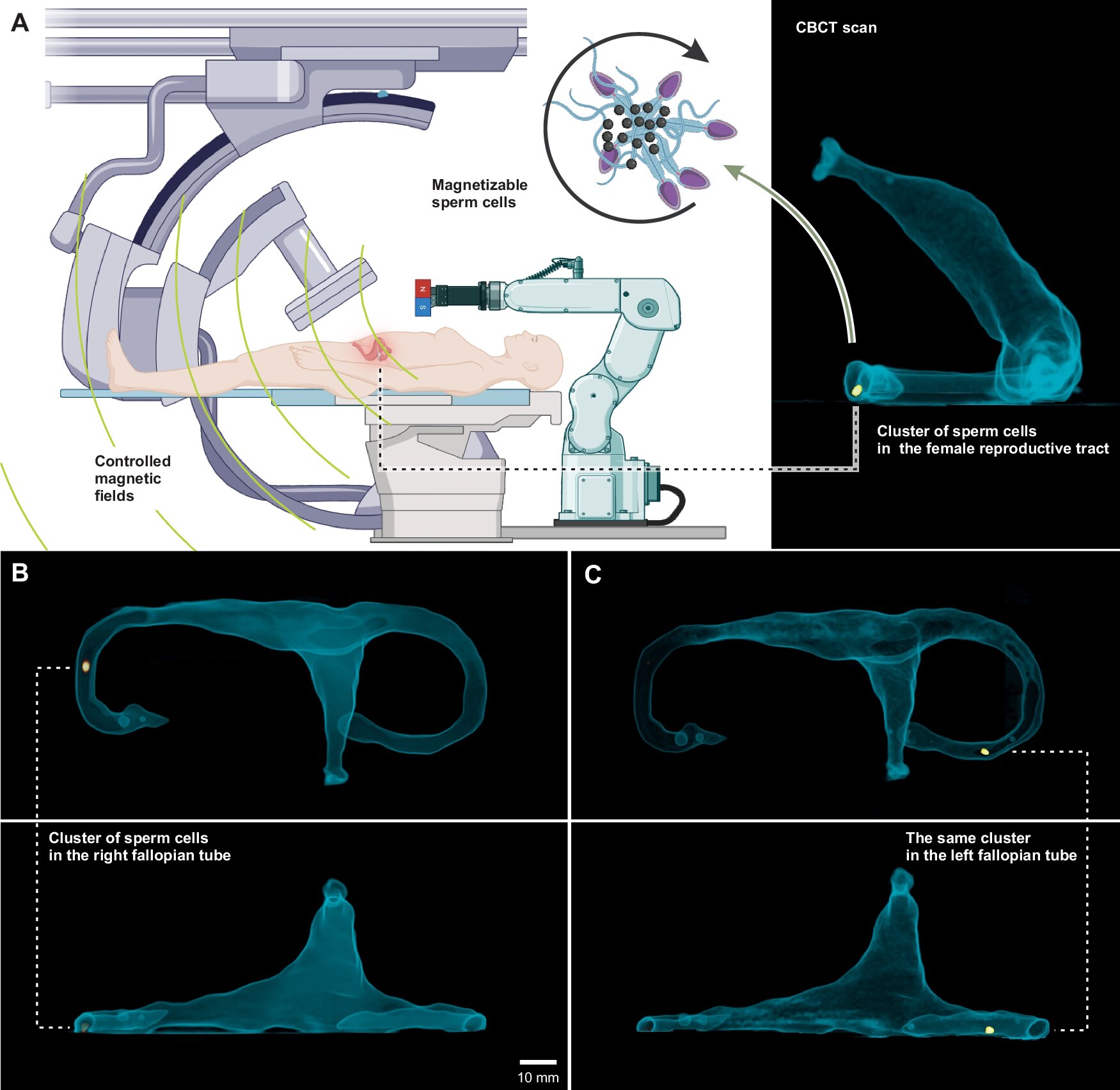
Sperm-based biohybrid microrobots targeting minimally invasive treatment in the female reproductive tract with weak, low-frequency, controlled external magnetic fields and X-ray fluoroscopy imaging for localization of the magnetizable sperm cell clusters. Credit: npj Robotics (2025). DOI: 10.1038/s44182-025-00044-1

A team of researchers at the TechMed Center of the University of Twente has transformed real sperm cells into tiny, magnetically controlled microrobots. These sperm bots can now be tracked in real time using X-ray imaging, a breakthrough in medical microrobotics.

This development, now published in npj Robotics, could open new doors in reproductive medicine, drug delivery, and infertility diagnostics.

Sperm cells are naturally fast, flexible swimmers that can navigate the complex environment of the female reproductive tract, making them promising candidates for use in medical microrobotics. Sperm cells are nearly impossible to see inside the human body using traditional imaging methods like X-ray. They’re small, low-density, and nearly transparent to radiation.

“Until now, visualizing sperm inside the body was nearly impossible,” says UT researcher Islam Khalil, lead author of the study.

Coating sperm cells

Together with researchers and medical professionals from the Radboud University Medical Center and the University of Waterloo (Canada), researchers at the University of Twente coated real sperm cells with magnetic nanoparticles. This made them visible under X-ray and responsive to external magnetic fields. For the first time, these sperm-based microrobots can now be tracked and steered inside a life-sized anatomical model.

Once inside, they can potentially deliver drugs to hard-to-reach places such as the uterus or fallopian tubes. The medication is loaded directly into the sperm cell bodies. “We’re turning nature’s own cell delivery systems into programmable microrobots,” says Khalil. This could be an important advancement for targeted treatments for conditions like uterine cancer, endometriosis, or fibroids, all of which currently lack precise drug delivery options.

See also  Nanopores that act like electrical gates pave way for ion-based computing

Peeking safely into fertilization

In addition to precise drug delivery, the technology could also offer new insights into the mystery of what happens inside the body during fertilization. By tracking sperm movement noninvasively inside the reproductive system, researchers hope to better understand unexplained infertility, sperm transport mechanisms, and even improve IVF techniques.

Tests showed that the sperm-nanoparticle clusters remained biocompatible, causing no significant toxicity to human uterine cells even after 72 hours of exposure. This makes them suitable candidates for future in-vivo applications.

More information:
Veronika Magdanz et al, Sperm cell empowerment: X-ray-guided magnetic fields for enhanced actuation and localization of cytocompatible biohybrid microrobots, npj Robotics (2025). DOI: 10.1038/s44182-025-00044-1

Provided by
University of Twente


Citation:
Sperm bots roll out: Cells coated with magnetic nanoparticles could transform future of fertility (2025, September 3)
retrieved 19 September 2025
from https://phys.org/news/2025-09-sperm-bots-cells-coated-magnetic.html

This document is subject to copyright. Apart from any fair dealing for the purpose of private study or research, no
part may be reproduced without the written permission. The content is provided for information purposes only.


Source link

cells coated fertility future magnetic Nanoparticles transform
Share. Facebook Twitter Pinterest LinkedIn Tumblr Email

Related Posts

Nanozyme Aptasensors Show Promise for Faster Food, Health, and Environmental Testing

September 1, 2026

DNA Nanotechnology May Open New Paths to Stroke Repair

August 31, 2026

Nanoparticle Prime Editing Corrects Metabolic Disease Mutation in Mice

August 31, 2026

AI Searched 150 Million Materials – and Found Two Promising Candidates for Future Electronics

August 31, 2026
Add A Comment

Comments are closed.

Top Posts

Lithium Doping for Better Performance

September 20, 2025

How protein coatings influence nanoparticles’ ability to avoid immune clearance and reach their destinations

October 17, 2025

Scientists create nanofluidic chip with ‘brain-like’ memory pathways

October 10, 2025

Subscribe to Updates

Get the latest sports news from SportsSite about soccer, football and tennis.

Explore the future with our Nanotech blog—covering innovations, research, applications, and breakthroughs shaping science, medicine, and modern technology.

We're social. Connect with us:

Facebook X (Twitter) Instagram YouTube
Top Insights

Biomass-Derived Nanomaterials Offer a Greener Route to Pollution Cleanup

September 1, 2026

Nanozyme Aptasensors Show Promise for Faster Food, Health, and Environmental Testing

September 1, 2026

Researchers Solve Two Major Problems Holding Back SiC Electronics

September 1, 2026

Subscribe to Updates

Get the latest creative news from FooBar about art, design and business.

  • Contact Us
  • Privacy Policy
  • Terms & Conditions

© 2026 elnano.com - All rights reserved.

Type above and press Enter to search. Press Esc to cancel.