
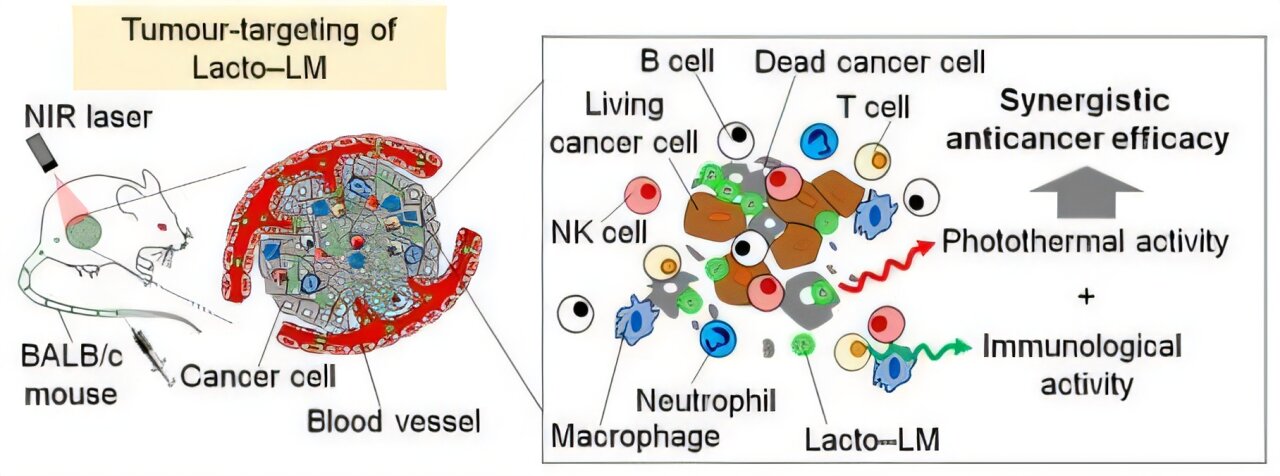
A research team led by Professor Eijiro Miyako from the Materials Chemistry Frontiers Research Area at Japan Advanced Institute of Science and Technology (JAIST) has successfully developed multifunctional nanocomposites by coating liquid metal surfaces with lactic acid bacteria components and near-infrared fluorescent dye (indocyanine green).
The paper is published in the journal Advanced Composites and Hybrid Materials.
The developed nanocomposites demonstrate excellent tumor-targeting capability through the EPR effect, effectively accumulating in tumors of mice transplanted with colorectal cancer. Furthermore, irradiation with highly bio-penetrative near-infrared laser light achieved multidimensional therapeutic effects:
- Visualization Diagnosis: Clear visualization of cancer sites through indocyanine green
- Immunotherapy: Potent immune activation through lactic acid bacteria components
- Photothermal Therapy: Localized hyperthermia treatment via liquid metal photothermal conversion
The research team successfully achieved complete elimination of transplanted mouse cancers within 5 days by applying near-infrared light irradiation for 5 minutes once daily over 2 days. Comprehensive biocompatibility studies also confirmed the high safety profile of these nanocomposites.
This research breakthrough is expected to lead to the creation of innovative cancer photoimmunotherapy technologies that integrate diagnosis and treatment.
Room-temperature liquid metals composed of gallium-indium (Ga/In) alloys possess excellent biocompatibility and physicochemical properties, attracting worldwide attention for biomedical applications. Professor Miyako’s team initiated this research based on the concept that “combining immune-activating substances with liquid metals for selective delivery to cancer sites could achieve potent antitumor effects and integrate diagnosis and treatment using near-infrared light.”
Recent research has revealed that tumor tissues harbor unique bacterial communities. Professor Miyako’s team has previously succeeded in isolating various bacteria from tumors and has been developing cancer treatment technologies utilizing these microorganisms.
The research team established a simple fabrication method for spherical nanoparticles by mixing Ga/In liquid metal, lactic acid bacteria components, and indocyanine green, followed by ultrasonic treatment. The nanocomposites produced through this method demonstrated the following characteristics:
- High Stability: Maintained particle size stability for over 7 days
- Excellent Cell Compatibility: High membrane permeability with no toxicity
- Efficient Photothermal Conversion: Heat generation capability under near-infrared light irradiation

Demonstration of outstanding therapeutic efficacy
In evaluation experiments using colorectal cancer-transplanted mice, 24 hours after tail vein administration of the nanocomposites, irradiation with 740–790 nm near-infrared light revealed clear fluorescent emission exclusively from cancer sites, confirming selective tumor accumulation via the EPR effect.
Subsequently, 808 nm near-infrared light irradiation of the accumulated sites (5 minutes every other day for a total of 2 treatments) achieved complete cancer elimination within 5 days through synergistic effects of immune activation and photothermal conversion.
Control experiment results:
- Lactic acid bacteria alone: Demonstrated moderate antitumor effects through immune activation
- Immune-inactive nanoparticles (PEG-phospholipid complex): No significant antitumor effects after laser irradiation
These results clearly demonstrate that the synergistic effects of immune activation by lactic acid bacteria components and photothermal conversion by liquid metal produce potent antitumor activity.
Cytotoxicity testing: In mouse colorectal cancer cells (Colon26) and human normal fibroblasts (TIG103), cell viability based on mitochondrial activity showed no decline 24 hours after nanocomposite administration, confirming the absence of cytotoxicity.
Biocompatibility testing: Blood tests (1 week) and body weight measurements (approximately 1 month) following mouse intravenous administration revealed minimal adverse effects on living organisms.
This research demonstrates that the developed nanocomposites can serve as foundational technology for next-generation cancer diagnosis and immunotherapy. Furthermore, it is expected to contribute as a novel technological foundation for material design through interdisciplinary integration of nanotechnology, optics, and immunology across broad research fields.
Moving forward, the team aims to expand applications to other cancer types and conduct further safety and efficacy validation toward clinical applications, striving to realize gentler and more effective cancer treatments for patients.
More information:
Nina Sang et al, Bacterial-adjuvant liquid metal nanocomposites for synergistic photothermal immunotherapy, Advanced Composites and Hybrid Materials (2025). DOI: 10.1007/s42114-025-01434-7
Citation:
Multifunctional liquid metal nanocomposites for cancer photoimmunotherapy successfully developed (2025, September 25)
retrieved 25 September 2025
from https://phys.org/news/2025-09-multifunctional-liquid-metal-nanocomposites-cancer.html
This document is subject to copyright. Apart from any fair dealing for the purpose of private study or research, no
part may be reproduced without the written permission. The content is provided for information purposes only.