
Close Menu
  • News
    • Medical
    • Nanomaterials
    • AI & Robotics
    • 2D Materials
    • Metamaterials
    • Nanoelectronics
    • ETF’s
    • Medicine
  • Environment
    • Earth.com
    • TreeHugger
    • Nanomuscle
  • Beauty
    • Makeupanalysis
What's Hot

Biomass-Derived Nanomaterials Offer a Greener Route to Pollution Cleanup

September 1, 2026

Nanozyme Aptasensors Show Promise for Faster Food, Health, and Environmental Testing

September 1, 2026

Researchers Solve Two Major Problems Holding Back SiC Electronics

September 1, 2026
Facebook X (Twitter) Instagram
  • Contact Us
  • Privacy Policy
  • Terms & Conditions
Facebook X (Twitter) Instagram
Elnano – Global Innovative Nanotechnology SolutionsElnano – Global Innovative Nanotechnology Solutions
  • News
    • Medical
    • Nanomaterials
    • AI & Robotics
    • 2D Materials
    • Metamaterials
    • Nanoelectronics
    • ETF’s
    • Medicine
  • Environment
    • Earth.com
    • TreeHugger
    • Nanomuscle
  • Beauty
    • Makeupanalysis
Elnano – Global Innovative Nanotechnology SolutionsElnano – Global Innovative Nanotechnology Solutions
Home » Light-sensitive nanoparticles could serve as contrast agents for advanced imaging
Medical

Light-sensitive nanoparticles could serve as contrast agents for advanced imaging

September 23, 2025No Comments3 Mins Read
Share
Facebook Twitter LinkedIn Pinterest Email
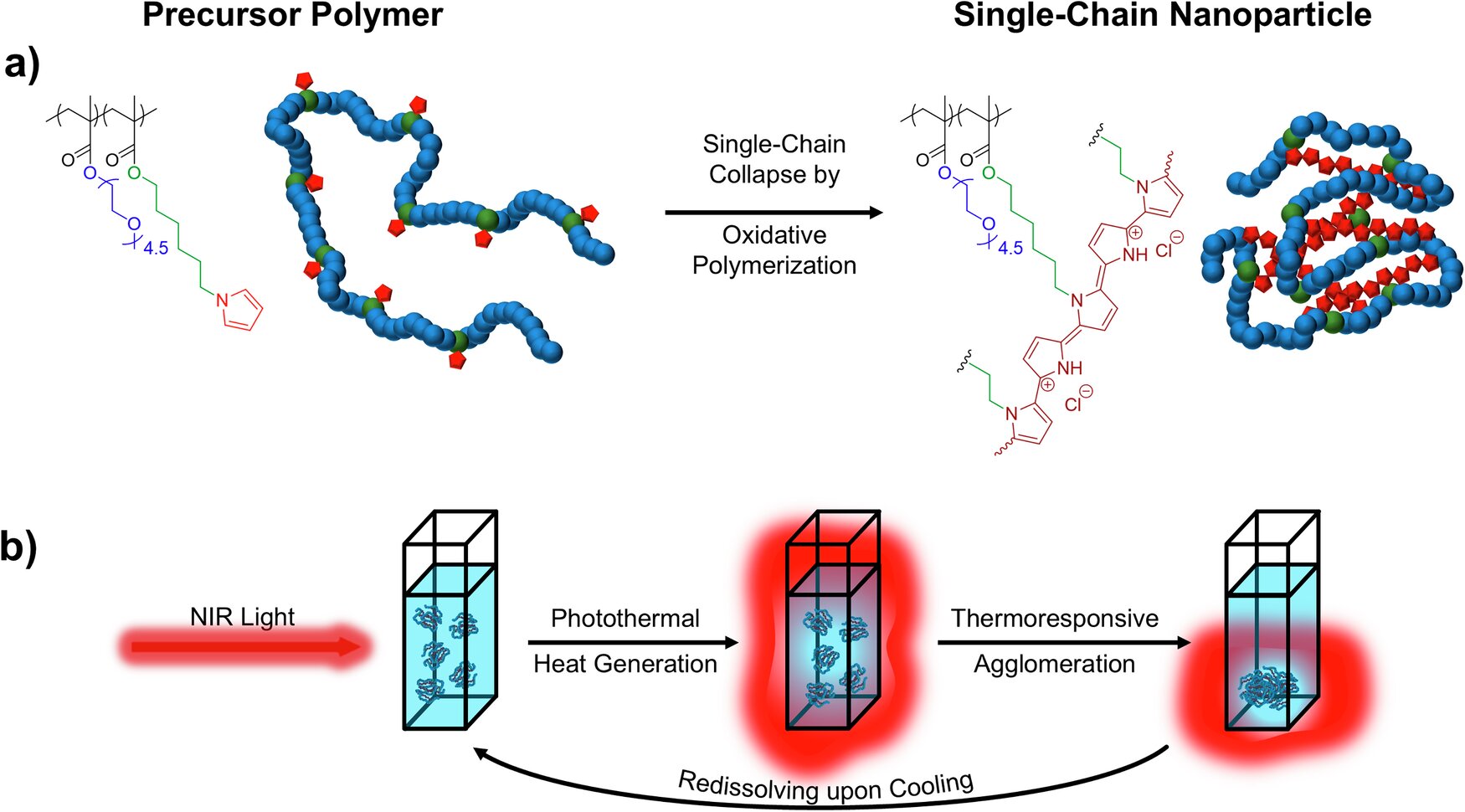
Concept of the photo-thermoresponsive SCNPs. a Illustration of the generation of SCNPs via oxidative polymerization of pyrrole sidechains, and (b) their use in photothermal therapy. The OEGMA-based SCNPs show LCST-type behavior resulting in the formation of water-insoluble agglomerates upon irradiation with NIR light. Credit: Communications Chemistry (2025). DOI: 10.1038/s42004-025-01518-x

A novel class of light-sensitive nanoparticles may one day enable new approaches to medical imaging. They were developed by a research team at Martin Luther University Halle-Wittenberg (MLU). The particles absorb laser light and convert them into heat, thereby changing their internal structure, similar to folded proteins. The research was published in the journal Communications Chemistry.

The newly developed particles are known as single-chain nanoparticles (SCNPs) and consist of individually folded polymer chains. The scientists embedded molecules of the substance polypyrrole into these chains, which absorb light in the near-infrared range and convert it into heat. Laser irradiation not only causes the nanoparticles to heat up, they also change their internal structure.

“When exposed to light, each individual nanoparticle clumps together to form a spherical structure that is only a few nanometers in diameter. This opens up the possibility of concentrating them in specific areas of the body—precisely where there is light,” says MLU-chemist Professor Wolfgang Binder. He led the study together with Dr. Justus Friedrich Thümmler, Professor Karsten Mäder from the Institute of Pharmacy, and Professor Jan Laufer from the Institute of Physics.

SCNPs have a remarkable thermoresponsivity; their structure reacts to changes in temperature. This property is based on the specific molecular design of the particles, which also allows them to convert light into heat very efficiently. Experiments in the lab have shown that even a weak laser beam and relatively few nanoparticles are enough to generate very high local temperatures—up to 85°C.

This effect is important, for example, for imaging techniques used in medical diagnostic testing. The rapid heating of the tissue releases sound waves. These can be measured with photoacoustic imaging techniques, which, in turn, can be used to create 3D models of the inside of the body. The team hopes that the newly developed particles could help study the development of cancer in a few years’ time, for example, by using photoacoustic imaging to make tumors and their response to treatment more visible and easier to track.

See also  How protein coatings influence nanoparticles' ability to avoid immune clearance and reach their destinations

But the potential goes even further: “In the future, we want to use the nanoparticles to transport an active ingredient into the body in a targeted manner and activate it there using light and heat,” explains Binder. The particles could possibly even be used to kill cancer cells through light-controlled heat, a process known as hyperthermia. However, more extensive studies are needed to explore the therapeutic potential of the new particles.

More information:
Justus Friedrich Thümmler et al, Photo-thermoresponsive polypyrrole-crosslinked single-chain nanoparticles for photothermal therapy, Communications Chemistry (2025). DOI: 10.1038/s42004-025-01518-x

Provided by
Martin Luther University Halle-Wittenberg


Citation:
Light-sensitive nanoparticles could serve as contrast agents for advanced imaging (2025, September 22)
retrieved 22 September 2025
from https://phys.org/news/2025-09-sensitive-nanoparticles-contrast-agents-advanced.html

This document is subject to copyright. Apart from any fair dealing for the purpose of private study or research, no
part may be reproduced without the written permission. The content is provided for information purposes only.


Source link

Advanced agents contrast imaging Lightsensitive Nanoparticles serve
Share. Facebook Twitter Pinterest LinkedIn Tumblr Email

Related Posts

Nanozyme Aptasensors Show Promise for Faster Food, Health, and Environmental Testing

September 1, 2026

New Versatile Nanoplatelet Platform Optimizes Tumor Imaging and Cancer Destruction

September 1, 2026

DNA Nanotechnology May Open New Paths to Stroke Repair

August 31, 2026

Nanoparticle Prime Editing Corrects Metabolic Disease Mutation in Mice

August 31, 2026
Add A Comment

Comments are closed.

Top Posts

Bioengineers explore how tumor mechanics and tiny messengers could shape the future of cancer research

September 21, 2025

30 TB hard drive launched by Seagate

September 19, 2025

New technique could speed up the development of acoustic lenses, impact-resistant films and other futuristic materials

September 18, 2025

Subscribe to Updates

Get the latest sports news from SportsSite about soccer, football and tennis.

Explore the future with our Nanotech blog—covering innovations, research, applications, and breakthroughs shaping science, medicine, and modern technology.

We're social. Connect with us:

Facebook X (Twitter) Instagram YouTube
Top Insights

Biomass-Derived Nanomaterials Offer a Greener Route to Pollution Cleanup

September 1, 2026

Nanozyme Aptasensors Show Promise for Faster Food, Health, and Environmental Testing

September 1, 2026

Researchers Solve Two Major Problems Holding Back SiC Electronics

September 1, 2026

Subscribe to Updates

Get the latest creative news from FooBar about art, design and business.

  • Contact Us
  • Privacy Policy
  • Terms & Conditions

© 2026 elnano.com - All rights reserved.

Type above and press Enter to search. Press Esc to cancel.