
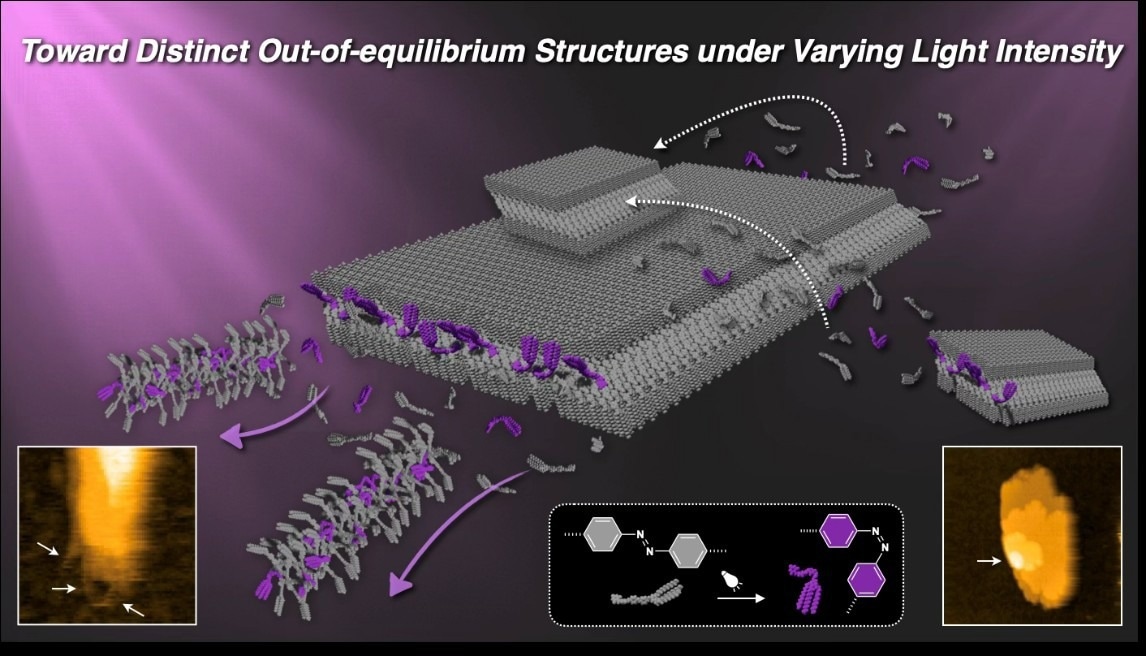
Out-of-equilibrium states that deviate from thermodynamic equilibrium are crucial not only for biological systems but also for designing synthetic functional materials.

Now, researchers from Japan have developed supramolecular 2D nanosheets capable of transforming into dimensionally distinct out-of-equilibrium structures depending on ultraviolet light intensity.
This work opens a new avenue for designing advanced adaptive materials that exhibit diverse responses depending on the light energy applied.
Constructing out-of-equilibrium molecular assemblies that deviate from thermodynamic equilibrium is a central challenge in materials science. While numerous studies have reported the creation of such states using external energy sources such as chemical fuels or light, few systems can adaptively access different states depending on how much energy is input.
Developing such systems could offer new design principles for advanced functional materials capable of flexibly adapting to environmental changes, much like biological systems.
In a recent study published online in Chem on November 17, 2025, researchers in Japan reported a supramolecular polymer system that can produce out-of-equilibrium states with distinct dimensionalities depending on the intensity of light applied. Using high-speed atomic force microscopy (HS-AFM), the research team revealed the underlying mechanisms of these dynamic transformations.
The study was led by Professor Shiki Yagai from Chiba University, Dr. Christian Ganser from Exploratory Research Center on Life and Living Systems, National Institutes of Natural Sciences, and Professor Masaki Kawano from Institute of Science Tokyo, with Assistant Professor Kenta Tamaki from Nagoya University (affiliated with Chiba University at the time of the research) as the first author.
“Our group has long been pursuing unique research aimed at controlling the nano- to mesoscale morphologies of molecular assemblies using light,” says Prof. Yagai. “However, we had not yet realized an out-of-equilibrium system that, much like living organisms, changes its structure or state depending on the amount of energy it receives. In this project, we hypothesized that by incorporating a light-responsive unit into a molecule already known to exhibit different assembly structures under different conditions, we might be able to guide it into distinct assemblies simply by varying the light intensity – and that idea marked the beginning of this study,” says Prof. Yagai, speaking of the inspiration behind this study.
To design the new system, the team attempted to integrate photoinduced structural changes at the molecular level (photoisomerization) with supramolecular polymorphism – structural variations at the mesoscale. They opted for azobenzene as the photoswitching unit and a barbituric acid-based merocyanine as the core responsible for hydrogen-bond-directed supramolecular polymorphism.
The newly synthesized molecule initially self-assembled into 1D coiled nanofibers, but when the solution was left under ambient light, it spontaneously transformed into thermodynamically stable 2D nanosheets through hydrogen bond rearrangement.
Under strong ultraviolet light irradiation, the 2D nanosheets transformed back into 1D linear nanofibers as a result of azobenzene photoisomerization, which induced a reorganization of the hydrogen-bonding patterns. HS-AFM observations revealed that this transformation selectively occurred along specific nanocrystalline facets.
Through single-crystal-guided structural analysis, the team found that these facets expose the photoswitching units, making them particularly susceptible to photons.
In contrast, under weak ultraviolet light irradiation, transmission electron microscopy (TEM) and AFM observations revealed that most of the smaller nanosheets disassembled, while some larger nanosheets grew vertically into 3D nanocrystals.
These findings suggest that the transformation proceeds via an Ostwald ripening mechanism, wherein small nanosheets dissolve and the released molecules redeposit onto larger ones, causing the latter to grow at the expense of the former. HS-AFM further captured localized transformation events, including secondary nucleation and epitaxial growth, occurring during the Ostwald ripening process.
“This out-of-equilibrium supramolecular system paves the way for developing highly functional materials that can alter their states in response to external stimuli, much like living systems,” concludes Prof. Yagai. “Looking ahead, by incorporating photoactive, electroactive, or even catalytic functions directly into the molecular design, it may be possible to create systems whose functional performance spontaneously adapts to environmental changes.”