
Close Menu
  • News
    • Medical
    • Nanomaterials
    • AI & Robotics
    • 2D Materials
    • Metamaterials
    • Nanoelectronics
    • ETF’s
    • Medicine
  • Environment
    • Earth.com
    • TreeHugger
    • Nanomuscle
  • Beauty
    • Makeupanalysis
What's Hot

Biomass-Derived Nanomaterials Offer a Greener Route to Pollution Cleanup

September 1, 2026

Nanozyme Aptasensors Show Promise for Faster Food, Health, and Environmental Testing

September 1, 2026

Researchers Solve Two Major Problems Holding Back SiC Electronics

September 1, 2026
Facebook X (Twitter) Instagram
  • Contact Us
  • Privacy Policy
  • Terms & Conditions
Facebook X (Twitter) Instagram
Elnano – Global Innovative Nanotechnology SolutionsElnano – Global Innovative Nanotechnology Solutions
  • News
    • Medical
    • Nanomaterials
    • AI & Robotics
    • 2D Materials
    • Metamaterials
    • Nanoelectronics
    • ETF’s
    • Medicine
  • Environment
    • Earth.com
    • TreeHugger
    • Nanomuscle
  • Beauty
    • Makeupanalysis
Elnano – Global Innovative Nanotechnology SolutionsElnano – Global Innovative Nanotechnology Solutions
Home » Laser pulses in graphene control electrons with lightning speed and nanometer precision
Nanotech

Laser pulses in graphene control electrons with lightning speed and nanometer precision

October 2, 2025No Comments3 Mins Read
Share
Facebook Twitter LinkedIn Pinterest Email
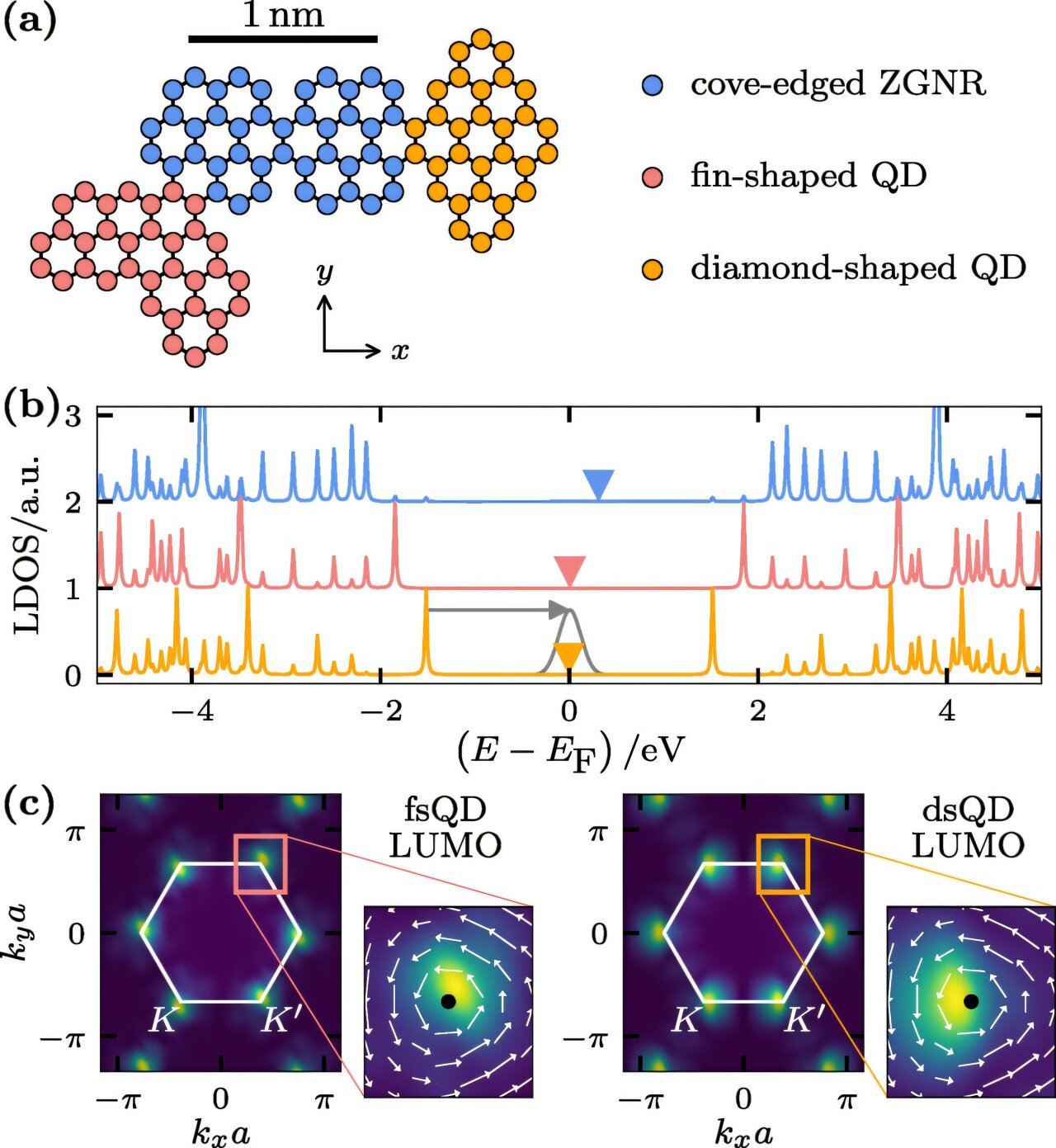
Ground-state properties of System 2. Credit: Physical Review Research (2025). DOI: 10.1103/dtk9-xv6n

A research team in Kiel has demonstrated a previously unknown effect in graphene—a single layer of carbon atoms whose discovery earned the 2010 Nobel Prize. For years, graphene has been seen as a promising material for nanoelectronics, thanks to its exceptional conductivity, flexibility, and stability. Now, researchers from the Institute of Theoretical Physics and Astrophysics at Kiel University have taken this promise a step further.

In a study published in Physical Review Research, Dr. Jan-Philip Joost and Professor Michael Bonitz show for the first time that light pulses can generate electrons at specific designated locations in the material. To investigate how electrons move and interact, they simulated the effects of laser pulses on small graphene clusters. Their results open up entirely new approaches for nanoelectronics.

Light pulses as nanoscale switches

In these systems, ultrashort laser pulses act like light switches on the nanoscale. Within just femtoseconds—a millionth of a billionth of a second—they switch electrons on and off at precisely defined spots. When a pulse strikes a graphene cluster, electrons gather at one edge. A second pulse can generate electrons almost instantly at a different site. The researchers can steer the electrons with high precision, like a traffic signal guiding them where to go.

“We discovered this spatial selectivity in a chemically completely homogeneous material—graphene consists solely of carbon,” explains Bonitz. “Until now, such an effect was only known in molecules composed of different atoms with distinct absorption properties. In our graphene clusters, control emerges solely from the electronic structure and from special topological states. Even under small perturbations, the electron positions remain stable, making the control reliable.”

See also  New efficiency record for perovskite solar cell

Challenges for integration into real devices

The findings could mark a major step forward for next-generation electronics. Today’s transistors operate in the gigahertz range. Graphene-based components switched by laser pulses could function in the petahertz range—up to 10,000 times faster.

In communication systems, precisely guided electron pathways could enable rapid data transfer with minimal energy consumption. This opens up possibilities for high-performance computing, AI chips, and other ultra-fast electronic systems. The challenge now is to integrate the excited electrons reliably into actual circuits.

“If these processes can be transferred into real devices, it would be a huge leap for nanoelectronics,” says Joost.

More information:
Jan-Philip Joost et al, Ultrafast charge separation induced by a uniform field in graphene nanoribbons, Physical Review Research (2025). DOI: 10.1103/dtk9-xv6n

Provided by
Kiel University


Citation:
Laser pulses in graphene control electrons with lightning speed and nanometer precision (2025, October 1)
retrieved 2 October 2025
from https://phys.org/news/2025-10-laser-pulses-graphene-electrons-lightning.html

This document is subject to copyright. Apart from any fair dealing for the purpose of private study or research, no
part may be reproduced without the written permission. The content is provided for information purposes only.


Source link

Control Electrons graphene Laser lightning nanometer precision pulses speed
Share. Facebook Twitter Pinterest LinkedIn Tumblr Email

Related Posts

New Versatile Nanoplatelet Platform Optimizes Tumor Imaging and Cancer Destruction

September 1, 2026

IBM debuts world’s first sub-1 nanometre chip technology

August 31, 2026

Atom-by-atom manufacturing takes a step forward

August 31, 2026

Pittcon Announces 2025 Nobel Laureate, Dr. Omar Yaghi, as Wallace H. Coulter Keynote Lecturer

August 31, 2026
Add A Comment

Comments are closed.

Top Posts

Sponge-like gold nanoparticles could upgrade ovarian cancer diagnostics

September 21, 2025

High-precision analysis of 2D materials microstructures achieved using electron microscopy and machine learning

November 14, 2025

Efficient PET-RAFT polymerization achieved by using low-toxicity shortwave infrared CuInSe₂/CuInS₂ quantum dots

October 15, 2025

Subscribe to Updates

Get the latest sports news from SportsSite about soccer, football and tennis.

Explore the future with our Nanotech blog—covering innovations, research, applications, and breakthroughs shaping science, medicine, and modern technology.

We're social. Connect with us:

Facebook X (Twitter) Instagram YouTube
Top Insights

Biomass-Derived Nanomaterials Offer a Greener Route to Pollution Cleanup

September 1, 2026

Nanozyme Aptasensors Show Promise for Faster Food, Health, and Environmental Testing

September 1, 2026

Researchers Solve Two Major Problems Holding Back SiC Electronics

September 1, 2026

Subscribe to Updates

Get the latest creative news from FooBar about art, design and business.

  • Contact Us
  • Privacy Policy
  • Terms & Conditions

© 2026 elnano.com - All rights reserved.

Type above and press Enter to search. Press Esc to cancel.