
High-density lipoproteins (HDL), also known as “good cholesterol,” remove excess cholesterol from the body’s tissues and transport it to the liver. This process is known to prevent atherosclerosis, the build-up of plaque in the walls of arteries. Atherosclerosis is associated with deadly symptoms, including heart attacks, strokes, aneurysms, and blood clots. Despite the importance of HDLs, scientists still have a limited understanding of how they are made.
“It was historically believed that HDLs pull out excess cholesterol from cells through passive diffusion,” explains lead researcher Professor Kazumitsu Ueda, a professor at Kyoto University’s Institute for Integrated Cell-Material Sciences (iCeMS).
“However, in 1999, a genetic analysis of Tangier disease, a condition characterized by low levels of blood HDL, revealed that the ATP-binding cassette protein A1 (ABCA1), an ATP-dependent transporter, was essential for the HDL production. That only deepened the mystery—how were HDLs being made, and what exactly were they doing?”
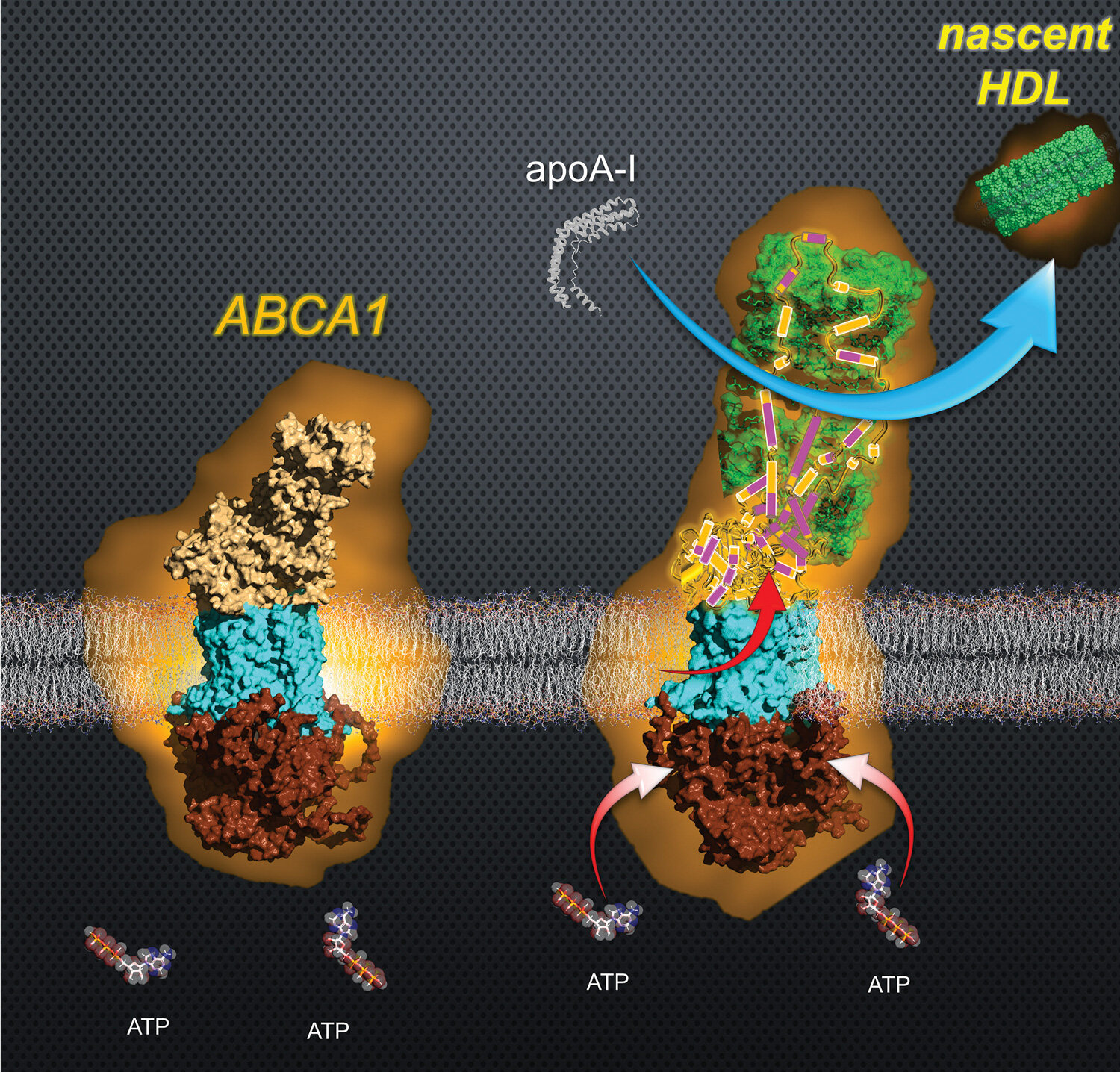
Now, a team of researchers from the iCeMS have used a new imaging method to reveal the molecular mechanism through which HDLs are made. They showed how ABCA1 generates HDL molecules. The findings are published in the journal Nano Letters.
The team originally hypothesized that ABCA1 would temporarily store around 500 cholesterol and phospholipid molecules in its extracellular domain (ECD), the part of ABCA1 that extends outside the cell. Although the ECD in ABCA1 is particularly large, an early study using cryoelectron microscopy reported that the ECD of ABCA1 forms a “tunnel” that can only accommodate fewer than ten lipid molecules at a time.
To peer into this microscopic mystery, Atsushi Kodan in Ueda’s team worked together with Noriyuki Kodera’s team at the Nano Life Science Institute (Nano-LSI) at Kanazawa University, which developed the high-speed atomic force microscopy used in this study. This technique enables researchers to watch molecular processes at sub-second temporal and nanometer spatial resolutions. “Few research groups in the world could perform this experiment,” says Ueda.
They saw that HDL generation is a much more complex process, in which ABCA1 transfers lipids into the ECD through the process of ATP hydrolysis, which releases the chemical energy stored in the bonds of ATP. The ECD temporarily grows a new structure to store a vast amount of lipids, which are then loaded en-masse onto apolipoprotein A-I (apoA-I). During this process, the ECD experiences a sudden and dynamic restructuring, losing about 30% of its volume. The loading of the lipids onto apoA-I produces the nascent HDLs.
“The physiological roles of HDL and cholesterol are often not fully understood,” says Ueda. “By clarifying the function and regulatory mechanisms of ABCA1, we hope to promote a more accurate understanding.”
The team hopes that improved understanding of how HDLs are made, and what functions they perform, could help studies focus on the role of both “good” and “bad” cholesterol in the body, and inform the treatment of cholesterol-related diseases.
Kodan says the high-speed atomic force microscopy the team employed enabled them to perform side-view imaging of membrane proteins, which is both rare and difficult. “This new methodology for efficient side-view imaging of human ABCA1 has the potential to be applied across a broad range of membrane protein systems, including the transport of lipids, drugs, and metabolic products,” he says.
More information:
Atsushi Kodan et al, Direct Visualization of ATP-Binding Cassette Protein A1 Mediated Nascent High-Density Lipoprotein Biogenesis by High-Speed Atomic Force Microscopy, Nano Letters (2025). DOI: 10.1021/acs.nanolett.5c03116
Citation:
How is good cholesterol made? Imaging method shows production mechanism at molecular level (2025, September 29)
retrieved 30 September 2025
from https://phys.org/news/2025-09-good-cholesterol-imaging-method-production.html
This document is subject to copyright. Apart from any fair dealing for the purpose of private study or research, no
part may be reproduced without the written permission. The content is provided for information purposes only.