
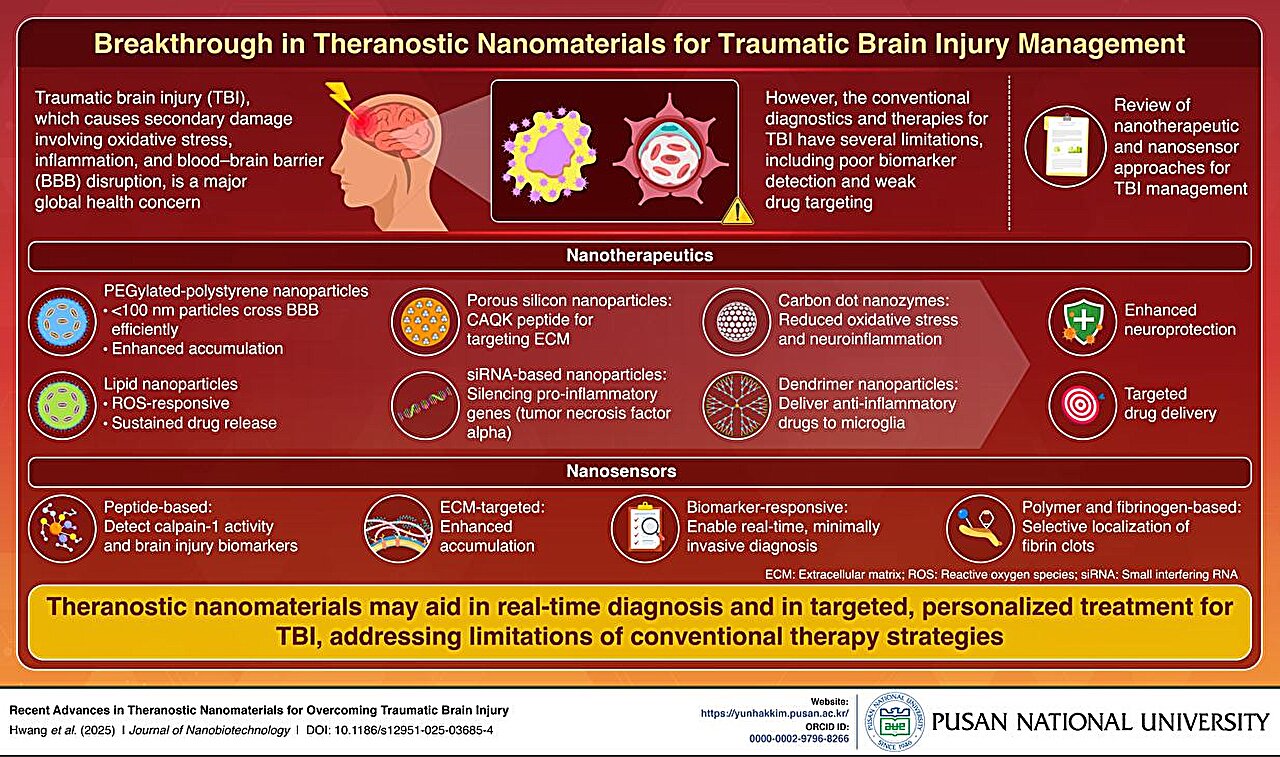
Traumatic brain injury (TBI) remains one of the most pressing public health challenges, leaving millions with lasting disabilities each year. When the brain suffers a sudden impact, from a fall, vehicle accident, or sports collision, it triggers inflammation, oxidative stress, and nerve damage that continue long after the initial trauma. Despite decades of research, the traditional diagnosis and treatment strategies often face limitations such as poor detection and inefficient drug delivery.
Breakthroughs in theranostic nanomaterials for TBI
In a recent study, a team of researchers led by Professor Yun Hak Kim from the Department of Anatomy and Department of Biomedical Informatics, School of Medicine, Pusan National University, Republic of Korea, has summarized recent breakthroughs in theranostic nanomaterials, engineered nanoparticles that can both diagnose and treat TBI. The study was published in the Journal of Nanobiotechnology on 29 October 2025.
This review highlights cutting-edge designs that can deliver drugs precisely where damage occurs, while simultaneously monitoring biological changes inside the brain. Theranostic nanomaterials work by combining two traditionally separate goals.
On one hand, they can transport neuroprotective or anti-inflammatory drugs through the brain’s natural defenses; on the other, they act as sensors, revealing how tissue responds to treatment in real time. These materials can be tuned to react to biological cues such as acidity, oxidative stress, or enzyme activity, signals that are abundant in injured brain tissue.
“Theranostic nanomaterials hold great promise for real-world clinical applications in TBI management. These multifunctional nanoplatforms could enable personalized and minimally invasive treatment strategies by simultaneously diagnosing injury severity, delivering targeted therapeutics, and monitoring recovery in real time,” says Prof. Kim.
Recent advances and future directions
The review sheds light on various nanotherapeutic approaches, including PEGylated-polystyrene nanoparticles, porous silicon nanoparticles, carbon dot nanoparticles, dendrimer nanoparticles, lipid nanoparticles (LNPs), and siRNA-based nanoparticles, all of which have demonstrated enhanced neuroprotection and targeted drug delivery in TBIs. Among the technologies discussed, LNPs can target damaged tissue and release neuroprotective molecules with efficacy and carbon-dot nanozymes act like artificial enzymes to neutralize harmful reactive molecules.
In addition, nanosensors such as peptide-based, ECM-targeted, polymeric and fibrinogen-based, and biomarker-responsive can aid in real-time diagnosis and monitoring of TBI progression. Notably, recent advances aim at merging these nanotechnologies with artificial intelligence and bioengineering to create adaptive treatment systems.
“Safety and biocompatibility remain central challenges before clinical adoption. Hence, the rational design of nanomaterials that can safely degrade in response to changes in pH or enzyme activity can help reduce chronic accumulation risks and ensure safer long-term clinical applications,” says Prof. Kim.
Transforming neurotrauma care with nanotechnology
Ultimately, the researchers believe these advances could revolutionize neurotrauma care, allowing doctors to diagnose TBI faster, deliver treatments more safely, and monitor recovery continuously. By merging diagnosis and therapy into a single, intelligent system, theranostic nanomaterials may usher in a new era of personalized brain medicine that offers patients better outcomes and renewed hope for recovery.
“Our study paves the way for development of customized, minimally invasive, and continuously monitored therapies, improving recovery outcomes and quality of life of patients with TBI,” concludes Prof. Kim.
More information:
Nam Cheol Hwang et al, Recent advances in theranostic nanomaterials for overcoming traumatic brain injury, Journal of Nanobiotechnology (2025). DOI: 10.1186/s12951-025-03685-4
Citation:
Exploring smart nanomaterials that detect and treat traumatic brain injuries simultaneously (2025, November 12)
retrieved 12 November 2025
from https://phys.org/news/2025-11-exploring-smart-nanomaterials-traumatic-brain.html
This document is subject to copyright. Apart from any fair dealing for the purpose of private study or research, no
part may be reproduced without the written permission. The content is provided for information purposes only.