
Close Menu
  • News
    • Medical
    • Nanomaterials
    • AI & Robotics
    • 2D Materials
    • Metamaterials
    • Nanoelectronics
    • ETF’s
    • Medicine
  • Environment
    • Earth.com
    • TreeHugger
    • Nanomuscle
  • Beauty
    • Makeupanalysis
What's Hot

Biomass-Derived Nanomaterials Offer a Greener Route to Pollution Cleanup

September 1, 2026

Nanozyme Aptasensors Show Promise for Faster Food, Health, and Environmental Testing

September 1, 2026

Researchers Solve Two Major Problems Holding Back SiC Electronics

September 1, 2026
Facebook X (Twitter) Instagram
  • Contact Us
  • Privacy Policy
  • Terms & Conditions
Facebook X (Twitter) Instagram
Elnano – Global Innovative Nanotechnology SolutionsElnano – Global Innovative Nanotechnology Solutions
  • News
    • Medical
    • Nanomaterials
    • AI & Robotics
    • 2D Materials
    • Metamaterials
    • Nanoelectronics
    • ETF’s
    • Medicine
  • Environment
    • Earth.com
    • TreeHugger
    • Nanomuscle
  • Beauty
    • Makeupanalysis
Elnano – Global Innovative Nanotechnology SolutionsElnano – Global Innovative Nanotechnology Solutions
Home » Efficient PET-RAFT polymerization achieved by using low-toxicity shortwave infrared CuInSe₂/CuInS₂ quantum dots
Nanotech

Efficient PET-RAFT polymerization achieved by using low-toxicity shortwave infrared CuInSe₂/CuInS₂ quantum dots

October 15, 2025No Comments2 Mins Read
Share
Facebook Twitter LinkedIn Pinterest Email
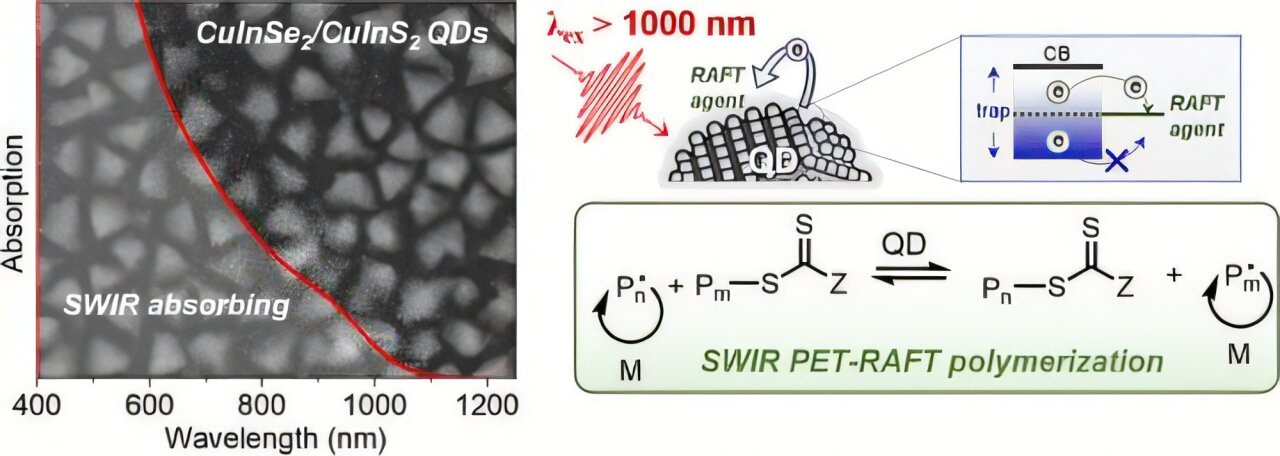
Graphical abstract. Credit: Journal of the American Chemical Society (2025). DOI: 10.1021/jacs.5c11312

Photoinduced electron/energy transfer reversible addition-fragmentation chain-transfer (PET-RAFT) polymerization enables precise light-controlled polymer growth. Traditional near-infrared strategies often rely on nonlinear optical processes such as two-photon absorption or photon upconversion, which typically require high-intensity laser excitation.

Direct shortwave infrared (SWIR) light-driven PET-RAFT has distinct advantages such as higher selectivity, deeper tissue penetration, and potential applications in three-dimensional printing and transdermal polymerization. However, efficient photocatalysts that can directly utilize SWIR photons remain rare.

In a study published in the Journal of the American Chemical Society, a team led by Prof. Wu Kaifeng and Prof. Du Jun from the Dalian Institute of Chemical Physics of the Chinese Academy of Sciences, along with Prof. Cyrille Boyer from the University of New South Wales, achieved living radical polymerization using low-toxicity copper indium selenide (CuInSe2) quantum dots (QDs), extending PET-RAFT excitation into the SWIR region at 1,050 nm.

Researchers synthesized highly luminescent CuInSe2/CuInS2 QDs with an absorption onset extended to 1,100 nm, and hybridized them with 4-Cyano-4-(dodecylsulfanylthiocarbonyl)sulfanylpentanoic acid as a photocatalyst. Under 1,050 nm excitation, this hybrid system effectively triggered PET-RAFT polymerization, achieving efficient polymerization through 3 mm of biological tissue.

Furthermore, researchers revealed that long-lived shallow defect-state electrons in CuInSe2 QDs played a key role during organic photochemical reactions, providing guidance for the development of high-performance SWIR photocatalysts.

“With further optimization of QDs, this strategy could enable efficient polymerization at even longer wavelengths, paving the way for SWIR-driven synthesis of advanced functional polymer materials,” said Prof. Du.

More information:
Yongshun Lyu et al, Efficient Photoinduced Living Polymerization Driven by Shortwave Infrared CuInSe2/CuInS2 Quantum Dots, Journal of the American Chemical Society (2025). DOI: 10.1021/jacs.5c11312

See also  Scientists Unveil Technique to Build Ultra-Thin Material Stacks That Promise Quantum Breakthrough

Provided by
Chinese Academy of Sciences


Citation:
Efficient PET-RAFT polymerization achieved by using low-toxicity shortwave infrared CuInSe₂/CuInS₂ quantum dots (2025, October 15)
retrieved 15 October 2025
from https://phys.org/news/2025-10-efficient-pet-raft-polymerization-toxicity.html

This document is subject to copyright. Apart from any fair dealing for the purpose of private study or research, no
part may be reproduced without the written permission. The content is provided for information purposes only.


Source link

achieved CuInSe₂CuInS₂ dots efficient infrared lowtoxicity PETRAFT polymerization Quantum shortwave
Share. Facebook Twitter Pinterest LinkedIn Tumblr Email

Related Posts

New Versatile Nanoplatelet Platform Optimizes Tumor Imaging and Cancer Destruction

September 1, 2026

IBM debuts world’s first sub-1 nanometre chip technology

August 31, 2026

Tiny Hidden Vibrations Could Make Aircraft More Fuel Efficient

August 31, 2026

Atom-by-atom manufacturing takes a step forward

August 31, 2026
Add A Comment

Comments are closed.

Top Posts

Novel Polyphenol-Metal Nanocarrier for Antibody Delivery

September 18, 2025

Alpaca-generated nanobody neutralizes a protein essential for herpes infection

September 20, 2025

Cost-Optimized, High-Speed Fiber-Alignment System for Silicon Photonics

November 12, 2025

Subscribe to Updates

Get the latest sports news from SportsSite about soccer, football and tennis.

Explore the future with our Nanotech blog—covering innovations, research, applications, and breakthroughs shaping science, medicine, and modern technology.

We're social. Connect with us:

Facebook X (Twitter) Instagram YouTube
Top Insights

Biomass-Derived Nanomaterials Offer a Greener Route to Pollution Cleanup

September 1, 2026

Nanozyme Aptasensors Show Promise for Faster Food, Health, and Environmental Testing

September 1, 2026

Researchers Solve Two Major Problems Holding Back SiC Electronics

September 1, 2026

Subscribe to Updates

Get the latest creative news from FooBar about art, design and business.

  • Contact Us
  • Privacy Policy
  • Terms & Conditions

© 2026 elnano.com - All rights reserved.

Type above and press Enter to search. Press Esc to cancel.