
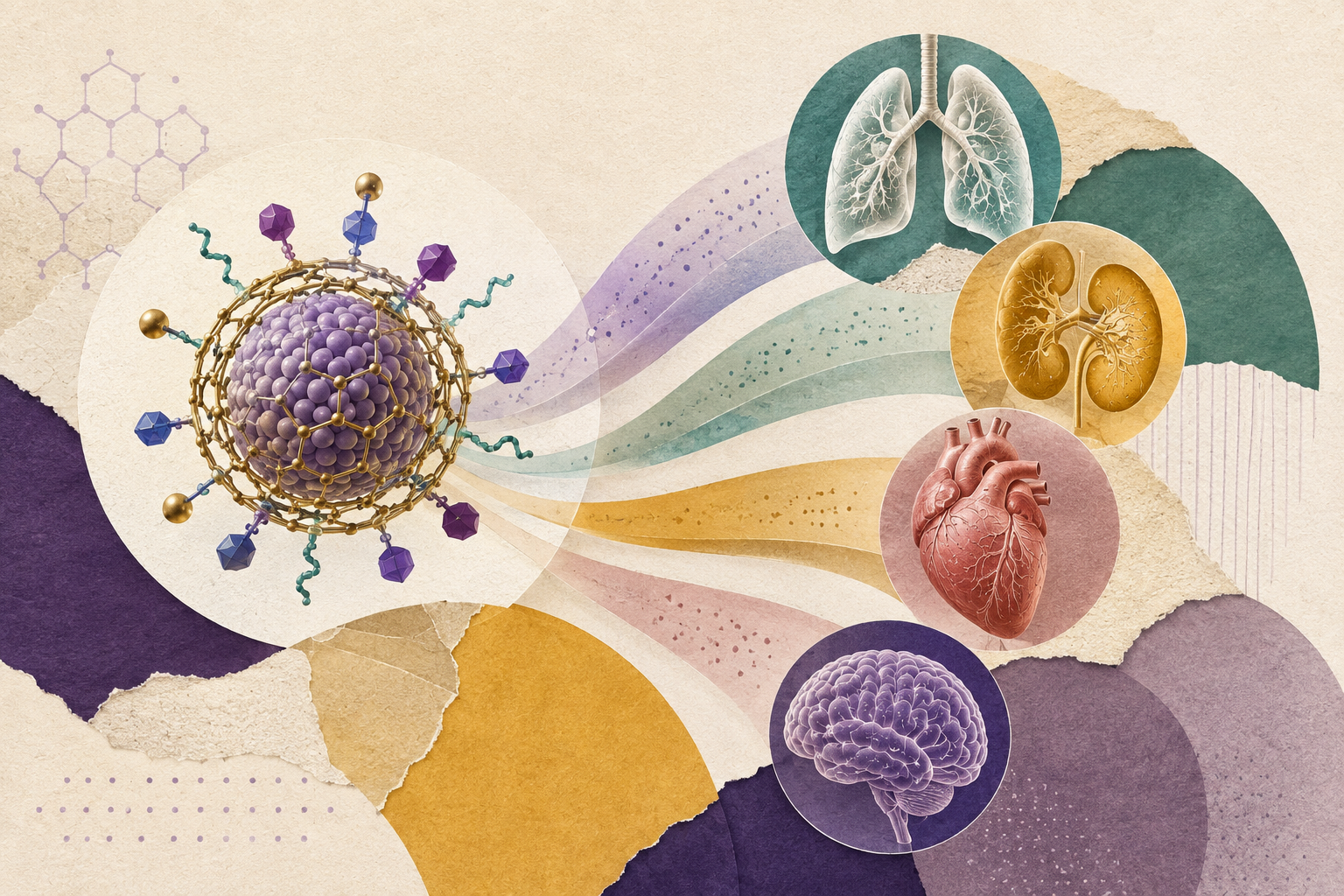
What happens when a nanoparticle is given a new surface identity? Researchers tested whether a tunable four-part coating could overcome one of nanomedicine’s most persistent delivery barriers.
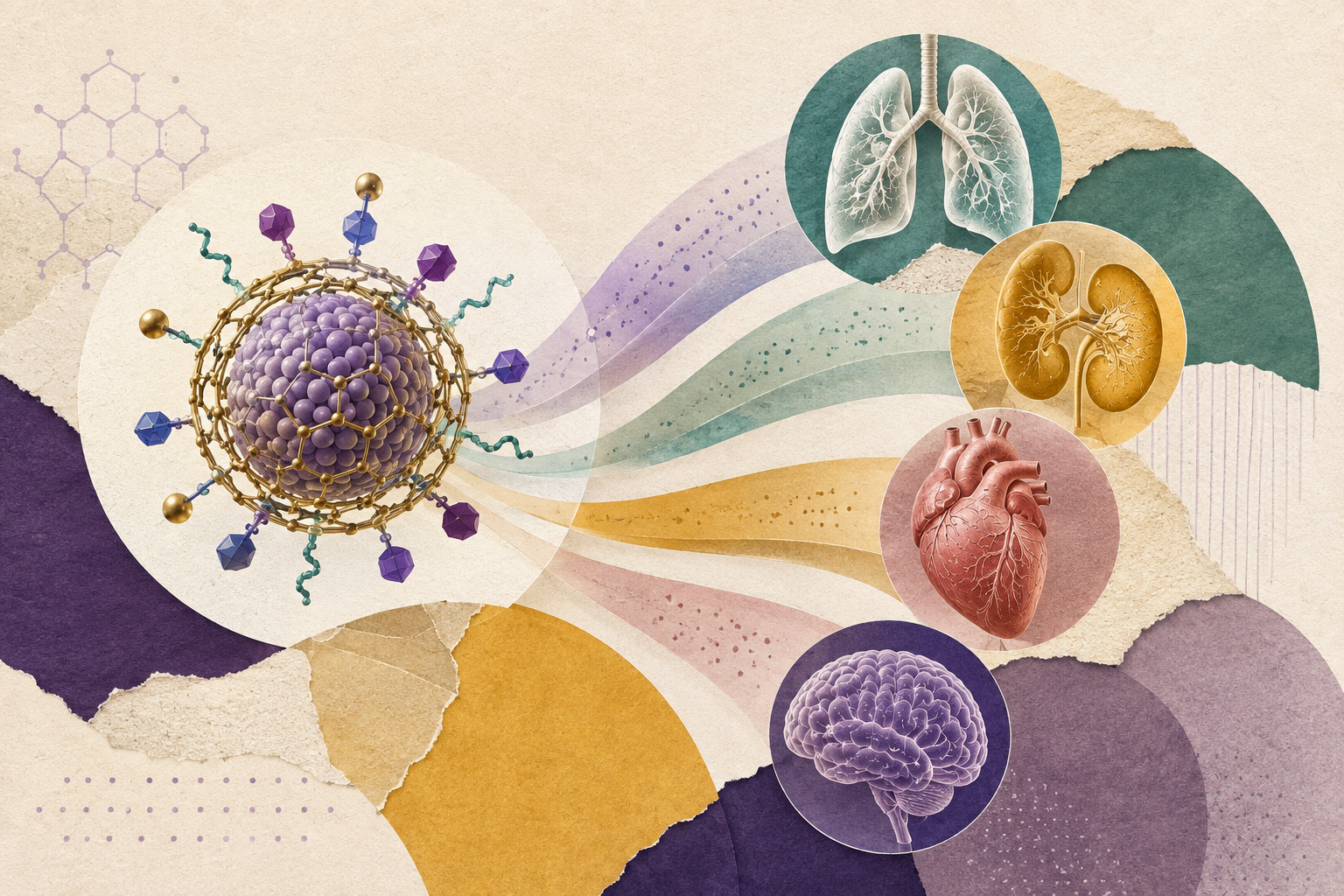
Paper: Selective organ deposition of nanoparticles directed by metal–organic network coatings. AI-generated abstract conceptual image created using ChatGPT/OpenAI
Targeting therapeutic nanoparticles to specific organs remains a significant challenge, as the body can redirect or clear them before they reach their intended destination.
A recent study published in the journal Nature Communications introduced a modular metal-organic network coating that effectively directs diverse nanoparticles to specific organs in mice.
In selected titanium-containing formulations, approximately 80% of the nanoparticle signal measured across the examined organs was in the lungs, with lung-selective localization apparent within four hours after intravenous injection, while redirecting the usual liver and spleen accumulation.
The tMPN approach provides a generalizable method for controlling nanoparticle distribution within the body, potentially supporting localized drug delivery.
Overcoming Challenges in Nanomedicine
Nanoparticle platforms, including lipid nanoparticles used in mRNA vaccines, have transformed the pharmaceutical industry and have significant implications for drug delivery in applications such as gene editing and cancer immunotherapy. However, a major challenge in nanomedicine is the body’s natural clearance and sequestration mechanisms.
After intravenous administration, most nonviral nanoparticles largely accumulate in or are sequestered by the liver and spleen, limiting their distribution to other organs and reducing their therapeutic potential.
Existing surface-modification strategies often require complex chemical conjugation tailored to specific particle types, limiting broader applicability across different nanoparticle platforms.
Development of Organ-Targeting Metal-Phenolic Coatings
To address these barriers, researchers developed a modular coating based on organ-targeting metal-phenolic networks. The coatings consist of four main components: polyethylene glycol (PEG) as a seeding agent, a structural protein such as bovine serum albumin (BSA), phenolic ligands as binding agents, and specific metal ions. By varying these components, the study modified the physical and chemical properties of the nanocarriers.
The approach was applied to several nanoparticle platforms, including quantum dots, lipid nanoparticles, silica spheres, gold nanoparticles, polymeric nanoparticles, and paramagnetic iron oxide nanoparticles.
The modified nanoparticles were tracked after intravenous injection into mice using IVIS fluorescence imaging of harvested organs and inductively coupled plasma mass spectrometry (ICP-MS).
The effects of metal ion type, PEG molecular weight, and phenolic ligand size were evaluated to assess the behavior of the modified surfaces in biological environments. Furthermore, proteomics analysis characterized the biomolecular corona, the layer of blood plasma proteins that forms around foreign materials after they enter the bloodstream.
Influence of Coating Composition on Organ Targeting
The results showed that network composition strongly influenced the distribution of nanoparticles among organs. Changing the metal ion produced distinct patterns. For instance, titanium ions produced nearly 80% relative lung deposition across the organs examined in selected formulations, while zinc and iron favored kidney accumulation, with zinc achieving 68% relative deposition. Higher-valency metal ions, including tungsten, also showed a greater propensity for pulmonary targeting.
Phenolic ligand selection significantly affected delivery to less accessible organs. Replacing larger tannic acid molecules with smaller ligands such as catechin and gallic acid increased cardiac deposition by four- to six-fold and improved brain localization by up to 15-fold.
Proteomics analysis demonstrated that smaller ligands reduced the adsorption of coagulation proteins, such as fibrinogen. This was accompanied by greater adsorption of albumin and apolipoprotein A-I. The researchers proposed that these changes might prolong circulation and facilitate interactions with low-density lipoprotein receptors, potentially contributing to greater deposition in the heart and brain.
The molecular weight of polyethylene glycol further influenced nanoparticle distribution. A low molecular weight of 2 kilodaltons maintained localized organ selectivity, whereas increasing it to 10 kilodaltons or higher led to broader distribution across the spleen, liver, and kidneys, thereby reducing the targeting effect. Tests with messenger RNA showed that mRNA encapsulated in lipid nanoparticles remained functional after coating and organ redirection.
The researchers also showed that the outer coating could override the original organ tropism of an underlying nanoparticle, redirecting lung-tropic particles toward the kidney or kidney-tropic particles toward the lung by changing the metal ion in the outer shell.
Implications for Enhanced Therapeutic Delivery
The modular coating could simplify the development of targeted nanoparticle therapies by providing a common interface for different nanocarriers. This approach allows existing platforms to be modified by adjusting the coating components.
Redirecting lipid nanoparticles toward the lungs and kidneys could support more localized messenger RNA delivery for respiratory and renal applications. Additionally, applying the coating to materials such as gold and iron oxide nanoparticles could expand their use in diagnostic imaging and other theranostic applications.
Short-term safety testing found no significant tissue abnormalities, inflammatory cytokine response, or weight loss in the mice, although much of the introduced metal was retained in the liver and/or kidneys seven days after injection. The findings remain preclinical, and the study did not test whether altered nanoparticle distribution improved disease treatment.
Conclusion: A Path Forward for Precision Medicine
In summary, organ-targeting metal-phenolic networks present a modular approach for controlling nanoparticle distribution in the body. The study showed that metal ions, phenolic ligands, and the molecular weight of polyethylene glycol can be adjusted to influence organ localization. Changes in the protein corona may contribute to these differences, although they do not fully explain the resulting biodistribution.
This approach could support targeted delivery using existing nanoparticle platforms, including lipid nanoparticles for messenger RNA therapies and gold or iron oxide nanoparticles for imaging and theranostic applications.
Future work should focus on clarifying the precise mechanisms underlying organ selectivity and evaluating long-term biocompatibility, therapeutic performance, and clinical translation.