
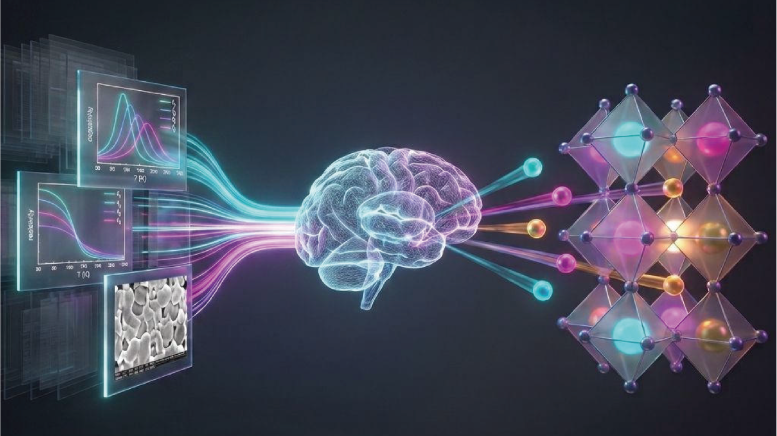
Researchers built a dataset of 1,202 records from 448 papers and screened about 150 million virtual compositions to identify potential materials for future MLCCs and electric vehicle electronics.
Finding a new electronic material can mean searching through an almost limitless number of possible chemical combinations. Researchers at Seoul National University have used artificial intelligence to make that search more manageable, pulling together data scattered across hundreds of scientific papers and using it to identify lead-free dielectric materials that remain stable at high temperatures.
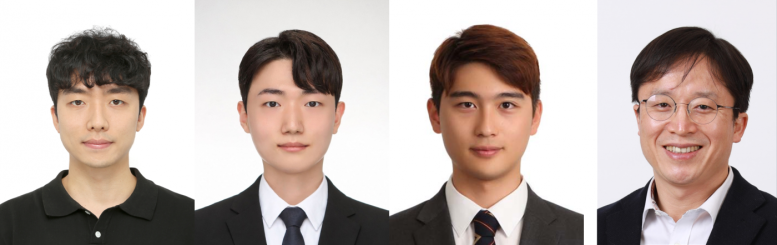
The Seoul National University College of Engineering research team was led by Professor Ho Won Jang of the Department of Materials Science and Engineering. The researchers combined information extracted from published studies with physics-informed machine learning to design new lead-free dielectric compositions. Integrated M.S./Ph.D. student Kwanwoo Song was first author and led the overall project, with integrated M.S./Ph.D. student Youngmin Kim and postdoctoral researcher Jaehyun Kim also contributing.
Dielectrics are insulating materials that block the direct flow of electricity while storing electrical charge. They are essential to multilayer ceramic capacitors (MLCCs) found in smartphones, electric vehicles, and other electronics. A higher dielectric constant allows a component of the same size to store more electrical energy, but useful materials must also preserve that performance as temperatures rise.
To search for promising compositions, the researchers combined multimodal literature mining, which extracts information from text, tables, and graphs, with physics-informed machine learning. Their inverse design strategy began with desired performance targets and worked backward to identify compositions likely to meet them.
The researchers assembled 1,202 records of dielectric properties from 448 scientific papers, then screened a virtual chemical space containing approximately 150 million possible compositions. That process reduced the field to 37 candidates. Two were synthesized and tested experimentally, and both showed high dielectric constants along with strong stability at elevated temperatures.
The findings were published in Nature Communications.
Trial and error faces millions of possibilities
Demand for heat-resistant dielectric materials is growing as technologies including electric vehicles, power electronics, and aerospace equipment increasingly operate at elevated temperatures. Relaxor ferroelectrics are particularly promising because their electrical response changes relatively gradually with temperature, potentially combining a high dielectric constant with performance across a wide temperature range.
Even among lead-free materials, however, the enormous number of possible elements and mixing ratios makes conventional trial-and-error searches expensive and slow. Another obstacle is the data itself. Useful measurements are scattered among the text, tables, and figures of numerous studies, while temperature, frequency, sample characteristics, and other experimental conditions differ across publications. Those inconsistencies make published information difficult to use directly for machine learning.
AI narrowed 150 million compositions to 37
The researchers addressed this problem by building a machine learning framework that organizes information from separate publications into one consistent dataset while using physical constraints to exclude compositions unlikely to exist.
Large language models were used to extract compositions and processing conditions from the text and tables of scientific papers. Graphs were converted into numerical data so the researchers could recover temperature-dependent dielectric properties.
Together, those sources produced 1,202 records containing composition, processing conditions, and dielectric properties from 448 papers. The researchers added 22 physical descriptors, including information related to elemental composition and microstructure, to make data from different publications more comparable.
They then combined 30 independently trained machine learning models to predict three important measures related to dielectric constant and temperature stability at the same time. The system also evaluated how closely the models agreed with one another, allowing compositions backed by greater predictive confidence to receive priority.
After applying predefined performance requirements and physicochemical constraints to about 150 million virtual compositions, only 37 candidate materials remained. The researchers refined the component ratios within the compositional family containing the greatest number of candidates and selected two formulations for experimental testing.
Two candidates met high-temperature standards
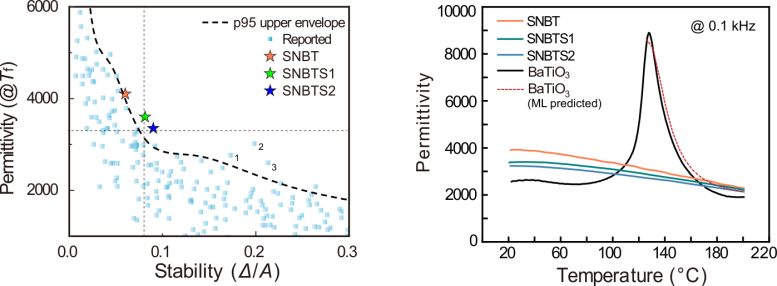
The two tested samples contained substitutions of 1 mol% and 2 mol% tin (Sn). At room temperature, they reached dielectric constants of 3,422 and 3,307, respectively.
Adding a small amount of Sn produced a useful balance: temperature stability improved without a substantial loss in dielectric constant. Compared with barium titanate (BaTiO₃), a material widely used in current multilayer ceramic capacitors, the new compositions maintained high dielectric constants more consistently across a broader span of temperatures.
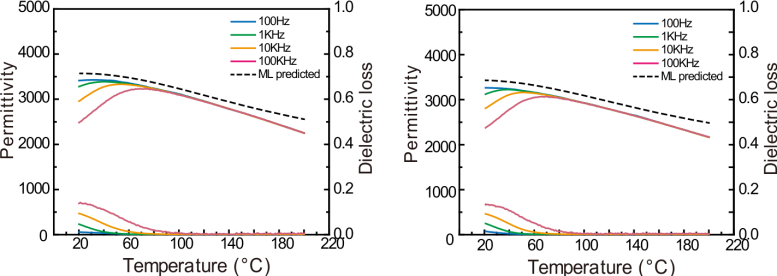
Both samples met the high temperature stability requirements for the international X5R, X6R, and X7R standards used for multilayer ceramic capacitors. Their dielectric constants were also among the highest reported for materials belonging to the same compositional family.
X5R, X6R, and X7R: Temperature stability classifications for dielectric materials used in multilayer ceramic capacitors, generally describing whether dielectric constant remains within ±15% of its value at 25°C across ranges beginning at −55°C and extending to 85°C, 105°C, and 125°C, respectively.
Tin substitution explains the stability gain
To determine why small amounts of tin improved performance, the researchers compared what the machine learning models had identified as important with measurements from piezoresponse force microscopy, Raman spectroscopy, and atomic resolution electron microscopy.
Their analysis showed that limited Sn substitution expands the crystal framework and increases electrical heterogeneity at the atomic scale. According to the researchers, those changes enhance temperature stability.
Beyond the two validated materials, the study demonstrates a way to turn information dispersed throughout the scientific literature into a dataset that can guide the design of new materials. The researchers say the same approach could be extended to functional oxides, thin films, and other material systems whose useful data are distributed across many publications.
The lead-free dielectrics tested in the study could eventually contribute to high-temperature multilayer ceramic capacitors and electronic components for electric vehicles, power electronics, and aerospace systems.
Professor Ho Won Jang said, “The significance of this study lies not simply in predicting performance with machine learning, but in integrating information scattered across multiple papers into a training dataset and then considering both physical laws and consistency among model predictions to narrow the search all the way down to candidates that could actually be synthesized.”
He added, “We hope the strategy presented in this study—combining multimodal literature mining with physics-informed machine learning—will extend beyond dielectric materials to the discovery of other functional oxides and thin-film materials, where data are scattered across numerous papers and formats and therefore require systematic integration.”
Kwanwoo Song, the study’s first author and an integrated M.S./Ph.D. student, led the work from construction of the literature-derived dataset and development of the machine learning models through candidate screening and experimental validation. His current research continues to use machine learning to search for new electronic materials, including lead-free dielectric and MLCC compositions as well as oxide channel materials for semiconductor transistors. He plans to continue research and development on high-performance electronic and dielectric materials.
Professor Ho Won Jang’s group has also previously applied AI to another materials discovery problem. In research led by postdoctoral researcher Jaehyun Kim as first author, the team discovered and experimentally validated a tungsten single-atom-based, non-precious-metal water electrolysis catalyst for green hydrogen production. That work was also published in Nature Communications.
Reference: “Machine-learning-guided inverse design of lead-free relaxors enabled by multimodal literature mining” by Kwanwoo Song, Youngmin Kim, Jaehyun Kim, Byeong-Jae Min, Hyun-Cheol Song, Nayeon Kang, Jungho Ryu and Ho Won Jang, 15 June 2026,Nature Communications.
DOI: 10.1038/s41467-026-74376-3
This research was supported by the National Research Council of Science & Technology (NST) and the Ministry of Science and ICT (MSIT) (GTL25021-230); the National Research Foundation of Korea (NRF) and MSIT (RS-2024-00421181); the MSIT InnoCORE Program (1.250021.01); and the Nano & Materials Technology Development Program of the NRF and MSIT (RS-2024-00405016).
Never miss a breakthrough: Join the SciTechDaily newsletter.
Follow us on Google and Google News.