
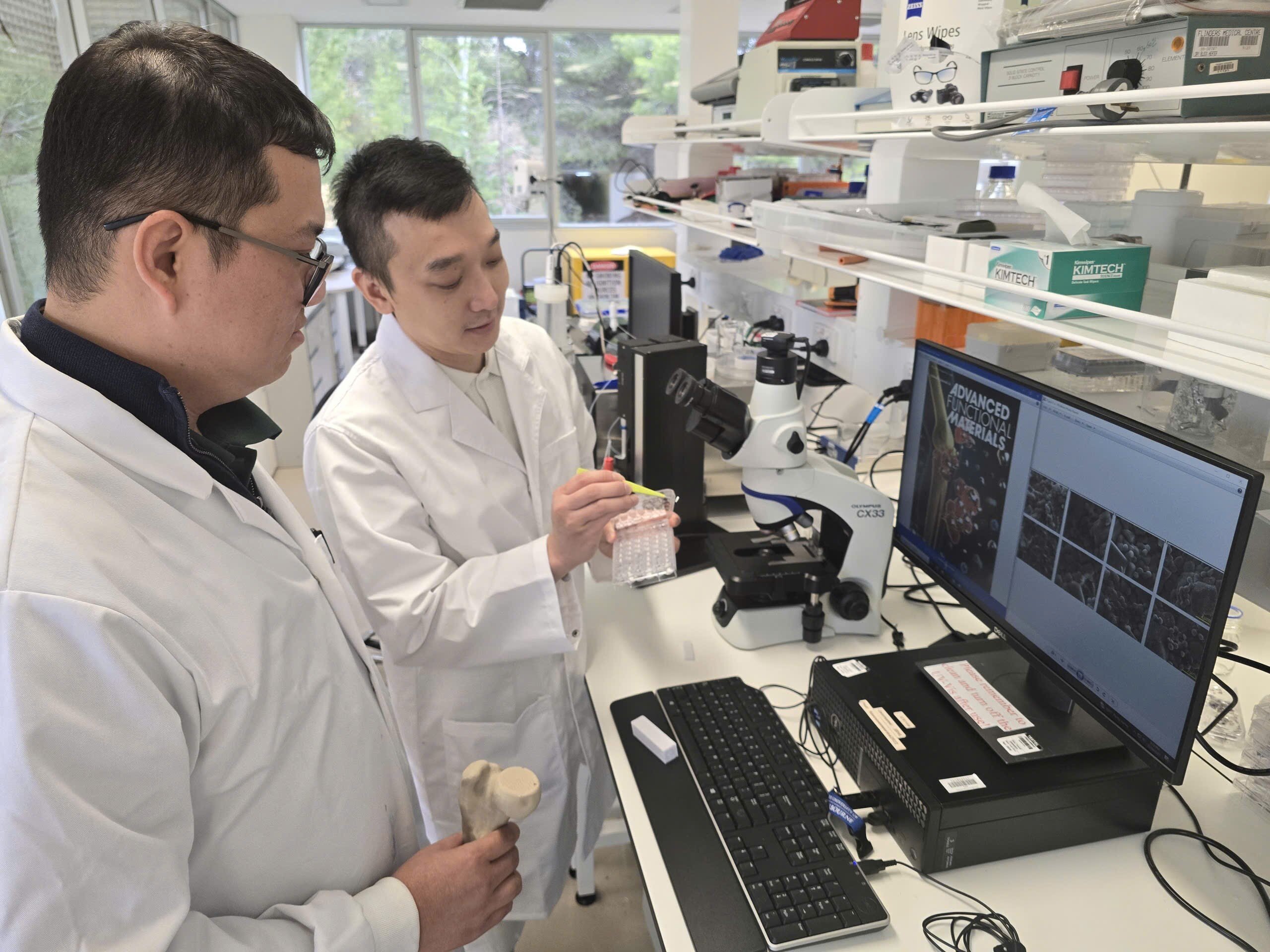
A pioneering liquid metal combination is shaping up as a potential secret weapon in the global fight against antimicrobial resistance, and promises to outlast existing implant materials.
While also able to combat infections, new research at the Flinders University Biomedical Nanoengineering Laboratory also confirms the special metallic material is far more biocompatible with bones—giving patients potential for quicker healing and device longevity after major orthopedic surgery.
“This new 3D bioceramic scaffold embedded with silver-gallium (Ag-Ga) liquid metal nanoparticles offers a dual-function biomaterial that simultaneously combats persistent infection and promotes bone regeneration,” says Flinders University Associate Professor Vi-Khanh Truong, lead author of a new article in Advanced Functional Materials.
“In our latest research, we show our scaffolds significantly reduce bacterial colonization at implant sites and promote healthy bone integration, confirming both antibacterial efficacy and regenerative capability in a physiologically relevant setting.”
This is the first reported instance of integrating liquid metal-based nanomaterials into a load-bearing, bioactive ceramic scaffold, explains Dr. Ngoc Huu Nguyen, a postdoctoral researcher on the project.
“Our approach differs fundamentally from conventional antibiotic-loaded materials. Instead of burst release, the scaffold provides sustained, localized antimicrobial protection while actively supporting bone healing,” he says.
Early career researcher Dr. Nguyen was instrumental in formulating the liquid metal-based bioceramic scaffold, successfully integrating Ag-Ga nanoparticles into hydroxyapatite to achieve a seamless combination of antimicrobial activity and bone-regenerative function.
Senior co-author Flinders University Professor Krasimir Vasilev says the latest research successfully incorporates the surface coatings to a fully integrated, regenerative scaffold platform for orthopedic and trauma applications.
“This innovation helps to create a new generation of bone repair materials that can prevent infection without relying on antibiotics, while also enhancing tissue integration and healing,” says Professor in Biomedical Nanoengineering Vasilev.
He says the multi-targeted antibacterial effects have been shown to be effective against a range of clinically significant pathogens, including Staphylococcus aureus, methicillin-resistant S. aureus (MRSA), Pseudomonas aeruginosa, and small colony variants—”which are notoriously difficult to eliminate using conventional antibiotics.”
Future applications could include:
- Antimicrobial bone void fillers for infected fractures, spinal fusions, and revision surgeries
- Next-generation antibiotic-free bone cements with ion-mediated antimicrobial action
- Patient-specific, 3D-printed scaffolds for craniofacial, long bone, and tumor resection defects
- Standalone implantable devices for infection-prone environments, such as diabetic foot and oncology-related bone loss.
Implant-associated infections remain a critical challenge in surgery and orthopedics. Systemic antibiotics are increasingly ineffective due to resistance, and antibiotic-loaded cements are often short-lived and narrow in spectrum, researchers say.
“Our technology offers a non-antibiotic, dual-function solution that can dramatically improve surgical outcomes—particularly for high-risk and compromised patients,” says Associate Professor Truong.
This research at Flinders University was conducted with experts from Shandong University and partner institutions.
More information:
Ngoc Huu Nguyen et al, Multifunctional Hydroxyapatite Coated with Gallium Liquid Metal‐Based Silver Nanoparticles for Infection Prevention and Bone Regeneration, Advanced Functional Materials (2025). DOI: 10.1002/adfm.71453
Citation:
Orthopedic implants aim to last longer with liquid metal-based nanomaterials (2025, October 8)
retrieved 8 October 2025
from https://phys.org/news/2025-10-orthopedic-implants-aim-longer-liquid.html
This document is subject to copyright. Apart from any fair dealing for the purpose of private study or research, no
part may be reproduced without the written permission. The content is provided for information purposes only.