
Traumatic injuries of the central nervous system (CNS)—such as traumatic brain injury (TBI) and traumatic spinal cord injury (SCI)—are characterized by oxidative damage and neuroinflammation. Current treatment relies mainly on supportive care and surgical intervention, with a lack of effective drugs to directly target the underlying damage.
For example, neural stem cell (NSC)-based therapy has shown therapeutic potential, but pathological microenvironments negatively impact NSC survival and directed differentiation, compromising therapeutic outcomes. Similarly, antioxidant treatment has limited success because most antioxidants don’t efficiently cross the blood-brain barrier (BBB).
Now, however, researchers from the Institute of Process Engineering (IPE) of the Chinese Academy of Sciences, in cooperation with Shenzhen Second People’s Hospital, have developed a novel exosome-based therapeutic agent for treating traumatic CNS injuries.
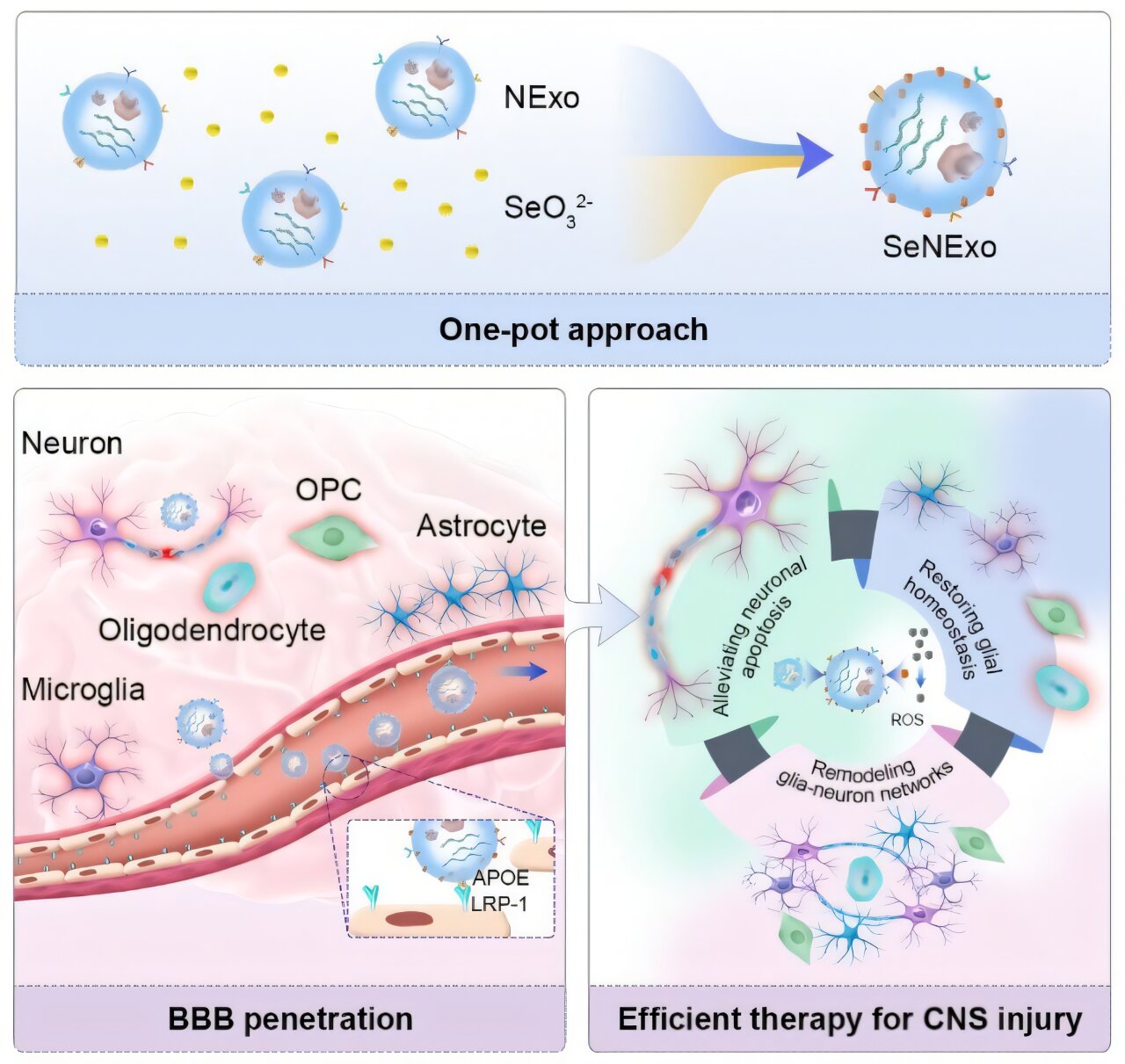
This treatment can alleviate neuronal apoptosis, restore glial homeostasis, and remodel glia-neuron networks, offering potent therapeutic benefits in murine (mouse) TBI and SCI models.
The study is published in Cell Reports Medicine.
Understanding that NSC therapy involves cell-to-cell communication via exosomes—nanosized vesicles secreted by cells, including NSCs—the researchers proposed using NSC-derived exosomes (NExo) to treat CNS injury, since the exosomes are stable and remain medically active in the pathological microenvironment.
The researchers also understood that exosome-based therapy was needed to address oxidative damage caused by reactive oxygen species (ROS) in the microenvironment.
Inspired by selenium’s capacity to scavenge ROS, the researchers developed an advanced NExo containing ultrasmall nano-selenium (~3.5 nm) via lipid-mediated nucleation (SeNExo).
Prof. Ma Guanghui from IPE said that SeNExo penetrated the BBB via the APOE_LRP-1 interaction after intravenous injection. Upon efficiently reaching the lesion site, the ultrasmall nano-selenium effectively scavenged ROS, while NExo promoted neuronal repair.
In a mouse TBI model, SeNExo reduced cerebral lesions and improved spatial learning and memory functions. Through proteomics, miRNA omics, and single-nucleus RNA sequencing, the researchers demonstrated that SeNExo significantly downregulated the expression of genes related to oxidative stress and apoptosis in neurons.
In addition, SeNExo profoundly altered the transcriptional program of inflammatory responses, promoting glial cells toward homeostasis. Moreover, SeNExo enhanced neuron-glia ligand-receptor pairs involved in CNS development while suppressing those associated with inflammation and astrogliosis. In a mouse SCI model, SeNExo also promoted locomotor recovery.
Both Prof. TAN Hui from Shenzhen Children’s Hospital and LI Weiping from Shenzhen Second People’s Hospital support the concept that SeNExo is a novel and promising therapeutic agent for treating traumatic CNS injury.
One peer reviewer from Cell Report Medicine said that the study provides convincing evidence that SeNExo can protect the brain following TBI and potentially SCI.
Prof. Wei Wei from IPE said that SeNExo offers excellent biocompatibility and stability. He also noted that its potent therapeutic efficacy and safety highlight its promising translational potential for developing clinically relevant CNS injury treatments.
More information:
Selenized neural stem cell-derived exosomes: a neotype therapeutic agent for traumatic injuries of the central nervous system, Cell Reports Medicine (2025). DOI: 10.1016/j.xcrm.2025.102319. www.cell.com/cell-reports-medi … 2666-3791(25)00392-1
Citation:
Tiny selenium-packed exosomes help heal brain and spinal cord damage in mice (2025, August 28)
retrieved 18 September 2025
from https://phys.org/news/2025-08-tiny-selenium-exosomes-brain-spinal.html
This document is subject to copyright. Apart from any fair dealing for the purpose of private study or research, no
part may be reproduced without the written permission. The content is provided for information purposes only.