
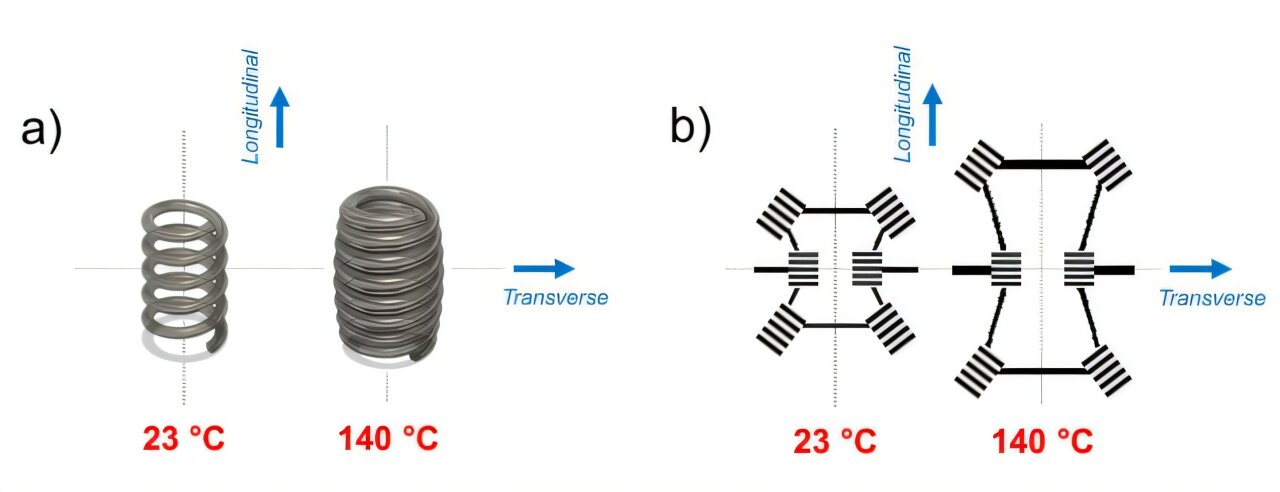
Researchers from the Skoltech Engineering Center’s Hierarchically Structured Materials Laboratory, in collaboration with colleagues from MISIS University and the Joint Institute for Nuclear Research, have for the first time observed nanoscale transformations in ultra-high molecular weight polyethylene—a material possessing a shape memory effect—in real time.
The scientists demonstrated that the key structural changes occur at a temperature of around 80°C, which is precisely the trigger for the material’s shape recovery process. These findings pave the way for creating materials that can effectively respond to external stimuli by rapidly returning to their original shape.
The study was published in the Physical Mesomechanics journal.
Ultra-high molecular weight polyethylene is known for its record strength, wear resistance, and biocompatibility. However, an equally important property is its ability to “remember” its original geometry: After deformation, a product made from it returns to its shape upon heating.
This effect is the basis for promising technologies—from artificial muscles and self-deploying structures to smart implants. Yet, the molecular and nanostructural mechanisms triggering shape recovery had not been fully understood.
To address this, the team conducted a unique experiment: they heated a sample of a self-reinforced composite based on ultra-high molecular weight polyethylene fibers to 140°C directly within an X-ray beam, simultaneously recording both small-angle and wide-angle X-ray scattering. This allowed them to track the reorganization of the crystalline and amorphous phases with nanometer resolution in real time.
It was discovered that at around 80°C, sharp changes begin to occur in the material along the fiber direction. The size of the nanostructures increases jump-wise by 1.5 times, and the dimensionality parameter changes by 10%.
No similar changes were recorded in the transverse direction. It was thus proposed that the driving force behind the shape memory effect is the “straightening” and rearrangement of the flexible amorphous chains, which, like a compressed spring, return to their initial state upon heating.
Understanding the fundamental mechanisms of shape memory opens the path to creating new polymer materials with tailored properties. Engineers will be able to more precisely program the activation temperature and recovery force for specific applications—from microscopic medical implants that unfold inside the body upon reaching body temperature, to powerful actuators for humanoid robots and energy harvesting systems.
“Our experiment is like shooting an ultra-slow-motion video of how the material’s invisible nanostructure ‘comes to life’ and starts moving upon heating,” says the study’s first author, Research Scientist Evgeny Statnik at the Skoltech Engineering Center’s Hierarchically Structured Materials Laboratory.
“We didn’t just record the changes—we linked them directly to the material’s macroscopic property. Now we can propose, not empirically but in a targeted way, how to modify the polymer’s structure to achieve the desired shape memory effect.”
More information:
E. S. Statnik et al, In Situ SAXS-WAXS Temperature Evolution Study of the Nanostructure of Self-Reinforced Ultrahigh Molecular Weight Polyethylene, Physical Mesomechanics (2025). DOI: 10.1134/s1029959924601490. On Preprints.org doi.org/10.20944/preprints202311.0594.v1
Citation:
Scientists see shape memory activation in ‘smart’ plastic (2025, October 1)
retrieved 1 October 2025
from https://phys.org/news/2025-10-scientists-memory-smart-plastic.html
This document is subject to copyright. Apart from any fair dealing for the purpose of private study or research, no
part may be reproduced without the written permission. The content is provided for information purposes only.