
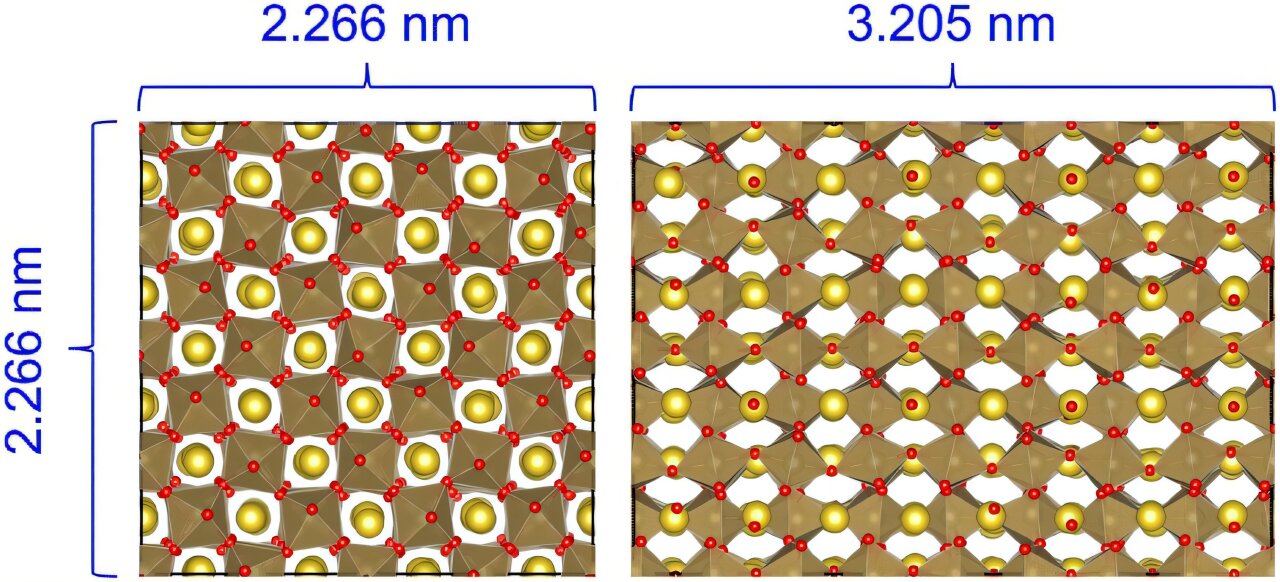
In a study appearing in Physical Chemistry Chemical Physics, researchers used quantum-chemical molecular dynamics simulations to visualize the ultrafast formation of polarons—charge carriers stabilized by lattice distortion—in NaTaO3, a key photocatalyst for solar water splitting.
The study revealed that positive charge carriers (hole polarons) stabilize rapidly and significantly (by about 70 meV) within 50 femtoseconds, a process driven primarily by the elongation of oxygen-tantalum (O-Ta) bonds. This atomistic, real-time understanding shows that hole stabilization is much stronger than that of electron polarons, providing crucial insights for rationally designing highly efficient solar fuel catalysts.
Generating hydrogen fuel using sunlight and water via photocatalysis is a globally important strategy for achieving carbon-free energy utilization. Photocatalysts, such as the archetypical perovskite oxide NaTaO3, absorb light to create reactive charge carriers (holes and electrons) that drive the water splitting reaction.
For high efficiency, these carriers must maintain their reactivity and lifetime, often achieved through polaron formation—where the charge carrier induces structural distortion in the crystal lattice to stabilize itself. However, observing these atomistic, ultrafast dynamics, which occur on the femtosecond scale, has been a major experimental hurdle.
To overcome these experimental limitations, the research team employed a computational approach using Born-Oppenheimer molecular dynamics (BOMD) simulations coupled with an accelerated quantum chemical method called divide-and-conquer density-functional tight binding (DC-DFTB).
This methodology allowed for the real-time tracking of atomic dynamics and associated changes in electronic structure simultaneously within a large, nanoscale model of pristine NaTaO3 containing 256 formula units. Simulations were performed with a 1 femtosecond time interval to observe the complete polaron formation process.
The simulations revealed that the charge carriers are only weakly localized across nanoscale spatial regions, a distribution attributed to structural disorder from thermal fluctuations. Positive hole polarons underwent rapid and significant stabilization of approximately 70 meV within 50 femtoseconds.
This stabilization proceeds via a two-step mechanism: the hole first localizes to a region with incidentally long O-Ta bonds and then further elongates those bonds in the relaxation process.
In stark contrast, negative electron polarons were found to be more delocalized, showed insignificant stabilization energy change, and their minor structural deformation was primarily dominated by thermal fluctuations.
This research delivers crucial, time-resolved mechanistic details on the fundamental processes governing charge carrier utilization in NaTaO3, providing a firm computational foundation that aligns qualitatively with previous time-resolved experimental observations of trapped carriers.
The finding that strong hole stabilization energy is synchronized with the O-Ta bond length change is vital for engineering new materials.
These results accelerate the rational design of highly active heterogeneous photocatalysts by suggesting that future material modification—specifically altering the B-site chemistry in perovskites—should focus on controlling O-Ta bonding to optimize hole polaron dynamics for superior solar fuel production.
More information:
Hiroki Uratani et al, Quantum-chemical molecular dynamics study of polaron formation in perovskite NaTaO3 as a water-splitting photocatalyst, Physical Chemistry Chemical Physics (2025). DOI: 10.1039/d5cp01859e
Citation:
Positive charge carriers stabilize instantly in key solar fuel catalyst (2025, September 30)
retrieved 1 October 2025
from https://phys.org/news/2025-09-positive-carriers-stabilize-instantly-key.html
This document is subject to copyright. Apart from any fair dealing for the purpose of private study or research, no
part may be reproduced without the written permission. The content is provided for information purposes only.