

A new elastic calcium phosphate material that closely resembles the structure of human bone has been successfully created by a research team from the Department of Orthopedics and Traumatology at the University of Hong Kong’s LKS Faculty of Medicine (HKUMed). The research findings’ efficacy and scientific validity were highlighted in Nature Communications.
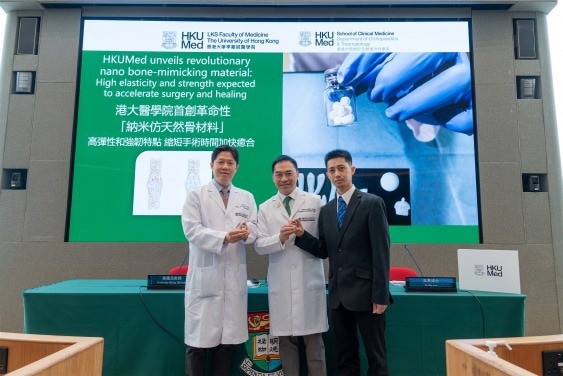
The material, known as ‘nano bone cement,’ presents a viable substitute for conventional bone transplants in orthopedic procedures, which usually involve obtaining tissue from the patient or a donor. According to research and experimental findings, this novel bone material speeds up the healing process in cases of bone defects and offers strong mechanical support.
The team intends to use this method to repair massive segmental bone defects, potentially accelerating patient recovery and obtaining optimal results.
Current Challenges in Large Segmental Bone Defect Surgery
Professor Kelvin Yeung Wai-kwok, Ng Chun-man Professor in Orthopedic Bioengineering at HKUMed and project leader of the study, stated that treating large segmental bone defects typically necessitates bone grafting. This frequently involves autografts from the patient’s own bone or allografts (donated bones), which are scarce and pose significant risks.
Autografts can cause difficulties and even collapse at the donor site, and also carry the risk of infection and immune rejection.
Traditional calcium phosphate bone materials are created by combining calcium and phosphorus powders with a liquid solution, which results in a hardened solid via a self-setting process.
This material closely resembles the composition of natural bone, offering excellent safety and biocompatibility. Moreover, it can be freely shaped before hardening, making it one of the most promising options for bone repair.
Dr. Wu Jun, Affiliated Associate Professor, Orthopedic Medical Centre, University of Hong Kong-Shenzhen Hospital
Traditional calcium phosphate artificial bone materials provide stiffness, but their compressive strength is lower than human cortical bone. Their lack of elasticity renders them prone to fracture in therapeutic settings, and they struggle to adjust to slight deformations during everyday activities, which can lead to structural collapse and treatment failures.
These restrictions limit the effectiveness and safety of current bone graft methods, emphasizing the importance of developing elastic bone materials to enhance the success rate of large segmental bone repair.
Revolutionary Triple ‘High Performance’ Nano Material
To overcome the limitations of conventional calcium phosphate bone materials, the HKUMed research team used nano-cluster anchoring technology to successfully merge the mechanical features of organic, flexible, and inorganic, stiff materials.
This achievement produced a novel ‘nano-artificial bone material’, calcium phosphate cement (CPC), with high flexibility, toughness, and strength.
Our goal is to mimic the structure of natural bone, and this innovative nanomaterial closely resembles human bone. Its mechanical properties are closer to those of natural bone, thus enhancing patient comfort and mobility. It can be shaped into any form before the hardening stage, making it particularly suitable for repairing irregularly shaped or complex bone defects.
Kelvin Yeung Wai-kwok, Ng Chun-man Professor, Orthopaedic Bioengineering, Department of Orthopaedics and Traumatology, School of Clinical Medicine, University of Hong Kong
Using the material’s ability to expand in volume after absorbing water, researchers created a novel form of elastic microsphere capable of automatically replacing bone defects. This invention simplifies surgical procedures and increases treatment efficiency.
The new nanomaterial maintains maximum compressive strength after absorbing water and exhibits excellent elasticity, a property not found in current bone material. It forms a porous structure that promotes cell adhesion and integration with the material, supporting bone tissue regeneration. This advancement will benefit more patients, offering them new hope for returning to a normal life.
Kelvin Yeung Wai-kwok, Ng Chun-man Professor, Orthopaedic Bioengineering, Department of Orthopaedics and Traumatology, School of Clinical Medicine, University of Hong Kong
Professor Wong Tak-man, Clinical Professor at the Department of Orthopedics and Traumatology, School of Clinical Medicine, HKUMed, believes that this innovative material will have several applications in orthopedic treatment.
The new technology significantly simplifies surgical procedures and reduces overall operation time. The material demonstrates exceptional strength, toughness, and superior biocompatible properties. Apart from filling defects in complex orthopedic surgeries, it can provide stability and promotes bone healing. It offers a more flexible, safe, and efficient solution for orthopedic and reconstructive surgery. Last but not least, it can expand its application in neurosurgery and dentistry in the near future.
Wong Tak-man, Clinical Professor, Department of Orthopedics and Traumatology, School of Clinical Medicine, University of Hong Kong
The National Key R&D Program of China, the Health and Medical Research Fund, and the Shenzhen Science and Technology Innovation Commission Research Fund were among the several funding sources that supported this study.
Journal Reference:
Liu, F. et.al. (2025) Inorganic-organic hybrid metamaterials with switchable high stiffness and elasticity. Nature Communications. doi.org/10.1038/s41467-025-59662-w.
Source: