
During a procedure known as laser lithotripsy, urologists use a small, video-guided laser to blast painful, potentially damaging kidney stones to smithereens. It’s better for the patient if urologists can break kidney stones down as finely as possible, ideally to a dust that can be safely suctioned out—but using more powerful lasers creates additional heat that can damage surrounding tissue and hurt the patient.
“Obviously, you don’t want to overpump the energy into your kidney, because that’s something that’s very dangerous,” said University of Chicago Pritzker School of Molecular Engineering (UChicago PME) Asst. Prof. Po-Chun Hsu. “What we demonstrate in our work is a way to better utilize the laser energy that is already being employed.”
Hsu has co-authored a new paper published in Advanced Science, the result of a collaboration of engineers and doctors from UChicago PME and Duke University who have pioneered a way to improve lasers’ efficiency on kidney stones, without changing the lasers. This work could result in shorter surgeries, faster recoveries, and less recurrence of a disease that affects 11% of Americans and raised national health spending more than $2 billion in 2000 alone.
“This is a classical example of how connecting dots can create something that’s transformative,” said Hsu, whose research mostly involves heat-reflective construction materials and fabrics.
Co-author Michael Lipkin, a urologist at Duke Health, described the collaboration between engineers and doctors as an opportunity for both.
“It’s a great opportunity as a clinician to be able to partner with world-class research scientists to attack a problem that has direct benefits for our patients,” Lipkin said. “These types of partnerships are fertile ground for great ideas that change the world.”
A solution in solution
To improve a laser’s performance without altering the laser itself, the interdisciplinary team required an innovative solution; an innovative saline solution.
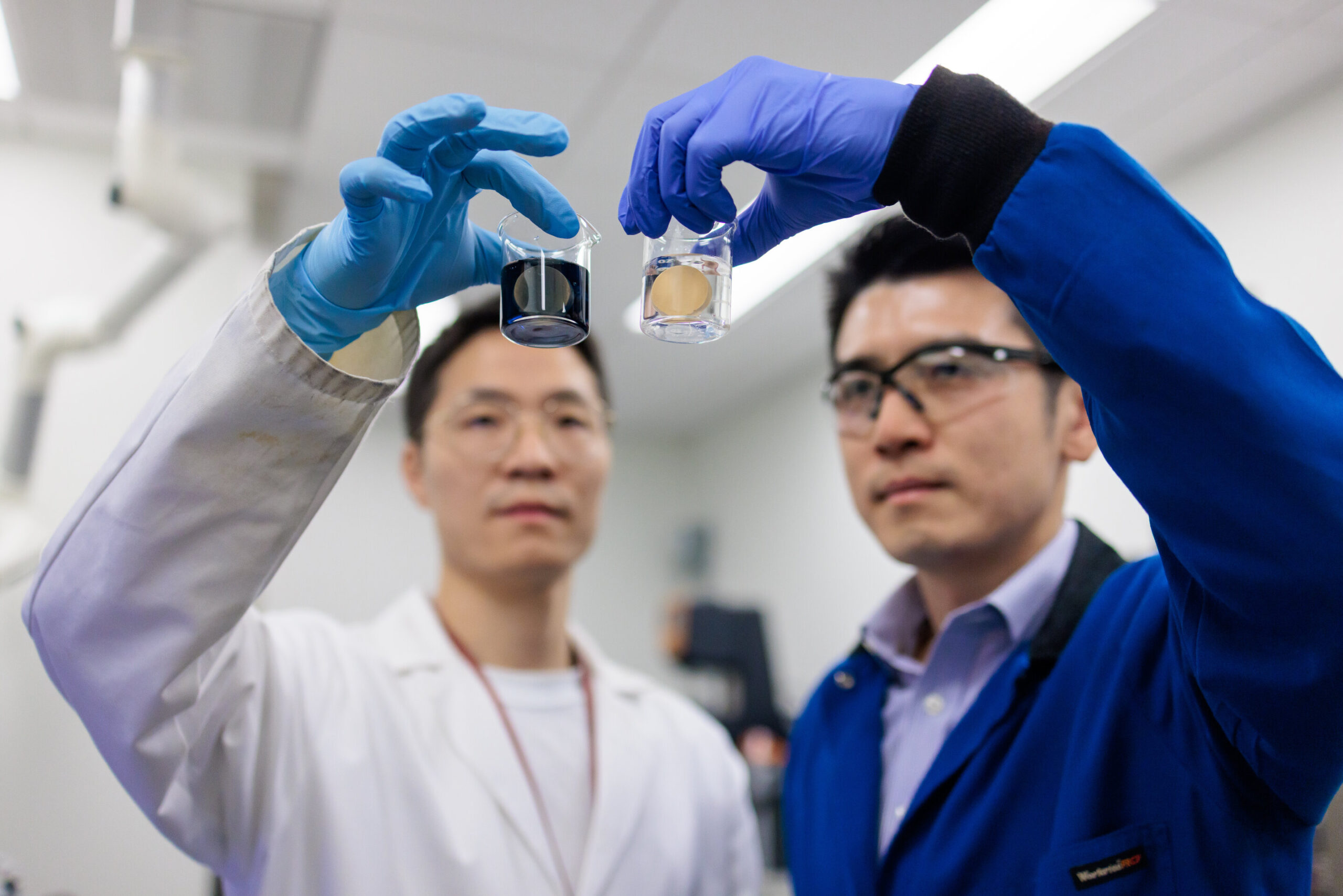
Doctors use saline—mildly salty water—to distend the hollow part of the kidney and maintain visibility during the procedure. Much of the laser energy is typically dissipated in the saline in the form of heat. The researchers found adding dark nanoparticles that absorb laser wavelengths to this saline solution keeps the laser focused on the stone, rather than reflecting or dissipating away.
This improves how much laser energy is transmitted to and absorbed by the kidney stones, a feature many believed couldn’t be easily manipulated, said corresponding author Prof. Pei Zhong of Duke University Engineering.
“Each laser has its own inherent wavelength based on the technology by which the laser was generated. People thought, “If the wavelength is fixed, you cannot change the absorption of the laser in the working fluid or in the stone that you’re trying to target,” Zhong said. “Nanofluid brings a new dimension, independent of the stone composition, independent of the laser, that can affect this very complex physical procedure.”
But not every nanofluid is appropriate for a medical procedure, said first author Qingsong Fan, a postdoctoral researcher at UChicago PME.
“First of all, the solution should be absorptive at the wavelengths of the laser, which is around 2,000 nanometers or two micrometers,” Fan said. “The second criterion is that the nanoparticles should disperse well in water because that’s how we irrigate the kidney. And the third one—and the most important criterion—is that it should be safe.”
Tests on lab-grown kidney stones revealed that the team hit all three marks. The nanofluid improved stone ablation efficiency by 38–727% in spot treatment and 26–75% in scanning treatment. Immersing living cells in the nanofluid for various durations up to 24 hours demonstrated that the effective nanoparticle solution was also nontoxic and safe.
In practice, however, this material will never be in contact with cells for nearly that long. Lithotripsy is an outpatient procedure that lasts about 30 minutes. Hsu hopes that improving the absorption efficiency could cut that time down to 10 minutes.
“If you spend too much time in this surgery, then waste heat from the laser will accumulate, and that’s actually going to be more harmful than the ablation itself,” Hsu said.

Different stones, different lasers
The study focused on holmium:yttrium-aluminum-garnet (Ho-YAG) lasers and lab-grown kidney stones. The gold standard for laser lithotripsy, Ho-YAG is by far the most common—but far from the only—type of laser used.
“Some lasers perform well in dusting, other lasers perform better in fragmenting, but no laser can perform exceptionally well both in dusting and fragmenting,” Zhong said. “Unless you are at a major hospital like the University of Chicago or Duke, community doctors may not be able to afford multiple lasers. Nanofluid has the potential to enhance the performance of each laser under different clinical scenarios.”
Next steps include testing to see how their new technique works using other common lithotripsy lasers and how it impacts real—rather than lab-grown—kidney stones.
Co-author Christine Payne, Donald M. Alstadt Chair of the Thomas Lord Department of Mechanical Engineering and Materials Science at Duke University, called the research “a good example of how fundamental research gets translated into clinical applications.”
“One of the most exciting aspects of this research is how a team of scientists and clinicians worked together using their own expertise to address an important question—how to better treat kidney stones,” Payne said.
More information:
Qingsong Fan et al, Nanofluid‐Enhanced Laser Lithotripsy Using Conducting Polymer Nanoparticles, Advanced Science (2025). DOI: 10.1002/advs.202507714
Citation:
Nanoparticle solution helps lasers pulverize kidney stones with improved efficiency (2025, October 28)
retrieved 29 October 2025
from https://phys.org/news/2025-10-nanoparticle-solution-lasers-pulverize-kidney.html
This document is subject to copyright. Apart from any fair dealing for the purpose of private study or research, no
part may be reproduced without the written permission. The content is provided for information purposes only.