
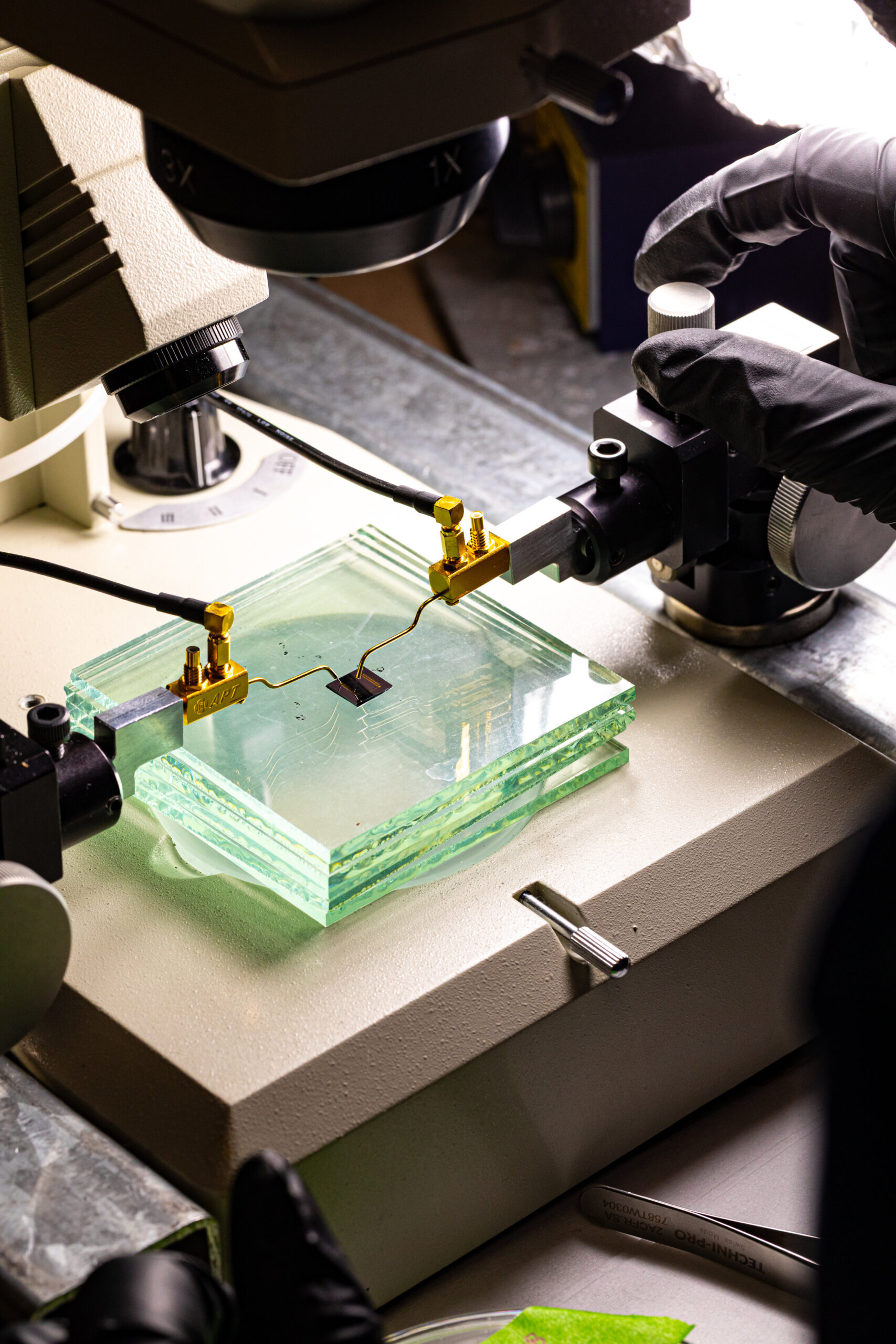
Researchers at the University of Arkansas and the University of Michigan have reported the first use of ultra-low power temperature sensors using graphene-based solar cells. The test is the first hurdle in developing autonomous sensor systems that draw power from multiple sources in the environment—solar, thermal, acoustic, kinetic, nonlinear and ambient radiation.
The work is published in the journal Journal of Vacuum Science and Technology B.
The end goal is development of multi-modal sensors (incorporating more than one of the above power sources) using the energy-harvesting capability of graphene that can last decades and helps realize the Internet of Things, in which smart technology is woven into the fabric of daily life.
Ashaduzzaman, a Ph.D. candidate in physics, is the first author on the U of A-led paper, but graphene energy harvesters are the brainchild of physics professor Paul Thibado, who began studying graphene’s unique properties more than a decade ago and is the corresponding author.
Success depended on overcoming two challenges:
- Reducing sensor power demand to nanowatts, a billionth of a watt, as opposed to the current standard, which is measured in microwatts (a millionth of a watt) and
- powering the sensor using energy harvested from the local environment.
Notably, this system and those expected to follow do not include batteries, which have a limited lifespan, allowing graphene-based energy harvesters to achieve long operational lifetimes—potentially decades.
“Power has to be drawn from the local environment,” Thibado explained, “so it’s self-powered and autonomous, and it has to have an extremely long operational lifetime to dramatically reduce the total cost of ownership. So set it and forget it.”
The U of A team was largely responsible for completing the second challenge above, while the University of Michigan team, led by David Blaauw, a professor of electrical engineering and computer science, was largely responsible for the first. Blaauw is an expert in low-power wireless sensors and embedded systems. He has even designed tiny sensors that can be planted in the wings of a butterfly.
The paper confirms that it’s possible to create an ultra-low power temperature sensor using graphene-based solar energy.
“We thought if we could remove the power management unit, maybe this sensor system would take an even smaller amount of power,” Ashaduzzaman explained. “So that is what we did. Then we connected three sets of solar cells to power the temperature systems directly with three storage capacitors.”
Thibado added, “We anticipate building devices that harvest multiple sources of energy within that device.”
By making them “multi-modal,” intermittent shortages in solar power can be augmented with additional thermal or non-linear power, whatever the case may be.
Thibado foresees the sensors being used in areas and fields where sensors would be useful, but the need to replace batteries would make them labor and cost prohibitive. This could include use in things like agricultural climate monitoring, tracking livestock, wearable fitness monitoring, building alarm systems, predictive maintenance and a wide range of other applications.
The abstract of the paper describes the work in plain language, stating that the researchers “built dozens of graphene-based solar cells, wire bonded them into standard packages and characterized the current-voltage characteristics of each under illumination. Next, solar cells were connected in series to increase the output voltage. Three different sets of solar cells were used to charge three storage capacitors to the voltage levels required by [the] temperature sensor.
“The storage capacitors require only a few minutes to charge, yet power the sensor system for more than 24 hours without recharging. Using storage capacitors also eliminates the need for a typical power management chip and the commonly used rechargeable battery. As a result, one can lower the overall power consumed by the sensor system and significantly extend its useful life,” says the abstract.
Co-authors from the U of A also included Syed M. Rahman, Md R. Kabir and James M. Magnum, all doctoral students. Co-authors from the University of Michigan included Hung Do and Gordon Carichner, in addition to Blaauw.
Ashaduzzaman said he has been working on the temperature sensor for about a year and a half. He said the next step is to perfect a kinetic energy harvester that harvests energy from the unique vibrational qualities of graphene. This capability will then be joined with the solar sensor, creating a multi-modal sensor. At least, that is the plan.
More information:
Ashaduzzaman et al, Array of mini-graphene-silicon solar cells intermittently recharges storage capacitors powering a temperature sensor, Journal of Vacuum Science & Technology B (2025). DOI: 10.1116/6.0004618
Citation:
First graphene-based solar cells used to power temperature sensors (2025, November 12)
retrieved 13 November 2025
from https://phys.org/news/2025-11-graphene-based-solar-cells-power.html
This document is subject to copyright. Apart from any fair dealing for the purpose of private study or research, no
part may be reproduced without the written permission. The content is provided for information purposes only.