

A recent study published in Advanced Functional Materials investigates how the phase behavior of formamidinium lead iodide (FAPbI₃) nanofillers impacts the properties of polyvinylidene fluoride (PVDF) films.
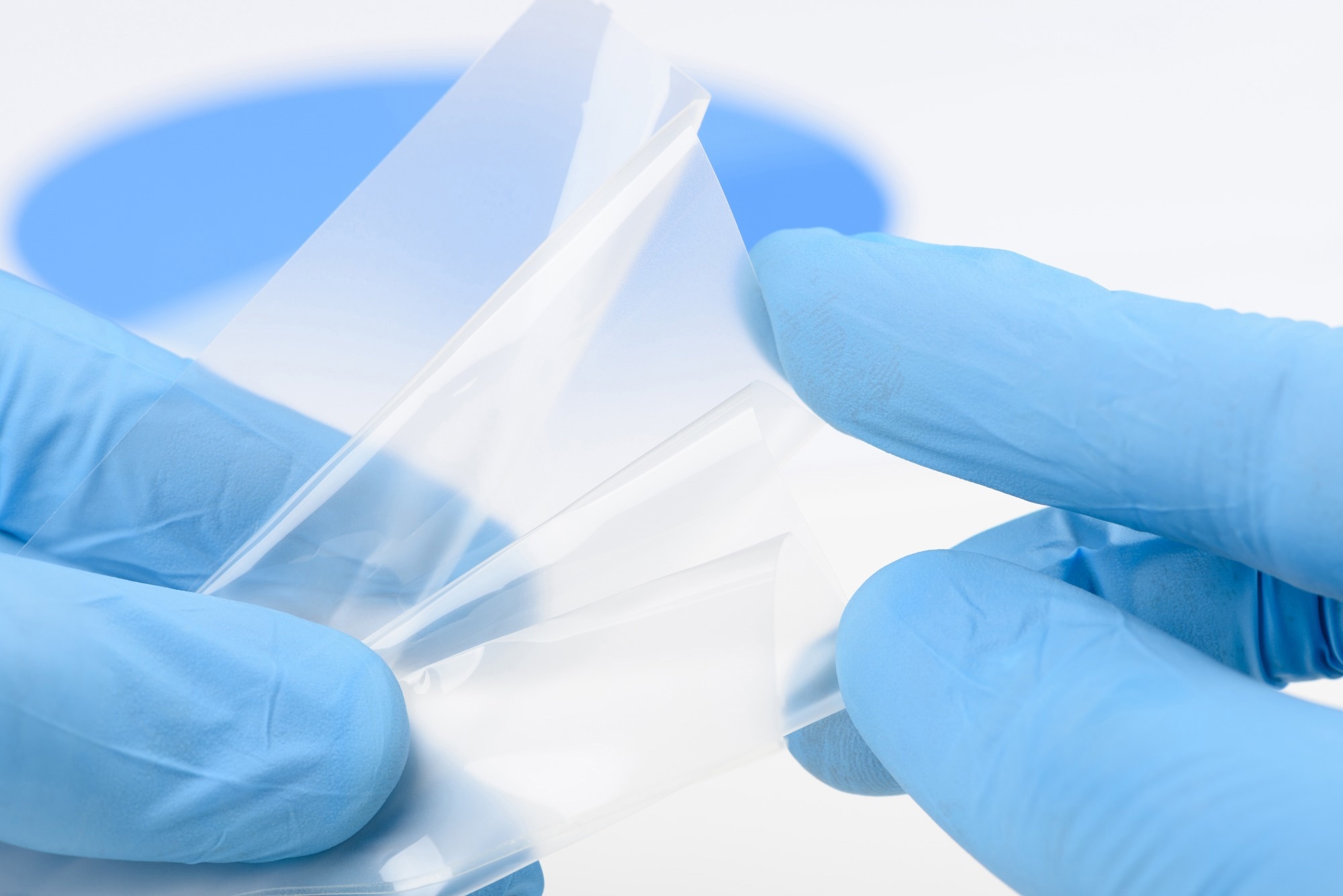 Image Credit: nevodka/Shutterstock.com
By integrating these nanofillers using a cost-effective 3D direct-ink writing (3D-DIW) technique, researchers achieved precise control over film architecture and nanomaterial distribution.
The goal? To use the polymorphism and surface chemistry of FAPbI₃ to develop high-performance, 3D-printed PVDF-based triboelectric nanogenerators (TENGs) for energy harvesting applications.
Background
As micro- and nanoscale electronic devices continue to advance, the need for compact, efficient, and sustainable energy sources grows. TENGs have become a promising solution, converting mechanical energy from everyday motions into electrical energy through contact electrification and electrostatic induction.
To improve TENG performance, researchers often look to enhance the properties of materials like PVDF, a polymer valued for its electroactive characteristics, especially in its β-phase, which supports strong polarization and high surface charge density. However, reliably producing PVDF films with a high β-phase content and optimal surface morphology remains a key challenge.
Recent studies show that incorporating nanofillers into PVDF can encourage phase transitions and structural changes that boost its triboelectric performance. Perovskite nanomaterials such as FAPbI₃ are particularly promising. These materials exhibit polymorphism, meaning they can exist in multiple crystal structures (notably δ and α phases), which interact with PVDF in ways that can significantly influence its crystalline phase and surface characteristics.
The Current Study
Researchers prepared PVDF composite films embedded with FAPbI₃ nanofillers using a 3D-DIW process. They began by formulating a printable ink—a mixture of PVDF dissolved in a suitable solvent combined with FAPbI₃ nanocrystal dispersions in either the δ or α phase.
The composite films were printed layer-by-layer onto substrates, followed by annealing at controlled temperatures to induce a phase transformation from δ to α in the FAPbI₃ nanocrystals. X-ray diffraction (XRD) confirmed this transformation, revealing structural shifts that influenced the film’s morphology and dielectric performance.
Surface chemical states were analyzed using X-ray photoelectron spectroscopy (XPS), providing insight into how the nanofillers affected surface composition.
Morphological analysis via field-emission scanning electron microscopy (FESEM) showed changes in porosity and the formation of mesoporous structures after annealing. Additional characterization using Fourier-transform infrared spectroscopy (FTIR) and Raman spectroscopy tracked phase content and chain conformations in PVDF.
Dielectric properties, including permittivity and surface potential, were measured to connect structural changes with triboelectric performance. The team also evaluated film durability, humidity and temperature stability, and scalability—successfully printing films up to 50 μm thick. Density functional theory (DFT) modeling offered further insight into the electronic interactions between PVDF and the nanofillers, highlighting how phase and surface chemistry shape charge transfer dynamics.
Results and Discussion
The phase of the FAPbI₃ nanofillers played a critical role in determining the PVDF composite’s structure and performance. When δ-phase nanocrystals were used, they promoted moderate increases in PVDF’s β-phase content due to the orthorhombic structure of the nanocrystals acting as nucleation sites. This enhanced electrostatic interaction between the nanofillers and the polymer chains.
Upon annealing to convert the nanocrystals into the α-phase (cubic and thermodynamically less stable), researchers observed significant changes in morphology. The films developed mesoporous structures, increasing surface area for charge accumulation. This structural evolution led to a substantial rise in β-phase content—up to 83 %, compared to around 45 % in pristine PVDF, confirmed through FTIR and XRD analyses.
The α-phase nanofillers also contributed to a more negative surface potential, indicating improved charge storage capabilities. FESEM imaging revealed a clear transition from porous to mesoporous architecture, and the impact on performance was notable: TENG devices made with α-phase composites reached peak-to-peak voltages of 392 V and power densities as high as 2587 μW cm−2, surpassing many previous reports.
Conclusion
This study shows that controlling the phase of perovskite nanofillers is a powerful strategy for tuning the dielectric and triboelectric properties of PVDF-based composites. The resulting TENGs demonstrated excellent performance, reliability under varying environmental conditions, and scalability, making them strong candidates for real-world energy harvesting applications.
This work integrates advanced materials like FAPbI₃ with 3D printing techniques, presenting a flexible and efficient approach to building next-generation power sources. The findings underscore the potential of polymorphic engineering within PVDF matrices to elevate triboelectric nanogenerator performance and support the growing demand for portable, sustainable energy solutions.
Journal Reference
Karimy NHZ., et al. (2025). Highly Efficient 3D-Printed PVDF-Based Triboelectric Nanogenerators Featuring Polymorphic Perovskite Nanofillers. Advanced Functional Materials. DOI: 10.1002/adfm.202424271, https://advanced.onlinelibrary.wiley.com/doi/10.1002/adfm.202424271