
Close Menu
  • News
    • Medical
    • Nanomaterials
    • AI & Robotics
    • 2D Materials
    • Metamaterials
    • Nanoelectronics
    • ETF’s
    • Medicine
  • Environment
    • Earth.com
    • TreeHugger
    • Nanomuscle
  • Beauty
    • Makeupanalysis
What's Hot

Nanotechnology Plus Medicine Equal NanoMedicine

February 3, 2026

Improving PPE’s Antimicrobial Efficacy with ZnO Nanoparticles

December 5, 2025

PI Introduces Next-Generation 6-Axis Nanopositioning Alignment System

December 4, 2025
Facebook X (Twitter) Instagram
  • Contact Us
  • Privacy Policy
  • Terms & Conditions
Facebook X (Twitter) Instagram
Elnano – Global Innovative Nanotechnology SolutionsElnano – Global Innovative Nanotechnology Solutions
  • News
    • Medical
    • Nanomaterials
    • AI & Robotics
    • 2D Materials
    • Metamaterials
    • Nanoelectronics
    • ETF’s
    • Medicine
  • Environment
    • Earth.com
    • TreeHugger
    • Nanomuscle
  • Beauty
    • Makeupanalysis
Elnano – Global Innovative Nanotechnology SolutionsElnano – Global Innovative Nanotechnology Solutions
Home » Electrified atomic vapor system enables new nanomaterial mixtures
Nanotech

Electrified atomic vapor system enables new nanomaterial mixtures

November 7, 2025No Comments3 Mins Read
Share
Facebook Twitter LinkedIn Pinterest Email
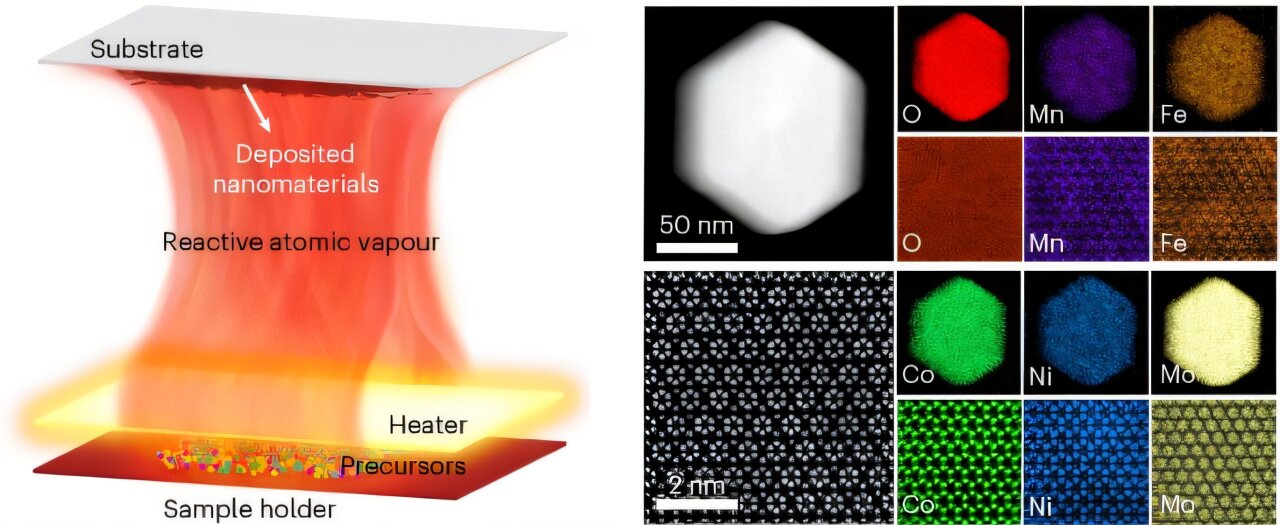
Credit: Nature Synthesis (2025). DOI: 10.1038/s44160-025-00914-4

Vapor-phase synthesis, a technique used to create very pure and scalable nanomaterials and coatings, has great promise for the electronic, optical, aerospace, energy and environment, and semiconductor industries.

Now, using a form of electrified vapor under atmospheric pressure, a team led by Yale’s Liangbing Hu has developed a system that’s more versatile, quicker and cheaper. The results are published in Nature Synthesis. The project is a collaboration with Prof. Yiguang Ju of Princeton University and Princeton Plasma Physics Laboratory. The study’s lead author, Xizheng Wang, a former postdoctoral researcher in Hu’s lab, is a professor at University of California Irvine.

Vapor-phase synthesis converts materials by vaporizing and then returning them to solid form, either as particles or as thin coatings. The challenge, though, is that doing so in atmospheric conditions and being able to control the properties of the final product is tricky. That’s partly because some materials have particularly high boiling points, which require the addition of complex, high-power systems, such as electron beams, plasma, and pulsed lasers.

These systems are costly to purchase and maintain. Further, to achieve optimal results, many conventional methods require vacuum pressure, which is also expensive and difficult to maintain.


Credit: Nature Synthesis (2025). DOI: 10.1038/s44160-025-00914-4

The Hu lab, though, has solved this through a new method they call electrified vapor deposition (EVD). Essentially, it uses an electrified carbon paper heater to quickly reach extremely high temperatures, which instantly vaporizes and dissociates the material and creates atomic vapor.

When this atomic vapor mixes with the surrounding argon gas (kept at room temperature), it rapidly cools and nucleates in a way that’s highly uniform. This results in pure nanomaterial products and thin films with excellent compositional and structural control. Critical to this method is that the system is specifically designed for continuous flow and rapid cooling of the vapor.

See also  Sensor platform uses nanopore 'speed cameras' to pinpoint gases in complex mixtures

The EVD system allows for the mixing of a wide range of materials that typically can’t be created using conventional means. It’s quick, low-cost, and can be used in atmospheric conditions without requiring vacuum systems and other expensive equipment.

More information:
Xizheng Wang et al, Electrified vapour deposition at ultrahigh temperature and atmospheric pressure for nanomaterials synthesis, Nature Synthesis (2025). DOI: 10.1038/s44160-025-00914-4

Provided by
Yale University


Citation:
Electrified atomic vapor system enables new nanomaterial mixtures (2025, November 6)
retrieved 7 November 2025
from https://phys.org/news/2025-11-electrified-atomic-vapor-enables-nanomaterial.html

This document is subject to copyright. Apart from any fair dealing for the purpose of private study or research, no
part may be reproduced without the written permission. The content is provided for information purposes only.


Source link

atomic Electrified enables mixtures nanomaterial System vapor
Share. Facebook Twitter Pinterest LinkedIn Tumblr Email

Related Posts

Improving PPE’s Antimicrobial Efficacy with ZnO Nanoparticles

December 5, 2025

PI Introduces Next-Generation 6-Axis Nanopositioning Alignment System

December 4, 2025

H.E. Máté Pesti’s Visit to Cubic Sensor and Instrument Co.

December 2, 2025

Nanostars Amplify SERS Signal and Boost Sensing

December 1, 2025
Add A Comment

Comments are closed.

Top Posts

Enhancing TENG Performance: PVDF and Perovskite Nanofillers

September 18, 2025

Nanoscale thermoelectric effects offer new perspectives on energy management

October 29, 2025

Ultra-Thin Filters Could Help Improve Production of Medicines and Dyes

October 24, 2025

Subscribe to Updates

Get the latest sports news from SportsSite about soccer, football and tennis.

Explore the future with our Nanotech blog—covering innovations, research, applications, and breakthroughs shaping science, medicine, and modern technology.

We're social. Connect with us:

Facebook X (Twitter) Instagram YouTube
Top Insights

Nanotechnology Plus Medicine Equal NanoMedicine

February 3, 2026

Improving PPE’s Antimicrobial Efficacy with ZnO Nanoparticles

December 5, 2025

PI Introduces Next-Generation 6-Axis Nanopositioning Alignment System

December 4, 2025

Subscribe to Updates

Get the latest creative news from FooBar about art, design and business.

  • Contact Us
  • Privacy Policy
  • Terms & Conditions

© 2026 elnano.com - All rights reserved.

Type above and press Enter to search. Press Esc to cancel.