
Plastic is ubiquitous in the modern world, and it’s notorious for taking a long time to completely break down in the environment—if it ever does.
But even without breaking down completely, plastic can shed tiny particles—called nanoplastics because of their extremely small size—that scientists are just now starting to consider in long-term health studies.
One of those scientists is Dr. Wei Xu, an associate professor in the Texas A&M College of Veterinary Medicine and Biomedical Sciences’ Department of Veterinary Physiology & Pharmacology. Xu’s current work is focused on what happens when nanoplastics interact with seawater, where they can pick up some curious hitchhikers in the form of chemicals and organic components.
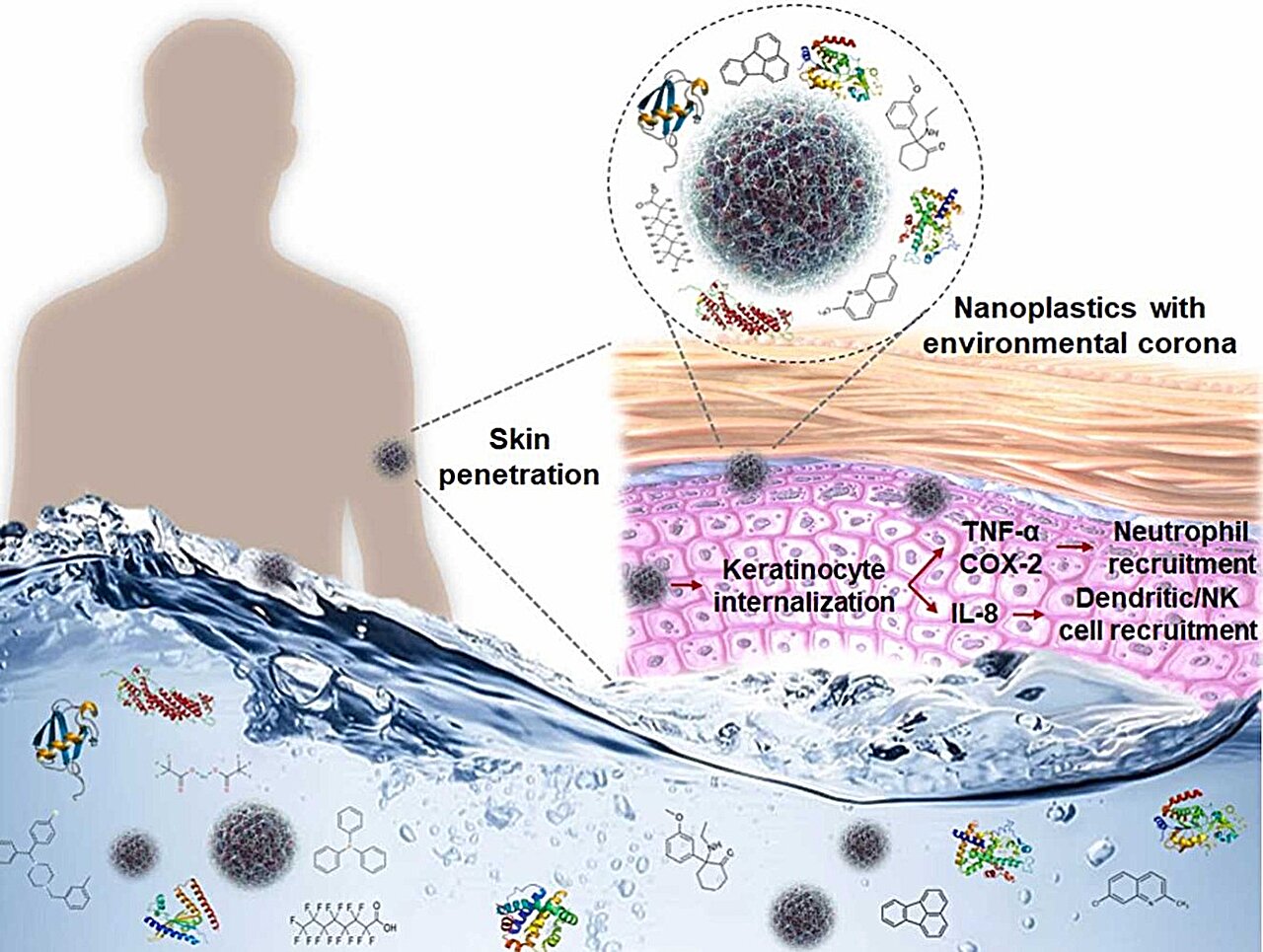
“When particles are released into the environment, they can interact with a lot of different materials that modify their surfaces, possibly including proteins, chemicals, and toxins,” Xu said. “Most people are concerned with what happens when you accidentally ingest nanoplastics, but our work looks at how they might be getting into the body through the skin and what they might be bringing with them.”
As they demonstrated in the Journal of Hazardous Materials, Xu and his team have discovered that nanoplastics with environmental coatings can sneak past some of the skin’s defenses at the microscopic level.
“We found that particles with the environmental coating accumulated in certain areas inside the cell and seemed successful at avoiding its ‘garbage disposal’ system, which might try to kill or expel them,” Xu said. “It’s like they’re wearing camouflage that allows them to stay inside the cell longer.”
While the long-term health consequences of nanoplastics in the body are still being studied, Xu’s research highlights the importance of the skin as a target for nanoplastics and the ability of the environment to alter particles before they’re absorbed by the body.
“While the nanoplastics themselves are a health concern, we also want to better understand these environmental coatings and what those may do once inside the body,” Xu said.
Tiny beads, big discoveries
To understand how nanoplastics affected by the environment enter the skin, Xu and his team created their own nanoplastic beads augmented by ocean water.
“There are vendors that produce nanoplastic particles for scientific research, but these particles have never been out in the environment,” Xu said. “So, before we conducted the toxicity assessment, we used water collected from the ocean off the coast of Corpus Christi.”

After letting the particles interact with the seawater for one to two weeks, Xu and his team were able to analyze the particles’ environmental coatings to see what kind of changes occurred. Then, they tested how the particles make their way inside cultured skin cells.
“We had conducted previous research using plain nanoplastic beads that showed how they induce a reaction from skin cells,” Xu said. “It was significant seeing how the beads with environmental coatings were better able to avoid the attack by the immune system.”
Tackling a complex problem
Xu’s research on the skin and environmental effects of particles is helping scientists understand that some of the trickiest problems in toxicology are even more complex than they had previously realized.
“In our research, we had to focus on a specific type of environmental coating, so we looked at proteins,” Xu said. “But what about those from algal blooms or other toxins? What happens when there are floods and water mixes with other contaminants? We haven’t had the chance to explore how these things intersect yet.”
Even if researchers do find solutions to preventing absorption of nanoplastics with certain kinds of environmental coatings, there’s no guarantee that those will continue to work.
“What if the environment is totally changed in 10 or 20 years and there are different coatings on the particles? We may have to keep coming up with new strategies to control them,” Xu said.
The first step, according to Xu, is for there to be better standardization for research on nanoplastic particles, which he hopes his research will help drive forward.
“I’ve had students look at publications on the same particle and find different results because other researchers aren’t required to consider environmental coatings,” he said. “We need better consistency for the long term.”
Another step is to fully analyze all the coating types that Xu and his team found in their study of seawater.
“We’ve already had people ask us about other types of coatings besides proteins,” he said. “It will be a lot of work, but it’s critical if we’re to understand the full scope of the problem.”
More information:
Kayla Simpson et al, Environmental protein corona on nanoplastics altered the responses of skin keratinocytes and fibroblast cells to the particles, Journal of Hazardous Materials (2025). DOI: 10.1016/j.jhazmat.2025.138722
Citation:
Chemicals may be hitching a ride on nanoplastics to enter the skin (2025, October 17)
retrieved 17 October 2025
from https://phys.org/news/2025-10-chemicals-hitching-nanoplastics-skin.html
This document is subject to copyright. Apart from any fair dealing for the purpose of private study or research, no
part may be reproduced without the written permission. The content is provided for information purposes only.