
Using tiny particles shaped like bottlebrushes, MIT chemists have found a way to deliver a large range of chemotherapy drugs directly to tumor cells.
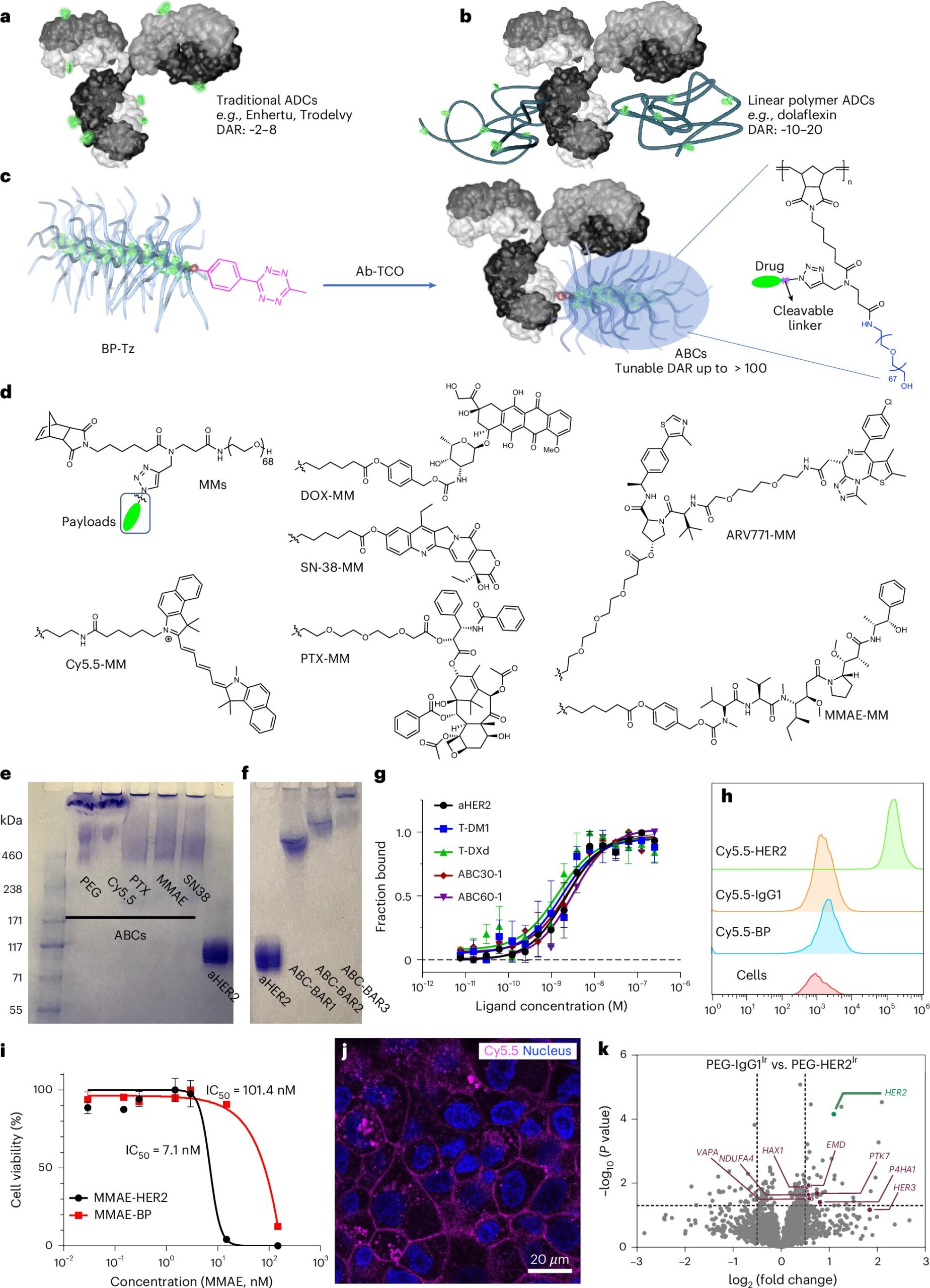
To guide them to the right location, each particle contains an antibody that targets a specific tumor protein. This antibody is tethered to bottlebrush-shaped polymer chains carrying dozens or hundreds of drug molecules—a much larger payload than can be delivered by any existing antibody-drug conjugates.
In mouse models of breast and ovarian cancer, the researchers found that treatment with these conjugated particles could eliminate most tumors. In the future, the particles could be modified to target other types of cancer, by swapping in different antibodies.
“We are excited about the potential to open up a new landscape of payloads and payload combinations with this technology that could ultimately provide more effective therapies for cancer patients,” says Jeremiah Johnson, the A. Thomas Geurtin Professor of Chemistry at MIT, a member of the Koch Institute for Integrative Cancer Research, and the senior author of the new study.
MIT postdoc Bin Liu is the lead author of the paper, which appears in Nature Biotechnology.
A bigger drug payload
Antibody-drug conjugates (ADCs) are a promising type of cancer treatment that consist of a cancer-targeting antibody attached to a chemotherapy drug. At least 15 ADCs have been approved by the FDA to treat several different types of cancer.
This approach allows specific targeting of a cancer drug to a tumor, which helps to prevent some of the side effects that occur when chemotherapy drugs are given intravenously. However, one drawback to currently approved ADCs is that only a handful of drug molecules can be attached to each antibody. That means they can only be used with very potent drugs—usually DNA-damaging agents or drugs that interfere with cell division.
To try to use a broader range of drugs, which are often less potent, Johnson and his colleagues decided to adapt bottlebrush particles that they had previously invented.
These particles consist of a polymer backbone that is attached to tens to hundreds of “prodrug” molecules—inactive drug molecules that are activated upon release within the body. This structure allows the particles to deliver a wide range of drug molecules, and the particles can be designed to carry multiple drugs in specific ratios.
Using a technique called click chemistry, the researchers showed that they could attach one, two, or three of their bottlebrush polymers to a single tumor-targeting antibody, creating an antibody-bottlebrush conjugate (ABC). This means that just one antibody can carry hundreds of prodrug molecules. The currently approved ADCs can carry a maximum of about eight drug molecules.
The huge number of payloads in the ABC particles allows the researchers to incorporate less potent cancer drugs such as doxorubicin or paclitaxel, which enhances the customizability of the particles and the variety of drug combinations that can be used.
“We can use antibody-bottlebrush conjugates to increase the drug loading, and in that case, we can use less potent drugs,” Liu says. “In the future, we can very easily copolymerize with multiple drugs together to achieve combination therapy.”
The prodrug molecules are attached to the polymer backbone by cleavable linkers. After the particles reach a tumor site, some of these linkers are broken right away, allowing the drugs to kill nearby cancer cells even if they don’t express the target antibody. Other particles are absorbed into cells with the target antibody before releasing their toxic payload.
Effective treatment
For this study, the researchers created ABC particles carrying a few different types of drugs: microtubule inhibitors called MMAE and paclitaxel, and two DNA-damaging agents, doxorubicin and SN-38. They also designed ABC particles carrying an experimental type of drug known as PROTAC (proteolysis-targeting chimera), which can selectively degrade disease-causing proteins inside cells.
Each bottlebrush was tethered to an antibody targeting either HER2, a protein often overexpressed in breast cancer, or MUC1, which is commonly found in ovarian, lung, and other types of cancer.
The researchers tested each of the ABCs in mouse models of breast or ovarian cancer and found that in most cases, the ABC particles were able to eradicate the tumors. This treatment was significantly more effective than giving the same bottlebrush prodrugs by injection, without being conjugated to a targeting antibody.
“We used a very low dose, almost 100 times lower compared to the traditional small-molecule drug, and the ABC still can achieve much better efficacy compared to the small-molecule drug given on its own,” Liu says.
These ABCs also performed better than two FDA-approved ADCs, T-DXd and TDM-1, which both use HER2 to target cells. T-DXd carries deruxtecan, which interferes with DNA replication, and TDM-1 carries emtansine, a microtubule inhibitor.
In future work, the MIT team plans to try delivering combinations of drugs that work by different mechanisms, which could enhance their overall effectiveness. Among these could be immunotherapy drugs such as STING activators.
The researchers are also working on swapping in different antibodies, such as antibodies targeting EGFR, which is widely expressed in many tumors. More than 100 antibodies have been approved to treat cancer and other diseases, and in theory, any of those could be conjugated to cancer drugs to create a targeted therapy.
More information:
Antibody–bottlebrush prodrug conjugates for targeted cancer therapy, Nature Biotechnology (2025). DOI: 10.1038/s41587-025-02772-z
This story is republished courtesy of MIT News (web.mit.edu/newsoffice/), a popular site that covers news about MIT research, innovation and teaching.
Citation:
‘Bottlebrush’ particles deliver big chemotherapy payloads directly to cancer cells (2025, September 9)
retrieved 20 September 2025
from https://phys.org/news/2025-09-bottlebrush-particles-big-chemotherapy-payloads.html
This document is subject to copyright. Apart from any fair dealing for the purpose of private study or research, no
part may be reproduced without the written permission. The content is provided for information purposes only.