
Close Menu
  • News
    • Medical
    • Nanomaterials
    • AI & Robotics
    • 2D Materials
    • Metamaterials
    • Nanoelectronics
    • ETF’s
    • Medicine
  • Environment
    • Earth.com
    • TreeHugger
    • Nanomuscle
  • Beauty
    • Makeupanalysis
What's Hot

Nanotechnology Plus Medicine Equal NanoMedicine

February 3, 2026

Improving PPE’s Antimicrobial Efficacy with ZnO Nanoparticles

December 5, 2025

PI Introduces Next-Generation 6-Axis Nanopositioning Alignment System

December 4, 2025
Facebook X (Twitter) Instagram
  • Contact Us
  • Privacy Policy
  • Terms & Conditions
Facebook X (Twitter) Instagram
Elnano – Global Innovative Nanotechnology SolutionsElnano – Global Innovative Nanotechnology Solutions
  • News
    • Medical
    • Nanomaterials
    • AI & Robotics
    • 2D Materials
    • Metamaterials
    • Nanoelectronics
    • ETF’s
    • Medicine
  • Environment
    • Earth.com
    • TreeHugger
    • Nanomuscle
  • Beauty
    • Makeupanalysis
Elnano – Global Innovative Nanotechnology SolutionsElnano – Global Innovative Nanotechnology Solutions
Home » A new bone substitute made out of 3D-printed glass
Medical

A new bone substitute made out of 3D-printed glass

September 24, 2025No Comments3 Mins Read
Share
Facebook Twitter LinkedIn Pinterest Email
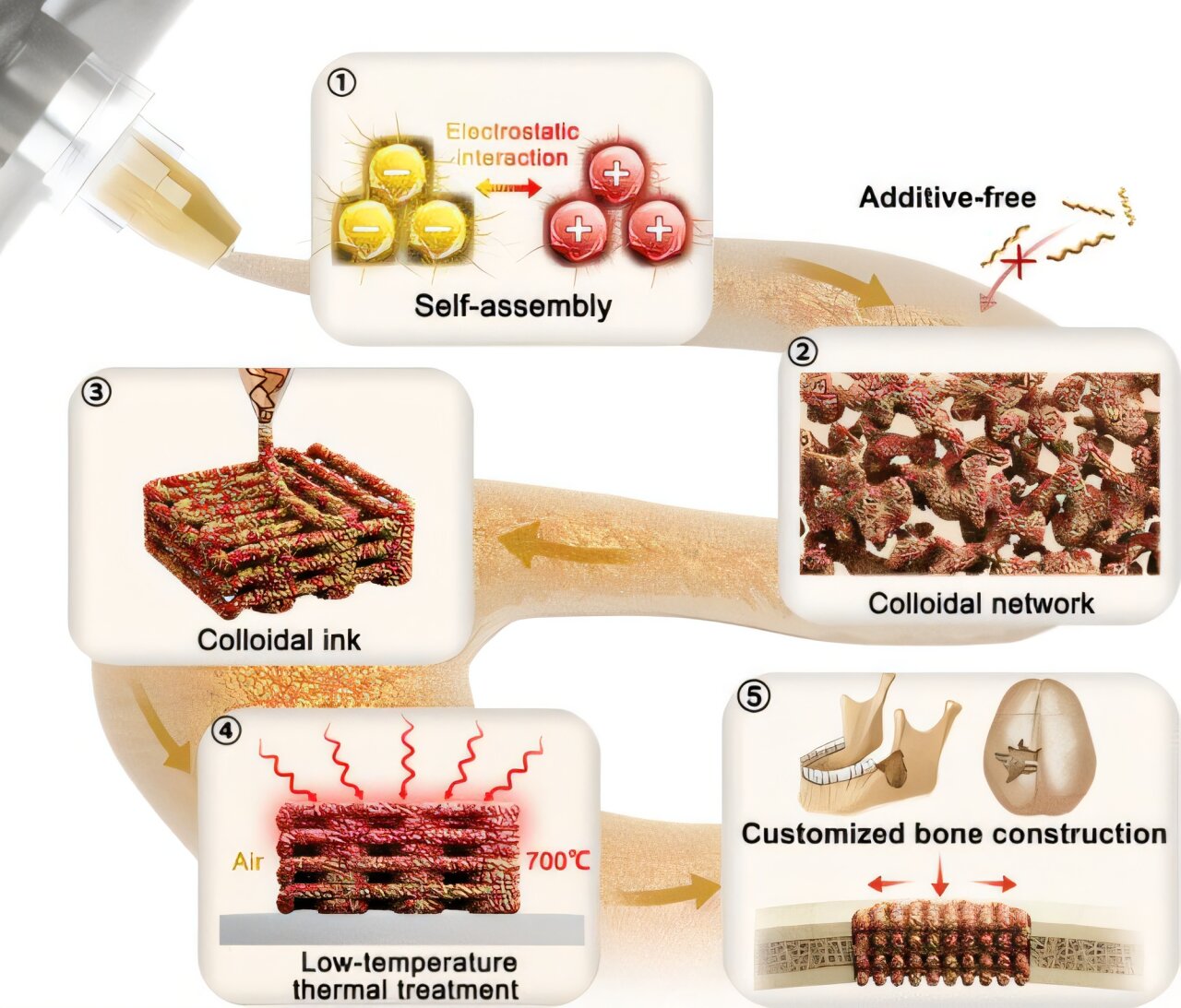
Credit: ACS Nano (2025). DOI: 10.1021/acsnano.5c06377

You might think that glass has no business acting as a replacement for bone, but it turns out the two materials have many similarities. For a new study published in ACS Nano, researchers developed a 3D printable bio-active glass that served as an effective bone replacement material. In rabbits, it sustained bone cell growth better than regular glass and a commercially available bone substitute.

Both bone and glass can bear weight better than they can withstand being stretched because of the crystalline structures of the molecules and minerals forming them. But unlike bone, the main ingredient in glass—silica—can exist in a liquid form and can be 3D printed into any desired shape, such as a perfect match to a missing section of bone. However, most 3D-printable glass requires toxic plasticizing agents, or the glass needs to be fused at temperatures higher than 2,000°F (1,100°C).

So, Jianru Xiao, Tao Chen, Huanan Wang and colleagues wanted to develop a 3D-printable glass that didn’t require plasticizers or extremely high temperatures to serve as a scaffold for bone-forming cells.

The researchers combined oppositely charged silica particles as well as calcium and phosphate ions—both known to induce bone cell formation—to form a printable, bio-active glass gel. After the glass was shaped with a 3D printer, it was hardened into its final shape in a furnace at a relatively cool 1,300°F (700°C). Next, they tested the new bio-glass against a 3D printed plain silica glass gel and a commercially available dental bone substitute by repairing skull damage in living rabbits.

Although the commercial product grew bone faster, the bio-glass sustained growth longer; after eight weeks, most bone cells present had grown on the bio-glass scaffold. The plain glass had barely any bone cell growth. The researchers say that this work demonstrates an easy, low-cost way to 3D print a bio-glass bone substitute, which could have wide-ranging applications across medicine and engineering.

See also  New Cooling Technique Could Make Bone Surgery Faster and Safer

More information:
Zhenzhen Dou et al, Rational Design of Purely Inorganic Self-Healing Colloidal Hydrogels To Enable “Green” 3D Printing of Bioglass-Based Bone Substitutes, ACS Nano (2025). DOI: 10.1021/acsnano.5c06377

Provided by
American Chemical Society


Citation:
A new bone substitute made out of 3D-printed glass (2025, September 23)
retrieved 24 September 2025
from https://phys.org/news/2025-09-bone-substitute-3d-glass.html

This document is subject to copyright. Apart from any fair dealing for the purpose of private study or research, no
part may be reproduced without the written permission. The content is provided for information purposes only.


Source link

3Dprinted Bone glass substitute
Share. Facebook Twitter Pinterest LinkedIn Tumblr Email

Related Posts

3D-Printed Plastic Sensor Could Make Siri a Better Listener

November 25, 2025

Green-synthesized zinc oxide nanoparticles from desert plants show broad antimicrobial activity

November 17, 2025

Genetically engineered virus acts as ‘smart sponge’ to extract rare earth elements from water

November 14, 2025

Magnetic nanoparticles that successfully navigate complex blood vessels may be ready for clinical trials

November 14, 2025
Add A Comment

Comments are closed.

Top Posts

Chitosan-hBN Films: Enhancing Sustainability and Performance

September 18, 2025

mRNA nanoparticles drive potent SARS-CoV-2 immunity in mice

October 18, 2025

Light-sensitive nanoparticles could serve as contrast agents for advanced imaging

September 23, 2025

Subscribe to Updates

Get the latest sports news from SportsSite about soccer, football and tennis.

Explore the future with our Nanotech blog—covering innovations, research, applications, and breakthroughs shaping science, medicine, and modern technology.

We're social. Connect with us:

Facebook X (Twitter) Instagram YouTube
Top Insights

Nanotechnology Plus Medicine Equal NanoMedicine

February 3, 2026

Improving PPE’s Antimicrobial Efficacy with ZnO Nanoparticles

December 5, 2025

PI Introduces Next-Generation 6-Axis Nanopositioning Alignment System

December 4, 2025

Subscribe to Updates

Get the latest creative news from FooBar about art, design and business.

  • Contact Us
  • Privacy Policy
  • Terms & Conditions

© 2026 elnano.com - All rights reserved.

Type above and press Enter to search. Press Esc to cancel.