
When dust sticks to a surface or a lizard sits on a ceiling, it is due to “nature’s invisible glue.” Researchers at Chalmers University of Technology, Sweden, have now discovered a quick and easy way to study the hidden forces that bind the smallest objects in the universe together. Using gold, salt water and light, they have created a platform on which the forces can be seen through colors.
The research is published in the journal Proceedings of the National Academy of Sciences.
In the lab at Chalmers, doctoral student Michaela Hošková shows a glass container filled with millions of micrometer-sized gold flakes in a salt solution. Using a pipette, she picks up a drop of the solution and places it on a gold-coated glass plate in an optical microscope.
What happens is that the gold flakes in the salt solution are immediately attracted to the substrate but leave nanometer-sized optical spaces between them and the gold substrate. The cavities created in the liquid act as resonators in which light bounces back and forth, displaying colors.
When the microscope’s halogen lamp illuminates the platform and a spectrometer separates the wavelengths, the different colors of light can be identified.
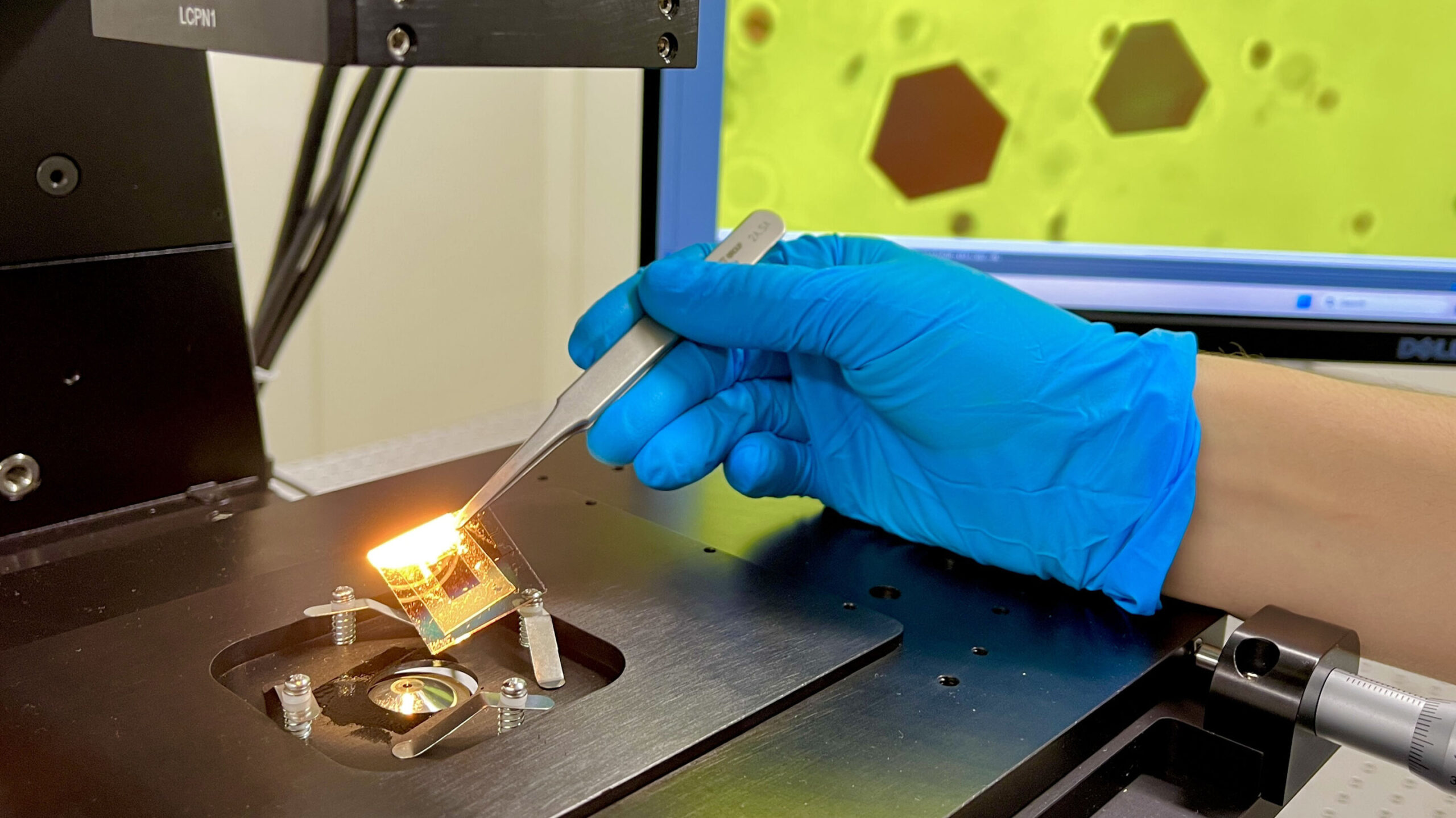
On the monitor which is connected to the lab equipment, it is now possible to see many flakes moving and changing to colors like red and green against the golden yellow background.
Studying ‘nature’s glue’ using light trapped in tiny cavities
“What we are seeing is how fundamental forces in nature interact with each other. Through these tiny cavities, we can now measure and study the forces we call ‘nature’s glue’—what binds objects together at the smallest scales. We don’t need to intervene in what is happening, we just observe the natural movements of the flakes,” says Hošková, a doctoral student at the Department of Physics at Chalmers University of Technology and first author of the paper.
Through the light captured in the cavities, the researchers can study the delicate balance between two forces—one pulling the tiny objects towards each other and one holding them apart. The joining force, the Casimir effect, makes the gold flakes connect to each other and the substrate.
The second, electrostatic force, arises in the salt solution and prevents the flakes from sticking completely to the substrate. When those two forces balance each other, this is known as a self-assembly process and the result is the cavities that open up new research possibilities.
“Forces at the nanoscale affect how different materials or structures are assembled, but we still do not fully understand all the principles that govern this complex self-assembly. If we fully understood them, we could learn to control self-assembly at the nanoscale. At the same time, we can gain insights into how the same principles govern nature on much larger scales, even how galaxies form,” says Hošková.

Gold flakes become floating sensors
The Chalmers researchers’ new platform is a further development of several years of work in Professor Timur Shegai’s research group at the Department of Physics. From the discovery in 2021 that a pair of gold flakes creates a self-assembled resonator, researchers have now developed a method to study various fundamental forces.
The researchers believe that the platform, in which the self-assembled gold flakes act as floating sensors, could be useful in many different scientific fields such as physics, chemistry and materials science.
“The method allows us to study the charge of individual particles and the forces acting between them. Other methods for studying these forces often require sophisticated instruments which cannot provide information down to the particle level,” says research leader Timur Shegai.

Can provide new knowledge on everything from medicines to biosensors
Another way to use the platform, which is important for the development of many technologies, is to gain a better understanding of how individual particles interact in liquids and either remain stable or tend to stick to each other.
It can provide new insights into the pathways of medicines through the body, or how to make effective biosensors, or water filters. But it is also important for everyday products that you do not want to clump together, such as cosmetics.
“The fact that the platform allows us to study fundamental forces and material properties shows its potential as a truly promising research platform,” says Shegai.
In the lab, Hošková opens a box containing a finished sample of the platform. She lifts it with tweezers and shows how easily it can be placed in the microscope. Two thin glass plates hold everything needed to study nature’s invisible glue.
“What I find most exciting is that the measurement itself is so beautiful and easy. The method is simple and fast, based only on the movement of gold flakes and the interaction between light and matter,” says Hošková, zooming the microscope in on a gold flake, the colors of which immediately reveal the forces at play.
-

In the lab at Chalmers, doctoral student Michaela Hošková shows a glass container filled with millions of micrometer-sized gold flakes in a salt solution. Using a pipette, she picks up a drop of the solution and places it on a gold-coated glass plate in an optical microscope. Credit: Chalmers University of Technology | Mia Halleröd Palmgren
-

When light is captured between micrometer-sized gold flakes in a salt solution, it is possible to study the delicate balance between two forces—one pulling the tiny objects towards each other and the other holding them apart. Credit: Chalmers University of Technology | Mia Halleröd Palmgren
How the researchers study ‘nature’s invisible glue’
Gold flakes approximately 10 micrometers in size are placed in a container filled with a salt solution, i.e. water containing free ions. When a drop of the solution is placed on a glass substrate covered with gold, the flakes are naturally attracted to the substrate and nanometer-sized cavities (100–200 nanometers) appear.
Self-assembly occurs as a result of a delicate balance between two forces: the Casimir force, a directly measurable quantum effect that causes objects to be attracted to each other, and the electrostatic force that arises between charged surfaces in a salt solution.
When a simple halogen lamp illuminates the tiny cavities, the light inside is captured as if in a trap. This allows the researchers to study the light more closely using an optical microscope connected to a spectrometer. The spectrometer separates the wavelengths of the light so that different colors can be identified.
By varying the salinity of the solution and monitoring how the flakes change their distance to the substrate, it is possible to study and measure the fundamental forces at play. To prevent the saline solution with the gold flakes from evaporating, the drops of gold flakes and saline are sealed and then covered with another glass plate.
The platform was developed at Chalmers’ Nanofabrication Laboratory, Myfab Chalmers, and at the Chalmers Materials Analysis Laboratory (CMAL).
More information:
Michaela Hošková et al, Casimir self-assembly: A platform for measuring nanoscale surface interactions in liquids, Proceedings of the National Academy of Sciences (2025). DOI: 10.1073/pnas.2505144122
Citation:
A platform of gold adds color to nature’s fundamental forces (2025, October 23)
retrieved 23 October 2025
from https://phys.org/news/2025-10-platform-gold-nature-fundamental.html
This document is subject to copyright. Apart from any fair dealing for the purpose of private study or research, no
part may be reproduced without the written permission. The content is provided for information purposes only.