
Picture the smartphone in your pocket, the data centers powering artificial intelligence, or the wearable health monitors that track your heartbeat. All of them rely on energy-hungry memory chips to store and process information. As demand for computing resources continues to soar, so does the need for memory devices that are smaller, faster, and far more efficient.
A new study by Auburn physicists has taken an important step toward meeting this challenge.
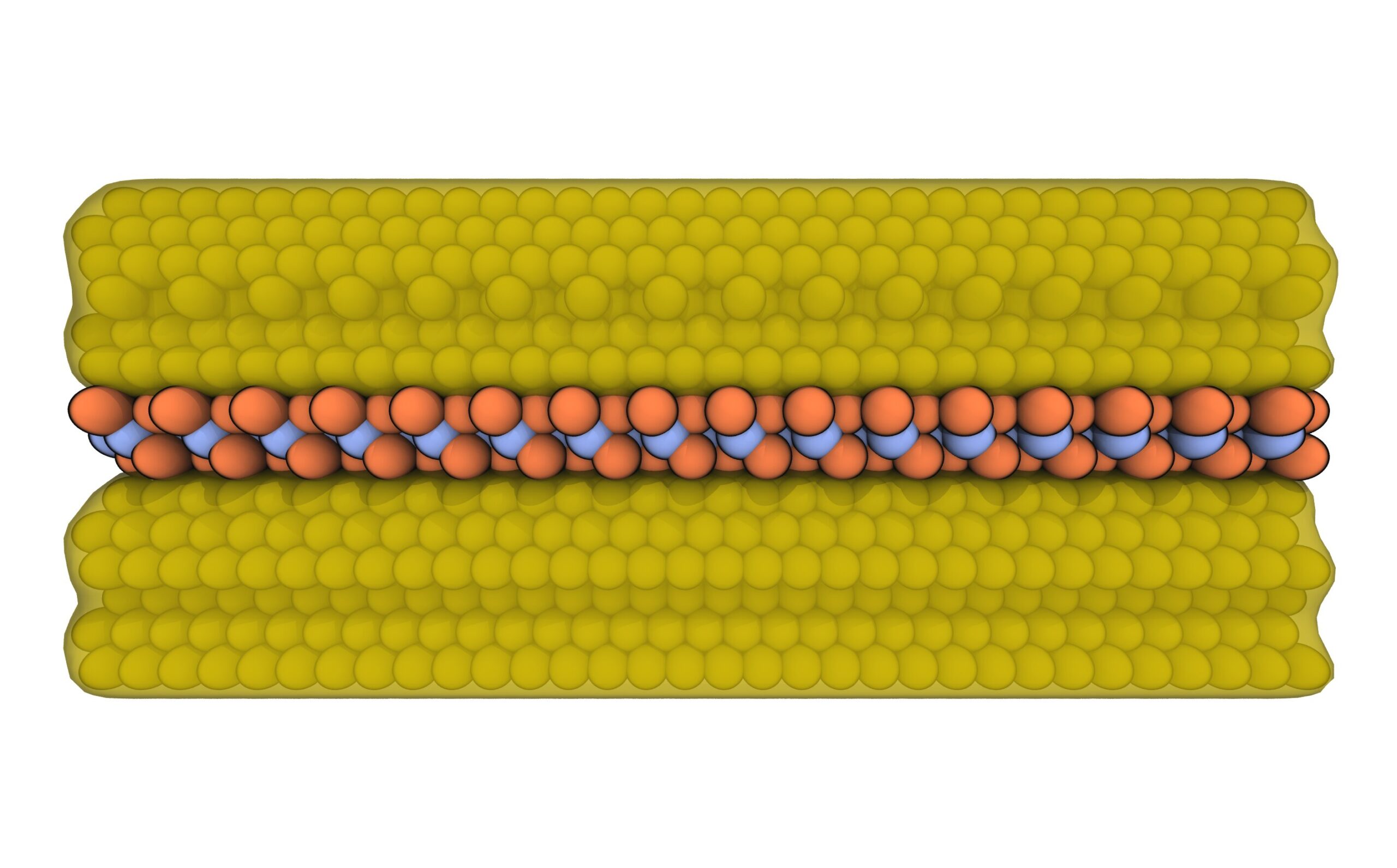
The study, “Electrode-Assisted Switching in Memristors Based on Single-Crystal Transition Metal Dichalcogenides,” published in ACS Applied Materials & Interfaces, shows how memristors—ultra-thin memory devices that “remember” past electrical signals—switch their state with the help of electrodes and subtle atomic changes inside the material.
At the heart of the work are transition metal dichalcogenides (TMDs), crystals that can be peeled down to a few-atom-thick films. These materials can behave like semiconductors, blocking current, or like metals, conducting it freely.
The Auburn team demonstrated that attaching different metal electrodes can tip the balance between these two states, providing engineers with a powerful new way to tune device performance.
“This is fundamental science with very practical implications,” says Dr. Marcelo Kuroda, Associate Professor of Physics at Auburn University and senior author of the study.
“By choosing the right electrode, we can make these devices switch more reliably and at lower power. That is exactly what we need for the next generation of electronics.
From artificial intelligence to health care
The discovery has wide-ranging applications. Because memristors mimic the way neurons strengthen and weaken their connections, they are a natural fit for neuromorphic computing—hardware designed to think and learn like the human brain. Such systems could run artificial intelligence at a fraction of today’s energy cost.
But the promise doesn’t stop there. Since TMDs can be made only a few atoms thick, they are also candidates for flexible and wearable electronics. Imagine medical implants that last for years on a single battery, or smart clothing woven with sensors that adapt to your body in real time.
“As our world becomes more connected, from AI servers to wearable devices, the energy footprint of computing is becoming a global challenge,” Dr. Kuroda explains. “Our work points to a path where we can build electronics that are both powerful and sustainable.”
Cracking the atomic code
To reach these conclusions, the researchers used first-principles calculations to characterize the physical properties of these TMDs under different conditions. They found that the synergy between electrodes, lowering the energy barrier that keeps the material “stuck” in one state, and tiny atomic vacancies—missing atoms in the crystal lattice—play a role in easing the transition between insulating and metallic phases.
The results match experimental observations, confirming that this switching is not just a theoretical curiosity but a real mechanism that engineers may exploit when producing devices.
The Auburn study provides a blueprint for designing more reliable memristors, which could one day replace or complement the memory inside computers, smartphones, and countless other devices.
“Instead of fighting against the imperfections of these materials, we are learning how to use them,” Dr. Kuroda says. “That’s the exciting part—what once seemed like a flaw may actually be the key to building the next generation of technology.”
More information:
Dakotah M. Kirk et al, Electrode-Assisted Switching in Memristors Based on Single-Crystal Transition Metal Dichalcogenides, ACS Applied Materials & Interfaces (2025). DOI: 10.1021/acsami.5c03361
Citation:
Atom-thin crystals provide new way to power the future of computer memory (2025, September 12)
retrieved 19 September 2025
from https://phys.org/news/2025-09-atom-thin-crystals-power-future.html
This document is subject to copyright. Apart from any fair dealing for the purpose of private study or research, no
part may be reproduced without the written permission. The content is provided for information purposes only.