
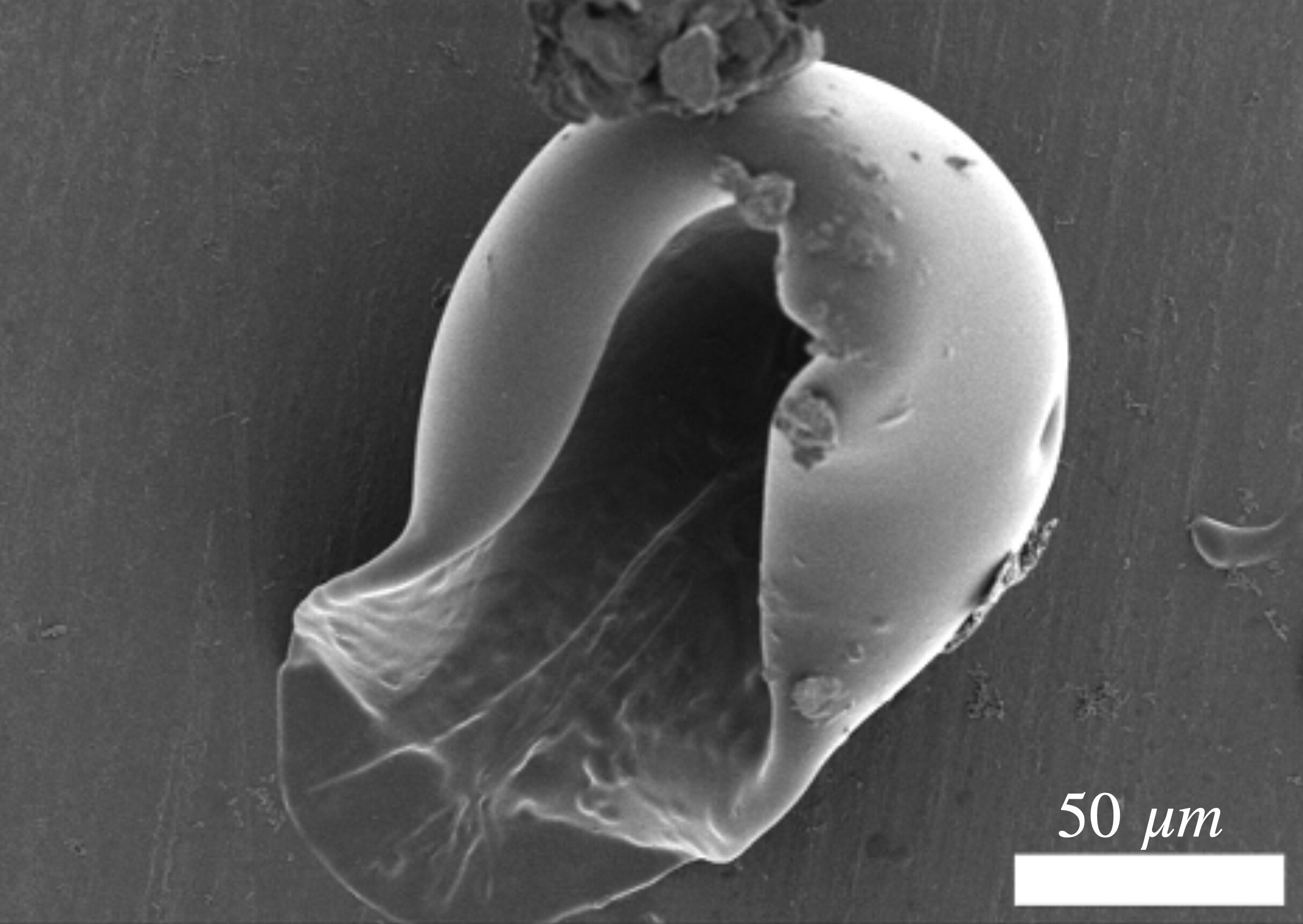
Tiny bioreactors, called nanocultures, are opening up new possibilities for microbiome research, especially in harsh and dynamic environments.
Each nanoliter-sized capsule, roughly the width of a human hair, can host tens of thousands of microbes so that they can be cultivated in their native environments. Developed by Tagbo Niepa, the system is scalable and high-throughput, capable of generating millions of nanocultures within an hour. When it’s time to release the encapsulated microbes, some of which are beneficial, researchers need a precise way to rupture the capsules on-demand.
Niepa wanted an elegant design, as easy as cracking open a chicken egg with a fork or knife. “But what if that egg were 2 million times smaller than a quail egg? How would you access its contents?” asks Niepa, associate professor of chemical engineering and biomedical engineering at Carnegie Mellon University.

Inspired by nature’s packaging, Niepa and collaborators engineered nanocultures with shells as resilient as eggshells. They are small enough to hold just 2–5 nanoliters of liquid, tough enough to withstand mechanical stress, and smart enough to rupture on cue. A semi-permeable shell allows small molecule exchange, enabling cell-cell communication and metabolic activity.
In their article published in Chemical Engineering Journal, Niepa, Shanna-Leigh Davidson, and collaborators engineer the chemistry of the nanoculture shell to control its mechanical properties. Beyond a defined threshold, it will burst, providing a mechanism for predictable and controlled release of the contents.
The idea came to Niepa in earlier experiments, when he noticed that nanocultures shrink slightly over about 24 hours. As bacteria start eating the food inside the nanoculture, their metabolic processes change the osmotic pressure. Water diffuses out of the capsule. “We wanted to know if we could reverse that system and use that as a way of causing the capsules to open,” says Niepa.
Niepa and Davidson, a former Ph.D. student, tested their idea with a solution equivalent to seawater because marine environments are one possible application for nanocultures. When they moved nanocultures from a salt solution to fresh water, osmosis caused the capsule to swell and burst. “There’s no solute or particle outside to pull the water away, so the water is pulled inside,” explains Niepa.
To optimize the method, Niepa and collaborators adjusted the chemical composition of the nanoculture shell. They developed their own polymer blend to achieve a strong yet brittle shell that would rupture under osmotic pressure. In experiments, they tested the elastic properties and swelling capacity of the shell.
They also demonstrated that platinum concentration can be used to control flexibility and rigidity. Platinum is used to catalyze the crosslinking reaction between monomers when making the nanoculture shell. At lower concentrations of platinum, reactions happen more slowly, and the polymers are not fully crosslinked. This makes the shell more flexible. Adding more platinum causes connections to happen faster, creating a harder and more rigid shell. Rigid shells burst with small openings. More flexible shells burst with larger openings.
“We use the crosslinking density of a polymer to tune the mechanics of it,” says Niepa. “We want something that is tunable so that we can allow more diffusion of water.” The design of the nanoculture shell allows researchers to leverage its mechanical properties together with osmosis for precise control.
Niepa and collaborators compared their osmotic swelling method with two common methods for rupturing cell membranes: bead beating and sonication. Bead beating blends cells with small, chemically inert beads to break down the membranes. Niepa and collaborators found that blending the nanocultures smashed the contents along with the capsules. Sonication converts ultrasonic waves into mechanical energy that ruptures cell membranes. The method forms a foam that proved difficult to remove from the nanoculture contents. Results show that bead beating and sonication of nanocultures yield fewer viable cells than osmotic swelling.

“We saw more release of live cells when we used the osmotic system than with bead beating or sonication,” says Niepa. “That means we get more clean DNA to work with.”
Gene sequencing is one of the final steps in potential applications for nanocultures. In soil environments, for example, researchers can cultivate microbes in nanocultures, then collect the nanocultures using a magnet and place them into a fresh water system to break them open. After collecting the cells that are released, researchers can perform sequencing to identify the cells or cultivate the cells again for mass production.
By establishing a method for the controlled release of nanoculture contents, Niepa and collaborators continue to demonstrate the utility of the nanoculture system for high-throughput cultivation of microbes.
More information:
Shanna-Leigh Davidson et al, Tunable lysis of functionalized nanocultures for efficient microbial and nucleic acid recovery, Chemical Engineering Journal (2025). DOI: 10.1016/j.cej.2025.168770.
Citation:
Cracking the nanoculture shell to unlock new frontiers in microbiome research (2025, September 23)
retrieved 23 September 2025
from https://phys.org/news/2025-09-nanoculture-shell-frontiers-microbiome.html
This document is subject to copyright. Apart from any fair dealing for the purpose of private study or research, no
part may be reproduced without the written permission. The content is provided for information purposes only.