
Close Menu
  • News
    • Medical
    • Nanomaterials
    • AI & Robotics
    • 2D Materials
    • Metamaterials
    • Nanoelectronics
    • ETF’s
    • Medicine
  • Environment
    • Earth.com
    • TreeHugger
    • Nanomuscle
  • Beauty
    • Makeupanalysis
What's Hot

NY Creates Begins Installation of First Major Tool for High NA EUV Lithography Center at Albany Nanotech Complex

May 7, 2026

Orange Leaf Extract Produces Greener Antibacterial Nanoparticles

April 9, 2026

Pittcon’s First San Antonio Experience a Roaring Success

April 8, 2026
Facebook X (Twitter) Instagram
  • Contact Us
  • Privacy Policy
  • Terms & Conditions
Facebook X (Twitter) Instagram
Elnano – Global Innovative Nanotechnology SolutionsElnano – Global Innovative Nanotechnology Solutions
  • News
    • Medical
    • Nanomaterials
    • AI & Robotics
    • 2D Materials
    • Metamaterials
    • Nanoelectronics
    • ETF’s
    • Medicine
  • Environment
    • Earth.com
    • TreeHugger
    • Nanomuscle
  • Beauty
    • Makeupanalysis
Elnano – Global Innovative Nanotechnology SolutionsElnano – Global Innovative Nanotechnology Solutions
Home » Two-step method enables controllable WS₂ epitaxy growth
Nanotech

Two-step method enables controllable WS₂ epitaxy growth

September 24, 2025No Comments3 Mins Read
Share
Facebook Twitter LinkedIn Pinterest Email
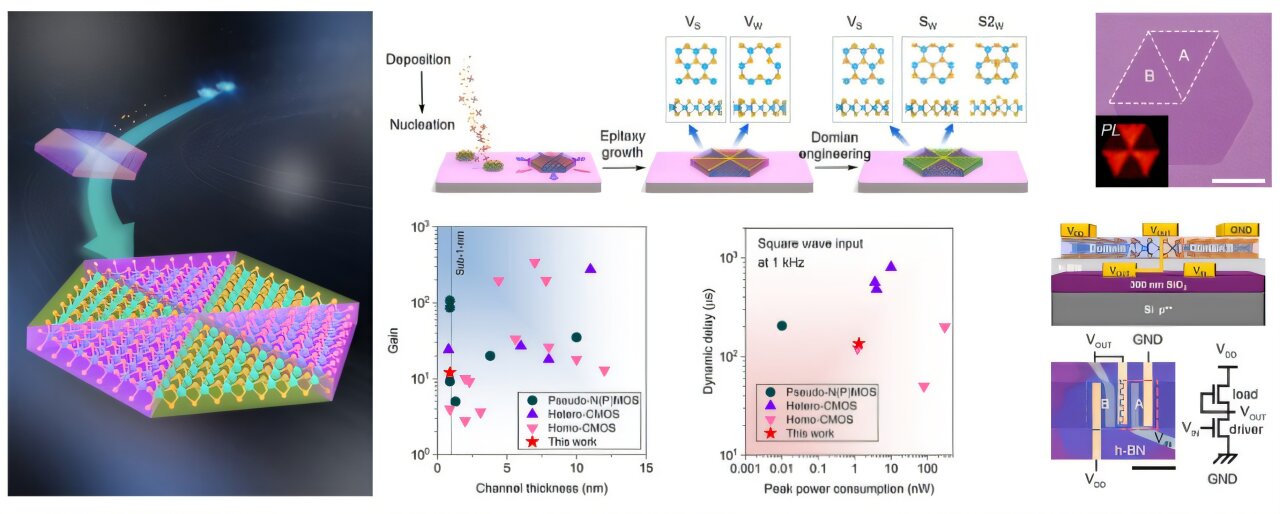
Two-step growth strategy for the WS2 homojunctions. (Image by USTC). Credit: USTC

In a study published in Journal of the American Chemical Society, a team led by Prof. Song Li from the University of Science and Technology of China (USTC) of the Chinese Academy of Sciences synthesized monolayer WS2 lateral homojunctions via in situ domain engineering, and enabled controllable direct chemical vapor deposition (CVD) growth of these structures.

Two-dimensional (2D) transition metal dichalcogenides are ideal candidates to replace silicon-based semiconductors due to their exceptional electrical properties at atomic scales. However, device applications require heterogeneous field-effect modulation behaviors across low-dimensional units. Van der Waals interactions or lateral atomic bonding allow damage-free integration into homojunctions/heterojunctions, but direct epitaxy growth remains challenging due to strict atomic species constraints.

In this study, researchers first determined optimal intrinsic defect configurations through theoretical simulations. Then they employed a two-step CVD method to achieve the in situ modulation of defect structures at the domain level, yielding homojunctions with tailored defect architectures.

In the first step, two types of domains in hexagonal samples were created under equilibrium growth conditions. In the second step, in order to meet the device requirements, the atomic configurations of specific domains were in situ manipulated to engineer the band structures of homojunctions.

It is worth mentioning that to control the epitaxy growth process, researchers manipulated the precursor feeding rates of tungsten trioxide and sulfur to an equilibrium state, which enabled the growth rate of the S-zigzag edges to be equal to that of the W-zigzag edges.

The synthesized WS2 homojunctions exhibited distinct field-effect characteristics while maintaining atomic lattice matching and customized band alignment at interfaces. Logic inverters based on these structures demonstrated rail-to-rail operation with a peak voltage gain of 12, dynamic delay of ~135 μs, and ultralow power consumption of 1.3 nW.

See also  Ultrathin racetrack memory devices now work without insulating buffer layers

The study provides a new perspective on in-situ engineering of both defect configurations and distributions within atomic layers, and a more comprehensive understanding of 2D landscape.

More information:
Qilong Cui et al, Growth of Monolayer WS2 Lateral Homojunctions via In Situ Domain Engineering, Journal of the American Chemical Society (2025). DOI: 10.1021/jacs.5c04546

Provided by
University of Science and Technology of China


Citation:
Two-step method enables controllable WS₂ epitaxy growth (2025, September 23)
retrieved 24 September 2025
from https://phys.org/news/2025-09-method-enables-ws8322-epitaxy-growth.html

This document is subject to copyright. Apart from any fair dealing for the purpose of private study or research, no
part may be reproduced without the written permission. The content is provided for information purposes only.


Source link

controllable enables epitaxy Growth Method Twostep WS₂
Share. Facebook Twitter Pinterest LinkedIn Tumblr Email

Related Posts

Orange Leaf Extract Produces Greener Antibacterial Nanoparticles

April 9, 2026

Pittcon’s First San Antonio Experience a Roaring Success

April 8, 2026

Silver-Coated Microrobots Break Down Antibiotics in Water

April 7, 2026

PI Earns Gold in MassEcon Economic Impact Awards

April 6, 2026
Add A Comment

Comments are closed.

Top Posts

Engineered extracellular vesicles halt lung cancer growth by silencing key protein

October 28, 2025

Study Shows a Plasmon-Induced Route to Advanced Hybrid Nanomaterials

October 14, 2025

Hyundai to use nanotechnology in cars from 2025–2026

September 18, 2025

Subscribe to Updates

Get the latest sports news from SportsSite about soccer, football and tennis.

Explore the future with our Nanotech blog—covering innovations, research, applications, and breakthroughs shaping science, medicine, and modern technology.

We're social. Connect with us:

Facebook X (Twitter) Instagram YouTube
Top Insights

NY Creates Begins Installation of First Major Tool for High NA EUV Lithography Center at Albany Nanotech Complex

May 7, 2026

Orange Leaf Extract Produces Greener Antibacterial Nanoparticles

April 9, 2026

Pittcon’s First San Antonio Experience a Roaring Success

April 8, 2026

Subscribe to Updates

Get the latest creative news from FooBar about art, design and business.

  • Contact Us
  • Privacy Policy
  • Terms & Conditions

© 2026 elnano.com - All rights reserved.

Type above and press Enter to search. Press Esc to cancel.