
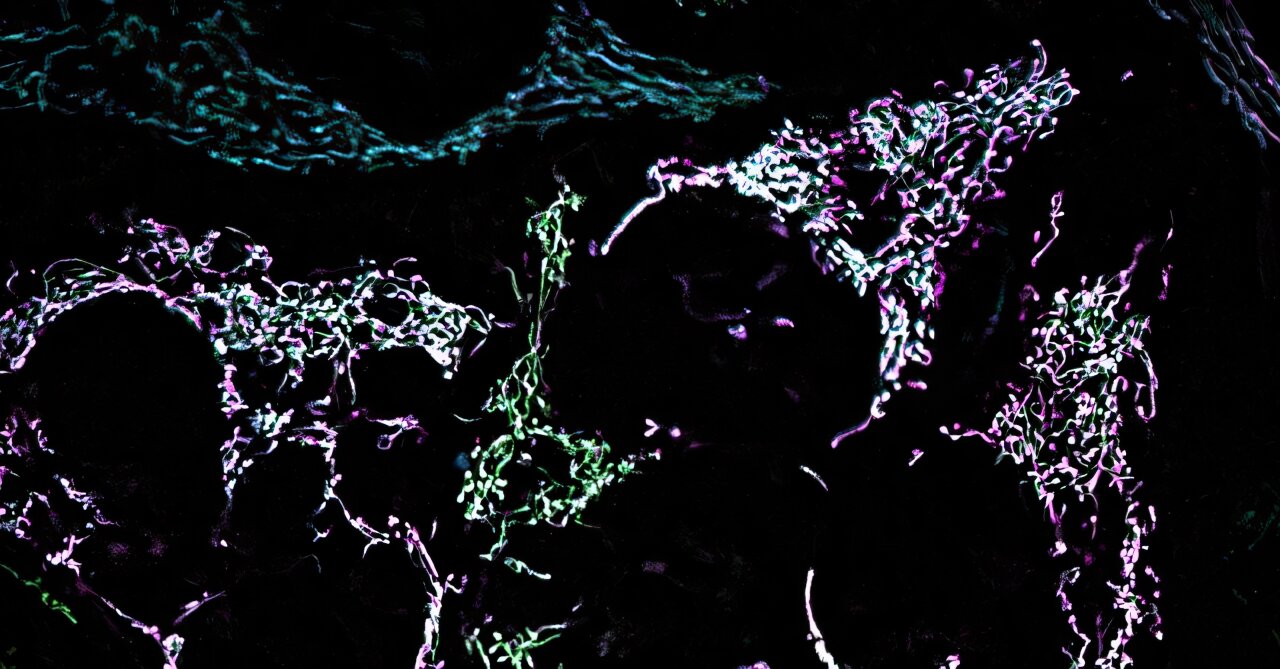
Lipids are fatty molecules that play critical roles in cell function, including membrane structure, energy storage and nutrient absorption. Most lipids are made in a cell organelle called the endoplasmic reticulum, but specific lipid types are shuttled around to different parts of the cell depending on their purpose. Each organelle serves a specific role in a cell and has its own unique mixture of lipids called a lipidome.
Scientists have long wanted to get a closer look at the movement of lipids around a cell, but because organelles are so close together—often only tens of nanometers apart—it’s tough to visualize with traditional light microscopy, which only has resolutions up to 250 nanometers.
Now researchers at the University of California San Diego have unveiled a new technology with the power to see cells in unprecedented detail. The tool, called fluorogen-activating coincidence encounter sensing (FACES), was developed in Associate Professor of Biochemistry & Molecular Biophysics Itay Budin’s lab. This work appears in Nature Chemical Biology.
Cell membranes are composed of lipid bilayers. These bilayers are 3–4 nanometers wide and are composed of two lipid layers called leaflets. The lipids in each leaflet are not necessarily the same types, further complicating attempts to understand the microscopic biochemistry taking place.
To get a glimpse of lipid movement, the team turned to fluorogens, small-molecule dyes that do not fluoresce unless they are bound to a special fluorogen-activating protein or FAP. The study shows how when lipids are chemically modified by attaching fluorogens to them, they only light up in parts of the cells where the FAP protein is found. By controlling the localization of the FAPs, researchers can selectively illuminate only the lipids at sites of their choosing.
“It’s like having a kind of switch,” stated Budin, the corresponding author on the paper. “You have a dye and you have a protein. By themselves, neither are fluorescent. But if they’re in the same place at the same time, they bind to each other, and the complex is fluorescent.”
This tool allows researchers to only see how lipids are transported to specific organelles in the cell, while other lipids in the cell remain dark. It can also parse the individual leaflets of a lipid bilayer, fluorescing one side while the other remains unseen. Budin’s lab uses FACES to see how lipids are trafficked between organelles and how they’re transported across a single membrane bilayer between two different leaflets.
The idea for the tool came from project scientist William Moore. Despite Budin’s initial hesitations about the technical challenges posed by using fluorogens to image lipids, Moore was persistent in getting his idea from the drawing board to the microscope room.
“Fluorogens are typically used for the localization and tracking of proteins that are genetically tagged with a FAP. I was confident we could reverse this logic and repurpose FAPs as sensors for the localization and tracking of fluorogens, which could be conjugated to other molecules like lipids,” stated Moore, who is the paper’s first author.
This new tool will complement the advanced imaging tools being developed in Obara’s lab. Together, they hope to better understand organelle communication—how different components of a cell interact with each other—including lipid transport. The project also featured key contributions from Professor of Biochemistry & Molecular Biophysics Neal Devaraj’s lab.
Budin hopes to make the sensor protein and fluorogen molecule easily available to other labs—even those not studying lipids.
“We’re focusing on the lipid angle because that’s what our lab studies,” said Budin. “But the technology can actually be applied to many different types of biomolecules that can be labeled using these kinds of chemicals. We want it to be used by biology and biochemistry labs around the world.”
More information:
William M. Moore et al, Leaflet-specific phospholipid imaging using genetically encoded proximity sensors, Nature Chemical Biology (2025). DOI: 10.1038/s41589-025-02021-z
Citation:
Tool enables nanoscale visualization of lipid movement between cell organelles (2025, October 16)
retrieved 16 October 2025
from https://phys.org/news/2025-10-tool-enables-nanoscale-visualization-lipid.html
This document is subject to copyright. Apart from any fair dealing for the purpose of private study or research, no
part may be reproduced without the written permission. The content is provided for information purposes only.