
Close Menu
  • News
    • Medical
    • Nanomaterials
    • AI & Robotics
    • 2D Materials
    • Metamaterials
    • Nanoelectronics
    • ETF’s
    • Medicine
  • Environment
    • Earth.com
    • TreeHugger
    • Nanomuscle
  • Beauty
    • Makeupanalysis
What's Hot

Nanotechnology Plus Medicine Equal NanoMedicine

February 3, 2026

Improving PPE’s Antimicrobial Efficacy with ZnO Nanoparticles

December 5, 2025

PI Introduces Next-Generation 6-Axis Nanopositioning Alignment System

December 4, 2025
Facebook X (Twitter) Instagram
  • Contact Us
  • Privacy Policy
  • Terms & Conditions
Facebook X (Twitter) Instagram
Elnano – Global Innovative Nanotechnology SolutionsElnano – Global Innovative Nanotechnology Solutions
  • News
    • Medical
    • Nanomaterials
    • AI & Robotics
    • 2D Materials
    • Metamaterials
    • Nanoelectronics
    • ETF’s
    • Medicine
  • Environment
    • Earth.com
    • TreeHugger
    • Nanomuscle
  • Beauty
    • Makeupanalysis
Elnano – Global Innovative Nanotechnology SolutionsElnano – Global Innovative Nanotechnology Solutions
Home » Scientists create nanofluidic chip with ‘brain-like’ memory pathways
Nanotech

Scientists create nanofluidic chip with ‘brain-like’ memory pathways

October 10, 2025No Comments3 Mins Read
Share
Facebook Twitter LinkedIn Pinterest Email
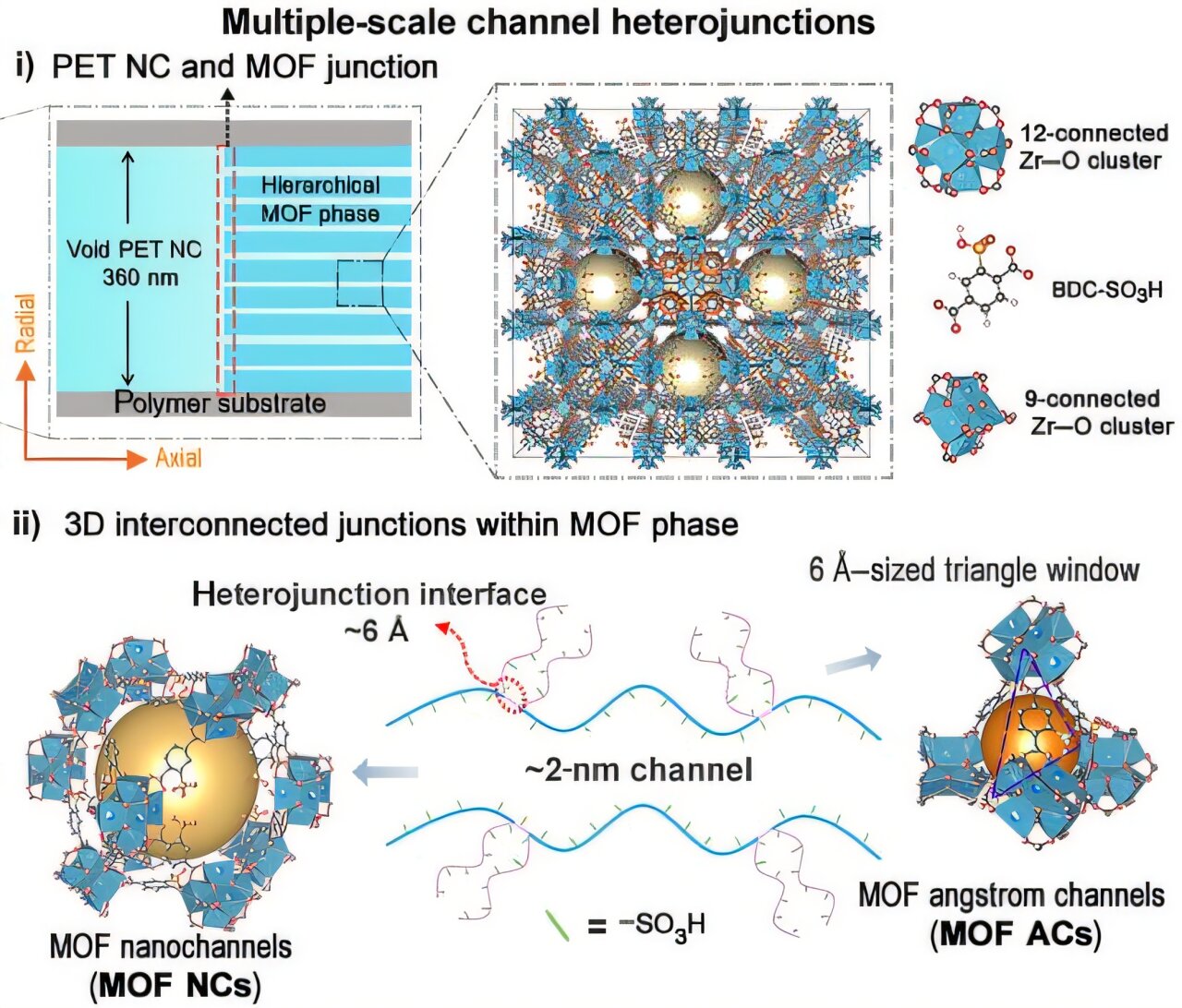
Sketch of the MOF nanofluidic device with two types of heterojunctions at different scales: (i) the one-dimensional (1D) junction between the confined space of the PET NC and the MOF dense phase and (ii) the 3D interconnected MOF intrinsic phase junctions on the local tip side of the h-MOFNT. Credit: Science Advances (2025). DOI: 10.1126/sciadv.adw7882

Scientists at Monash University have created a tiny fluid-based chip that behaves like neural pathways of the brain, potentially opening the door to a new generation of computers.

Roughly the size of a coin, the chip was built from a specially designed metal-organic framework (MOF), and channels ions through tiny pathways, mimicking the on/off switching of electronic transistors in computers.

But unlike conventional computer chips, it can also “remember” previous signals, mimicking the plasticity of neurons in the brain.

The work is published in the journal Science Advances.

Co-lead author Sir John Monash Distinguished Professor and ARC Laureate Fellow, Professor Huanting Wang, Deputy Director of the Monash Center for Membrane Innovation, highlights the potential of engineered nanoporous materials for next-generation devices.

“For the first time, we’ve observed saturation nonlinear conduction of protons in a nanofluidic device. This opens up new opportunities for designing iontronic systems with memory and even learning capabilities,” Professor Wang said.

“If we can engineer functional materials like MOFs just a few nanometers thick, we could create advanced fluidic chips that complement or even overcome some limitations of today’s electronic chip.”

To demonstrate its potential, the team built a small fluid circuit with multiple MOF channels. The chip’s response to voltage changes mimicked the behavior of electronic transistors, while also showing memory effects that could one day be used in liquid-based data storage or brain-inspired computing systems.

Co-lead author Dr. Jun Lu, from the Monash Department of Chemical and Biological Engineering, who is currently working as a visiting scholar at the University of California, said the development was the first-of-a-kind and a major step toward computers that think more like humans, using liquid instead of solid circuits.

See also  Nano-switch achieves first directed, gated flow of excitons

“Our chip can selectively control the flow of protons and metal ions, and it remembers previous voltage changes, giving it a form of short-term memory,” Dr. Lu said.

“What makes our device truly special is its hierarchical structure, which allows it to control protons and metal ions in entirely different ways. This kind of selective, nonlinear ion transport hasn’t been seen before in nanofluidics.”

More information:
Xiaoyi Hu et al, Selective ion transport of nonlinear resistive switching by hierarchical nanometer-to-angstrom channels for nanofluidic transistors, Science Advances (2025). DOI: 10.1126/sciadv.adw7882

Provided by
Monash University


Citation:
Scientists create nanofluidic chip with ‘brain-like’ memory pathways (2025, October 10)
retrieved 10 October 2025
from https://phys.org/news/2025-10-scientists-nanofluidic-chip-brain-memory.html

This document is subject to copyright. Apart from any fair dealing for the purpose of private study or research, no
part may be reproduced without the written permission. The content is provided for information purposes only.


Source link

brainlike Chip Create memory nanofluidic pathways Scientists
Share. Facebook Twitter Pinterest LinkedIn Tumblr Email

Related Posts

Improving PPE’s Antimicrobial Efficacy with ZnO Nanoparticles

December 5, 2025

PI Introduces Next-Generation 6-Axis Nanopositioning Alignment System

December 4, 2025

H.E. Máté Pesti’s Visit to Cubic Sensor and Instrument Co.

December 2, 2025

Nanostars Amplify SERS Signal and Boost Sensing

December 1, 2025
Add A Comment

Comments are closed.

Top Posts

Bioengineers explore how tumor mechanics and tiny messengers could shape the future of cancer research

September 21, 2025

Engineered extracellular vesicles halt lung cancer growth by silencing key protein

October 28, 2025

AI Cracks the Code for the Next Generation of Solar Power

September 25, 2025

Subscribe to Updates

Get the latest sports news from SportsSite about soccer, football and tennis.

Explore the future with our Nanotech blog—covering innovations, research, applications, and breakthroughs shaping science, medicine, and modern technology.

We're social. Connect with us:

Facebook X (Twitter) Instagram YouTube
Top Insights

Nanotechnology Plus Medicine Equal NanoMedicine

February 3, 2026

Improving PPE’s Antimicrobial Efficacy with ZnO Nanoparticles

December 5, 2025

PI Introduces Next-Generation 6-Axis Nanopositioning Alignment System

December 4, 2025

Subscribe to Updates

Get the latest creative news from FooBar about art, design and business.

  • Contact Us
  • Privacy Policy
  • Terms & Conditions

© 2026 elnano.com - All rights reserved.

Type above and press Enter to search. Press Esc to cancel.