
Sometimes, the best way to achieve a big outcome is to start small. That principle is at the center of new work from a University of Virginia researcher who specializes in nanotechnology and controlled delivery of medical treatments.
Evan Scott, a biomedical engineering professor with dual appointments in UVA’s School of Engineering and Applied Science and School of Medicine, authored a recent publication in Nature Communications in which he and a team of colleagues created a new way to deliver sustained medical treatments. They unveiled a polymer-based system that assembles itself inside the body to deliver treatment with precision and without triggering immune rejection or requiring invasive procedures.
The technology could lead to big improvements in many fields, including vaccine development. “This could one day help us optimize new vaccine formulations—and faster,” said Scott, Thomas A. Saunders III Family Jefferson Scholars Foundation Distinguished University Professor and leader of the Scott Research Lab.
How it works
For delivering medicine within the body, Scott’s lab has previously worked in biomimicry by designing nanoscale, billionth-of-a-meter delivery vehicles that “copy” the structure and function of viruses. These tiny particles safely transport drugs to specific cells and tissues, rapidly triggering therapeutic responses for the treatment of disease or even to prevent organ rejection.
But his current research instead employs biomimicry for slow drug release to tackle problems that require sustained modulation of the immune system. Here, he is copying nature’s ability to use hierarchy: where very simple components can self-organize into larger, more complex structures.
As an example, imagine linking together small LEGO bricks to build a larger brick, and then using these LEGO bricks to build a castle. In this hierarchy, the tiny LEGO bricks were the basis of a much more complex structure, a castle, which required an intermediate component for assembly, the larger bricks.
“Most things that are very complicated are actually made of very simple small pieces,” Scott explained. “You can make a very complicated structure in a top-down fashion, but building it large and complicated from the start is not always the best or only way. When creating nanoscale materials, it’s often more efficient to use a bottom-up strategy by making simple small-scale components first that can then combine and scale to make a much larger complex mechanism.”
Take collagen, for example, which makes up most of our skin and supports tendons, bones, ligaments and other types of tissue. Collagen is really made up of very small amino acids that link together and organize into larger proteins, which are then assembled into long coils.
In order to maximize strength and stability, these coils themselves combine into fibrils that finally form the thick collagen fibers that make up our tissue. This hierarchical strategy allows nature to be extremely efficient, as these same amino acids can be the basis of all the different proteins, tissues and organs within our body.
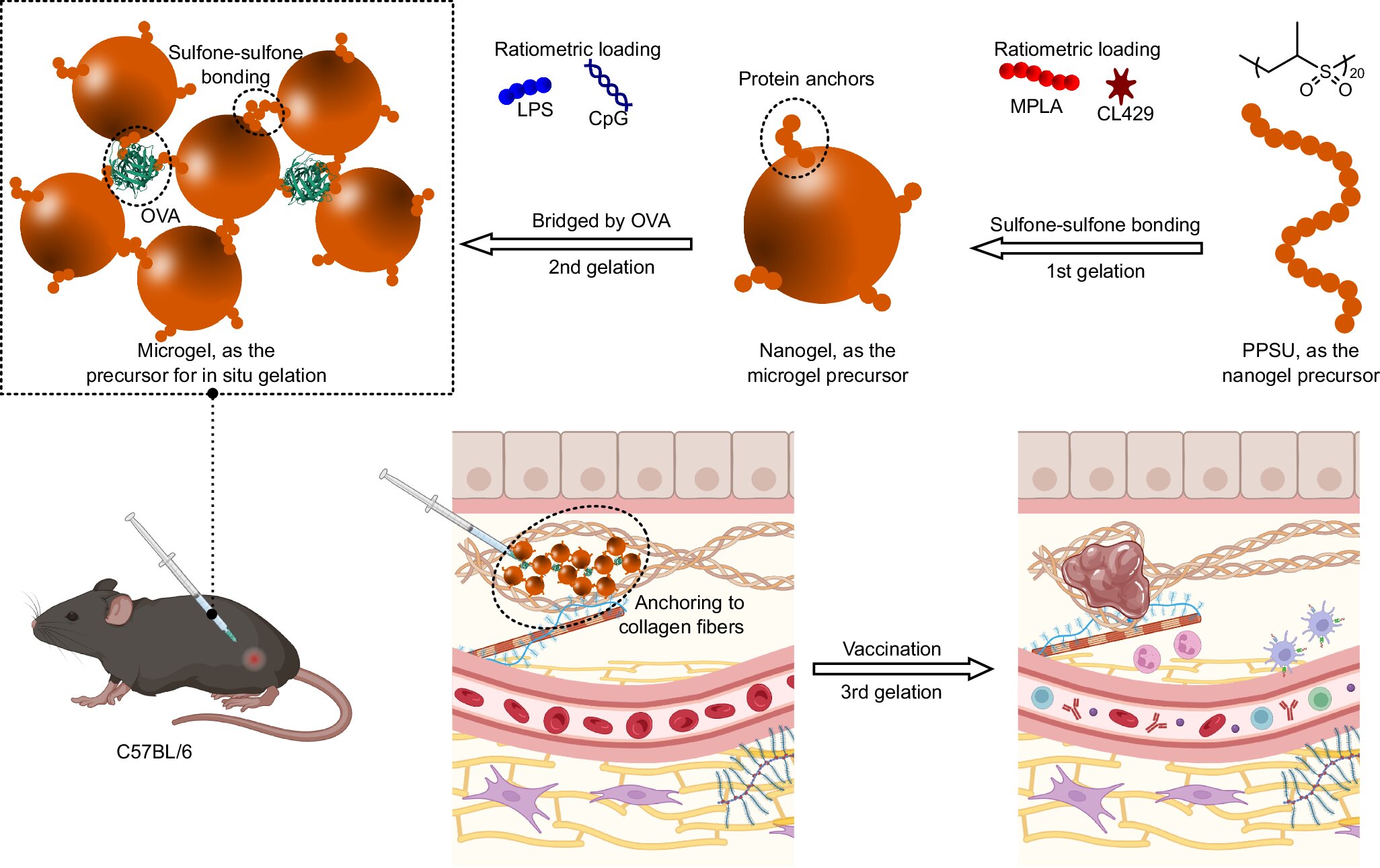
In the new research, Scott’s lab created a small synthetic polymer—called propylene sulfone—that can go through multiple steps of hierarchical assembly to make different types of scaffolds in the body that can load drugs and slowly release them over time. It could, for example, combine synthetic building blocks to create a gel under the skin for delivering medicines that don’t trigger an immune response.

The idea of delivering medicine from gels and scaffolds for sustained treatment isn’t new, but it’s often expensive and difficult, and in some cases requires invasive methods like surgery, Scott said.
“It’s actually a big problem,” he said. “If you pre-make a large gel outside of the body, it will require surgery for implantation, which involves long recovery times and a risk of infection. Here, we use propylene sulfone building blocks to assemble the gel within tissue following a simple non-invasive injection.”
What it could mean for vaccine development
In the new paper, Scott and his team used their new synthetic materials as a vaccine delivery system that instructs the body’s immune system to rapidly generate antibodies against attack. Because these materials can self-assemble inside the body, they can form precise, stable structures that hold and release multiple vaccine components over time. This makes it possible to design vaccines that are both complex and highly controlled without requiring surgery or complex manufacturing steps.
Most vaccines work in one of two ways: they either use the whole pathogen, or specific pieces that can be purified or synthesized, to safely trigger an immune response without causing disease. In the first, scientists inactivate a whole pathogen by either killing it or growing multiple generations in different culture environments until they evolve into the desired version. These are called inactivated and attenuated vaccines respectively, which have many different components from the bacteria for stimulating a robust immune response.
The second approach, called a subunit vaccine, is usually where two carefully selected components—such as the pairing of a single antigen and an adjuvant, meant to boost response—are injected into the body to treat the infection. “And these subunit vaccine formulations are usually very simple and limited in capability,” Scott said.
Currently, attenuated vaccines are usually more effective for treatment, likely because their higher complexity allows more realistic stimulation of the immune system. But they are also harder to produce consistently and take a lot longer to make than subunit vaccines.
By using a self-assembling polymer scaffold, Scott’s approach can mimic some of that complexity by efficiently carrying multiple antigens and adjuvants in a single injection—and controlling exactly how and when each is released.
Scott’s new research shows a path forward for subunit vaccines that could make them both more effective and quicker to produce while achieving a higher complexity that mimics responses from attenuated vaccines.
“Our question was: can we make a synthetic subunit vaccine that has more components from the bacteria, maybe five or six, instead of just the typical two. But you must also know which pieces are in there, and how to control the amount of each component to regulate what they can do.”
That’s where the new materials science breakthrough in their research could help. Instead of combining elements with two functions, Scott’s team successfully introduced five components while specifying the amount and release rate of each. This could let them create and rapidly optimize a more effective vaccine—with multiple points of attack against infection—in a controlled way, with faster production time.
It’s a bit like using the LEGO bricks approach again—starting with tiny building blocks that click together into a larger, functional structure. Here, those “blocks” are the individual vaccine components, and the “castle” is the fully assembled delivery system that releases them in the right order.
“This is really big for us because it demonstrates a new multi-drug delivery system,” Scott said. “It can deliver drugs in new combinations; including antigen, adjuvant, antibodies and enzymes; but it could also have long-term impact in vaccine design and delivery in general.”
More information:
Fanfan Du et al, A biomimetic multi-component subunit vaccine via ratiometric loading of hierarchical hydrogels, Nature Communications (2025). DOI: 10.1038/s41467-025-60416-x
Citation:
Polymer scaffold can self-assemble in tissue to deliver multiple vaccine components over time (2025, October 7)
retrieved 7 October 2025
from https://phys.org/news/2025-10-polymer-scaffold-tissue-multiple-vaccine.html
This document is subject to copyright. Apart from any fair dealing for the purpose of private study or research, no
part may be reproduced without the written permission. The content is provided for information purposes only.