
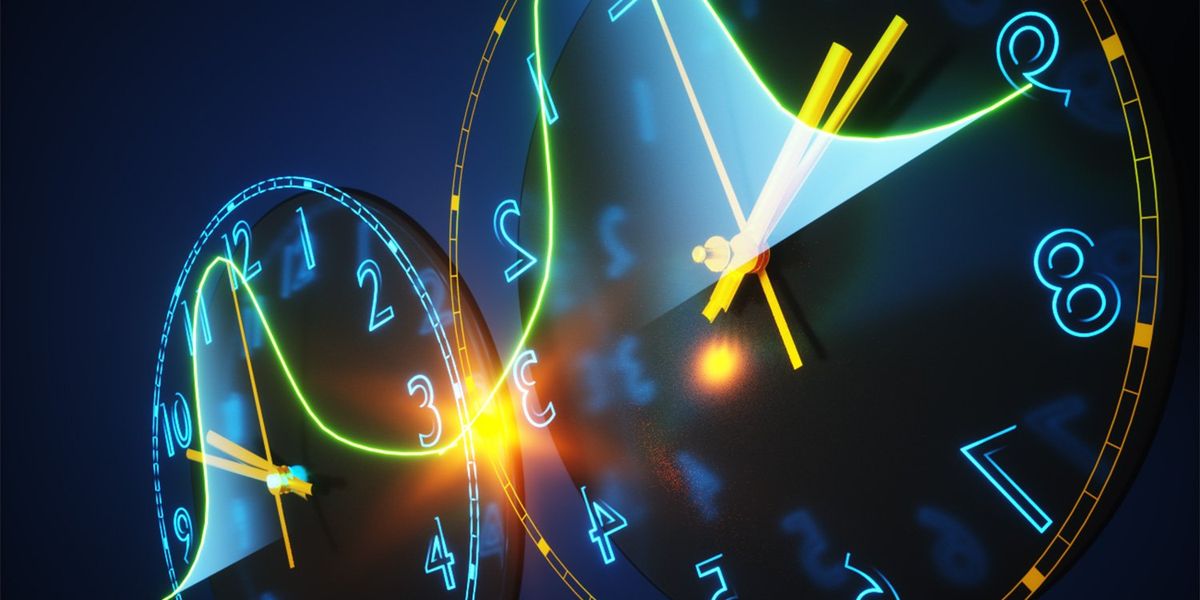
Usually, electromagnetic waves pass through each other unseen and undisturbed. Getting light beams to notice each other is no easy task. Typically, scientists must coax them into interacting via complex materials. Now, physicists at the City University of New York (CUNY) Advanced Science Research Center have designed a fundamentally new way to make light beams collide with each other—by reflecting them both on the same mirror in time. By controlling light with light, the team also showed off the beam-shaping capabilities of their technique, with possible applications in telecommunications and scientific measurement.
The team demonstrated their time-mirror technology back in March, but now they’ve shown that two opposing light pulses hitting the same time mirror can be made to collide with each other, much like massive objects. Moreover, the researchers can exert control over the type of collision that occurs. The light pulses, the researchers report, can collide elastically, like two billiard balls bouncing off each other; inelastically, like two pieces of Silly Putty hitting each other and sticking together; or constructively, like two balls with spring-loaded mechanisms tripped by the collision, shooting apart faster than they came together.
“You can decide if the total energy in the system decreases, grows, or stays the same.”
—Andrea Alù, CUNY
“We call them photon collisions because it reminds us of how two massive objects interact when they bump into each other,” says Andrea Alù, distinguished professor of physics at CUNY and senior author on the study. “What is remarkable about this time interface is that if you choose the instant in which you drive it, you can decide if the total energy in the system decreases, grows, or stays the same.”
To create their time mirror, the team used a specially engineered metamaterial. A regular mirror is formed by an abrupt change in the index of refraction between two materials, causing light to be reflected at the interface. Similarly, a time mirror is formed by an abrupt change in the index of refraction—but in time. Time-reflected light is still traveling in the same direction, but backward—like a sound recording played in reverse.
This metamaterial chip is capable of creating a time mirror for light waves traveling through it, allowing two light waves to crash into each other. Shawn Rhea/CUNY Advanced Science Research Center
The researchers achieved this time mirror using a 6-meter-long meandering transmission line printed on a chip. They connected many switches, linked capacitors between the transmission line and the ground every 20 centimeters, closer together than one wavelength of the light. By switching these capacitors on or off, they could change the index of refraction in the material as quickly as 3 nanoseconds. “Suddenly, the wave feels as if it’s in a completely different medium,” Alù says.
They sent light pulses toward each other from both ends of the transmission line and switched the index of refraction at different points in time. By changing how overlapped the two light beams were during the switch, they could change the nature of the collision—elastic, inelastic, or constructive.
What’s more, by choosing the shape of one of the light beams and the timing of the switch, the researchers could effectively reshape the other beam to suit their needs. They demonstrated erasing a section of a light signal and shortening a pulse. Because the time interface works for a huge range of frequencies, this method can be used to shape broadband light; it’s very useful for wireless communications. The ability to shape light into ever shorter bursts is also of great promise for sensing and measurement applications.
The team is currently working on extending this method into the visible-light and infrared-light regimes. They expect the wave interaction effect to persist across a huge range of settings. “In principle, one could kill [an electromagnetic] tsunami using this technique. You have a tsunami coming to you, and then you send a wave against it,” Alù says. “Of course, you have to shape it right. And you have to make this transition happen, but you can completely suppress the waves coming towards you.”
In addition to possible applications in telecommunications, this technique holds a lot of scientific promise. Applying the time mirror many times in rhythm could be used to create a time crystal. The team is also currently looking at the potential quantum properties of these time interfaces, and the fate of single photons colliding through them.
From Your Site Articles
Related Articles Around the Web