
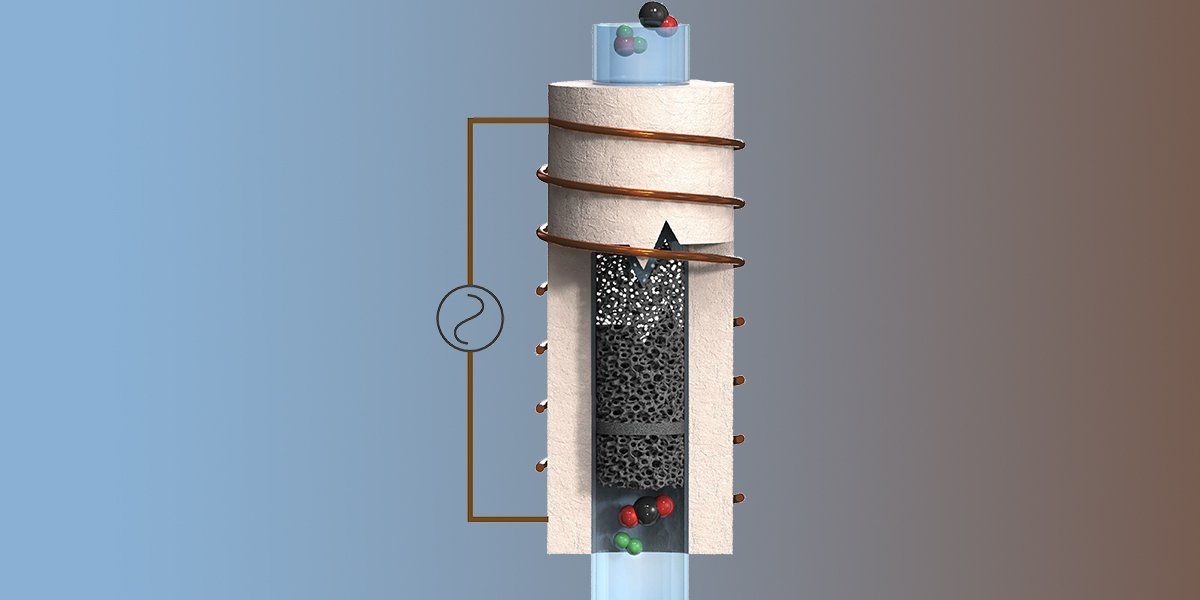
High temperature reactors for industrial processes like steelmaking and hydrogen gas production must operate at hundreds to thousands of degrees Celsius. Traditionally, fossil fuels are used to heat a transfer liquid that is then pumped into the reactor to create these scorching temperature. Researchers at Stanford have developed a new approach using electricity, which could come from green sources, to do the job much more efficiently.
The process, described last month in Joule, is based on high-frequency magnetic induction, and it’s essentially the same process used in modern induction stovetops for the home. When you pass an alternating magnetic field through an electrically conductive material such as steel, the magnetic field induces eddies of current in the material, and these currents heat the material. Unlike using an external heat source such as a flame, this inductive heat is generated evenly throughout the material at the same time.
Instead of using steel as the resistive material, the Stanford scientists created a reactor using an electrically conductive ceramic metamaterial. (Metamaterials are structured composite materials that exhibit properties not found individually in its constituents.) A power source generating an alternating magnetic field at megahertz frequencies induces even heating througout the metamaterial, producing the high temperatures required by industrial-level chemical processes.
The result is a self-contained, internally heated thermochemical reactor that can be encased in insulation instead of conductive metal. This design eliminates the combined inefficiencies of burning fossil fuels, heating a transfer fluid, and then transporting that fluid to the reactor chamber. This increased efficiency alone can reduce the carbon footprint for the process.
Metamaterials for electricity conduction and chemistry
The researchers were able to create a ceramic metamaterial with low electrical conductivity and a lattice structure that is mostly empty. Like a sponge, this greatly increases the surface area of the material which in turn creates additional benefits. First, it serves to reduce the conductivity of the ceramic even further, which helps it heat faster and more efficiently. The voids in the lattice also greatly increase the surface area within the reactor, so it comes in contact with the reagents more thoroughly and transfers the heat more efficiently. And these voids can also contain catalysts that will speed the reactions.
“[These] concepts really require a new breed of engineer, the electrical-chemical engineer, who understands as much about chemical industrial processes as power electronics.”
To demonstrate the practicality of this new design, the research team created a lab-scale reactor to convert captured carbon dioxide and hydrogen into syngas, a chemical mixture that can be used to create sustainable fuels or other useful materials. They also were able to demonstrate that the reactor operated at 85 percent efficiency, converting the CO2 at the rate predicted by theoretical thermodynamic estimates.
When powered by renewable energy sources, this new reactor design would greatly reduce the carbon emissions involved in chemical production. According to some sources, as much as 20 percent of global CO2 emissions come from industrial heating processes.
In addition to converting captured CO2 into useful materials without relying on fossil fuels, the Stanford team sees opportunities to reduce the carbon emissions of other industrial processes. One large target for the new technology is the manufacturing of cement, which relies on baking limestone at very high temperatures. Cement production alone may account for about 9 percent of all CO2 emissions by human activity.
According to Eve Pope, technology analyst with IDTechEx:
“Addressing CO2 emissions from cement production is a rapidly growing market, with upcoming regulations such as the European Union’s Cross Border Adjustment Mechanism (CBAM) expected to increase demand for cement decarbonization technologies. Major cement producers are investing in new technologies including renewable high temperature heat generation and direct utilization of captured carbon dioxide. IDTechEx has forecasted over 100 million tons of CO2 could be directly utilized in cement/concrete each year by 2045.”
The Stanford group is currently working towards scaled up versions of the concept. Several issues must be addressed before large scale adoption, including developing cost-effective industrial workflows that combine electrified reactors with renewable feedstocks and related chemical refining processes and supply chains.
“Real world translation of these types of concepts really requires a new breed of engineer, the electrical-chemical engineer, who understands as much about chemical industrial processes as power electronics,” says Jonathan Fan, an associate professor of electrical engineering at Stanford. “Only by developing these electrification technologies through the lens of heavy industry will they have a chance to translate into impactful decarbonization solutions.”