
Electronic devices lose energy as heat due to the movement of electrons. Now, a breakthrough in nanoengineering has produced a new kind of switch that matches the performance of the best traditional designs while pushing beyond the power-consumption limits of modern electronics.
Researchers from the University of Michigan have achieved what scientists have been trying to execute for a long time: designing electronics that harness excitons—pairs of an electron and a corresponding hole (a missing electron) bound together forming a charge-neutral particle—instead of electrons.
The newly designed nanoengineered optoexcitonics (NEO) device featured a tungsten diselenide (WSe2) monolayer on a tapered silicon dioxide (SiO2) nanoridge. The switch achieved a 66% reduction in losses compared to traditional switches while surpassing an on–off ratio of 19 dB at room temperature, a performance that rivals the best electronic switches available on the market.
The findings are published in ACS Nano.
The journey of electrons through a conductor isn’t always smooth. Even though conducting materials allow electrons to flow through them, they resist electron flow to some extent. The resistance to flow causes some of the energy in the electrons to convert to thermal energy. This emission of energy as heat is what warms up laptops, smartphones, and other household electronics.

Since excitons don’t carry an electric charge, they drastically reduce energy loss and improve efficiency. However, scientists have struggled to control excitons because they lack charge, making it difficult to move them quickly, in a controlled direction, and over distances long enough for practical applications such as switches.
For the NEO device, the researchers harnessed excitons in a monolayer of tungsten diselenide (WSe2), a material with a binding energy high enough to keep excitons stable even at room temperature. The WSe2 layer was then placed on a carefully engineered silicon dioxide (SiO2) nanoridge with tapers.
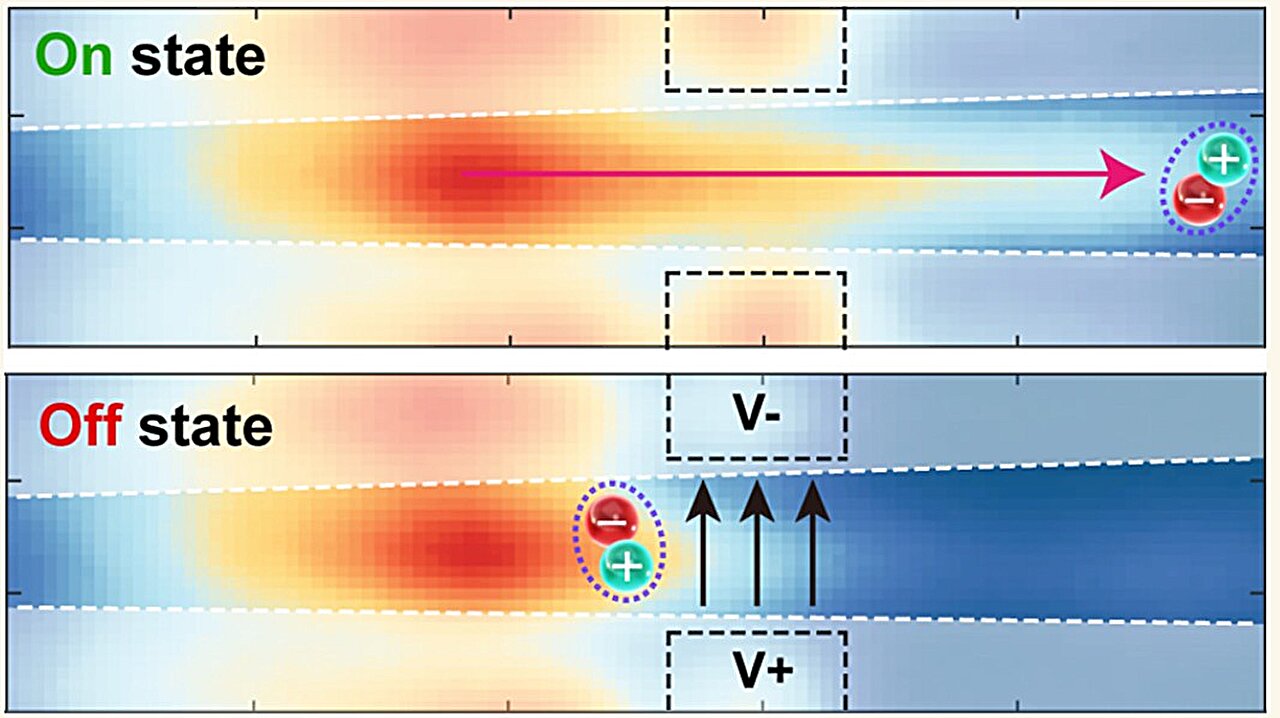
The setup allowed the researchers to overcome long-standing issues by enabling strong interactions between light and dark excitons (excitons that do not emit light), resulting in a quantum effect that can pull the entire exciton population to transport both farther and faster—up to 400% more than popular exciton guides.

The exciton–light interaction also generated a strong opto-excitonic force that formed an energy barrier capable of blocking exciton flow to switch the signal “off” and reversing the process when needed. In addition, the NEO device controlled exciton directionality using a tapered nanoridge structure, which creates a directional force that acts as a photonic guide, steering excitons along a single, well-defined path.
The researchers note that their findings demonstrate how a tailored structural design can enhance and control exciton transport, paving the way for next-generation excitonic devices that bridge the gap between electronics and photonics.
Written for you by our author Sanjukta Mondal, edited by Sadie Harley, and fact-checked and reviewed by Robert Egan—this article is the result of careful human work. We rely on readers like you to keep independent science journalism alive.
If this reporting matters to you,
please consider a donation (especially monthly).
You’ll get an ad-free account as a thank-you.
More information:
Zhaohan Jiang et al, Nanoengineered Optoexcitonic Switch, ACS Nano (2025). DOI: 10.1021/acsnano.5c05057
© 2025 Science X Network
Citation:
Next-generation nanoengineered switches can cut heat loss in electronics (2025, September 14)
retrieved 19 September 2025
from https://phys.org/news/2025-09-generation-nanoengineered-loss-electronics.html
This document is subject to copyright. Apart from any fair dealing for the purpose of private study or research, no
part may be reproduced without the written permission. The content is provided for information purposes only.