
Across the world, more than 1.5 billion people suffer from chronic liver disease. The U.S. Centers for Disease Control and Prevention reports that it kills more than 52,000 people a year in the United States alone—the ninth most common cause of death in the nation.
Despite this significant impact on society, alcohol-related liver disease (ARLD) remains largely unaddressed by medical research. Texas A&M University researcher Dr. Jyothi Menon aims to change that with a promising new therapy that she’s developing. Her findings were recently published in Biomaterials.
“Liver diseases are rapidly increasing around the world, and there’s a significant risk of them slowly progressing to more dangerous conditions like cancer,” said Menon, an associate professor in the Department of Biomedical Engineering. “Being able to use our technologies to develop effective solutions against this progression is what’s driving me and driving this research.”
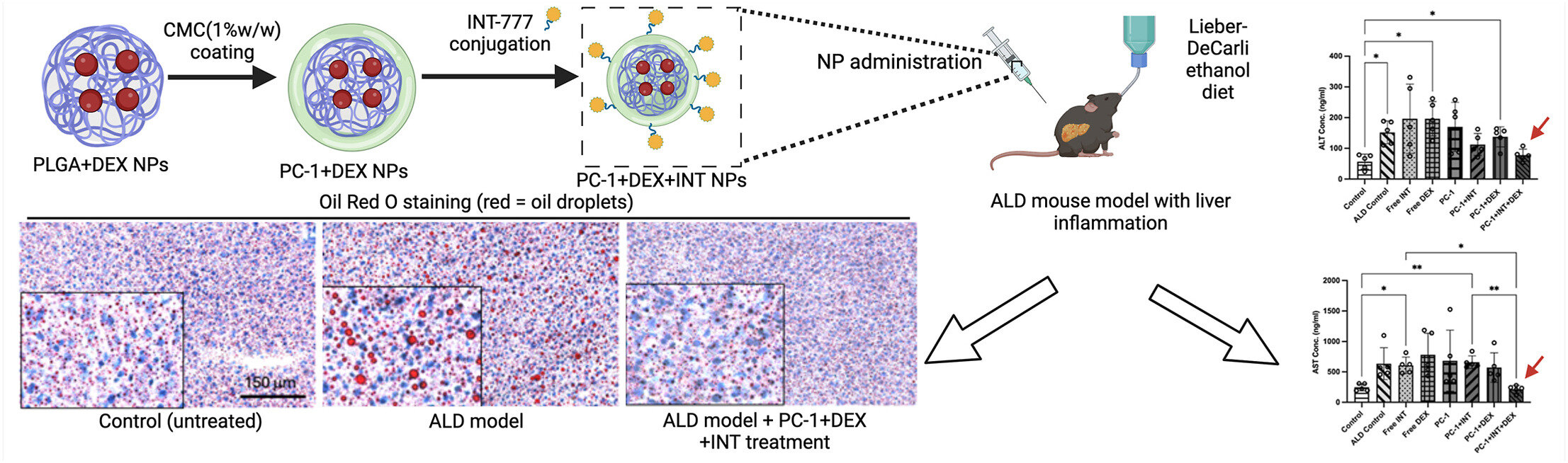
While current treatments for ARLD focus on alcohol cessation and anti-inflammatory medications, Menon and her collaborators at the University of Rhode Island are taking a much more focused approach. They have developed microscopic nanoparticles that are a thousand times smaller than the diameter of a human hair. These safe and biodegradable nanoparticles can seek out and attach to damaged liver cells. By binding to the cells, the nanoparticles help stop them from fueling disease progression.
In healthy humans, the liver is a naturally self-healing organ, capable of regenerating most of its function even when 70% to 80% has been damaged. A key part of this healing process involves immune cells called Kupffer cells that protect the liver from infection and harmful substances. In a healthy liver, they also produce proteins that promote an anti-inflammatory response in other liver cells.
In chronic liver conditions, when liver damage progresses and repetitive injury occurs, the organ’s self-repairing functions also become damaged. Then, the liver unintentionally begins harming itself. The Kupffer cells, which previously fought inflammation, start releasing protein signals with the opposite effect—increasing inflammation and encouraging other liver cells to form scar tissue in a process called fibrosis.
The result is life-threatening organ dysfunction and even fatal liver cancer.

The Menon Lab’s nanoparticles are engineered to stop this damaging process. Their surface is designed to recognize and selectively bind to a protein found only on Kupffer cells in the liver, allowing them to avoid other liver cell types. This protein functions as a receptor in the cell’s membrane, receiving chemical signals and triggering cell behaviors in response. When it is activated by the nanoparticle’s coating, it promotes beneficial, anti-inflammatory behavior in the Kupffer cells instead of increasing inflammation and scarring. The nanoparticles also release anti-inflammatory therapies as they break down, delivering medicine directly to the cells that need it most.
“Instead of going for the cells which are producing the scar tissue, we’re going one step behind and targeting the Kupffer cells themselves so that we can prevent them from stimulating other cells in the liver and causing this fibrosis progression,” Menon said.
The result is far greater than the sum of its parts.
“The individual components on their own did not have much of a therapeutic effect,” Menon said. “But when we gave our final formulation with everything combined, it reduced inflammation and lipid droplet formation seen due to fat buildup in the liver. It was the combination of all of these things that actually had an effect.”
Getting to this point was no easy feat. Because Menon’s team is one of the first to attempt this kind of approach, there was no prior research to lean on.
“As one of the first groups to even approach something like this using nanoparticle-based drug delivery systems, there wasn’t any sort of prior literature to help us figure out what roadblocks there could be when we took up this research,” Menon said. “The first time we were able to confirm that these particles can target Kupffer cells, it was very exciting for us.”
While Menon is currently focused on alcohol-related liver disease, her nanoparticle therapies have much broader applications. Targeted nanoparticles could be the future of disease treatment across numerous parts of the body.
“What we have generated is very promising preliminary work that shows that this formulation can selectively target a specific cell population in the liver to deliver therapies and can potentially have a meaningful impact on the treatment of chronic ARLD,” she said. “Our formulations are versatile, so they can be adapted or modified for treating other kinds of inflammation and fibrosis in other organs.”
More information:
Janitha M. Unagolla et al, A novel Kupffer cell-targeting nanoparticle system to Mitigate alcohol-associated liver disease, Biomaterials (2025). DOI: 10.1016/j.biomaterials.2025.123623
Citation:
Nanoparticles show potential for halting inflammation and scarring in alcohol-related liver disease (2025, October 14)
retrieved 14 October 2025
from https://phys.org/news/2025-10-nanoparticles-potential-halting-inflammation-scarring.html
This document is subject to copyright. Apart from any fair dealing for the purpose of private study or research, no
part may be reproduced without the written permission. The content is provided for information purposes only.