
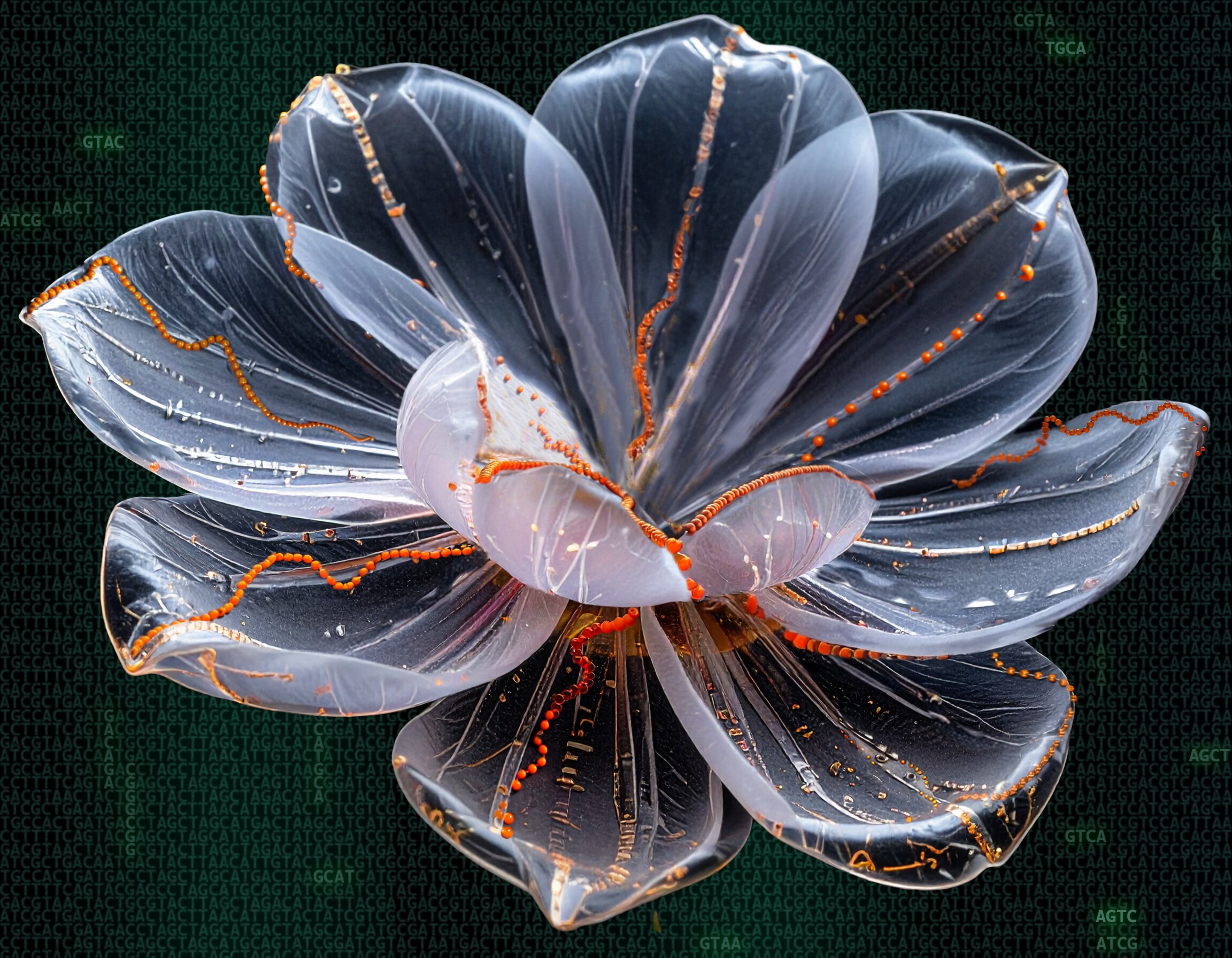
Researchers at the University of North Carolina have created microscopic soft robots shaped like flowers that can change shape and behavior in response to their surroundings, just like living organisms do. These tiny “DNA flowers” are made from special crystals formed by combining DNA and inorganic materials. They can reversibly fold and unfold in seconds, making them among the most dynamic materials ever developed on such a small scale.
The work has been published in Nature Nanotechnology.
Each flower’s DNA acts like a tiny computer program, telling it how to move and react to the world around it. When the environment changes, such as when acidity rises or falls, the flower can open, close, or trigger a chemical reaction. That means these DNA-based robots could one day perform tasks on their own, from delivering medicine to cleaning up pollution.
“People would love to have smart capsules that would automatically activate medication when it detects disease and stops when it is healed. In principle, this could be possible with our shapeshifting materials,” said Dr. Ronit Freeman, senior and corresponding author of the paper and director of the Freeman Lab at UNC.
“In the future, swallowable or implantable shape-changing flowers could be designed to deliver a targeted dose of drugs, perform a biopsy, or clear a blood clot.”
The idea was inspired by natural processes such as flower petals unfurling, coral pulsing, and tissues forming in living organisms. The researchers wanted to mimic these complex behaviors in artificial materials, a challenge that has long stumped scientists working at microscopic scales.
“We take inspiration from nature’s designs, like blooming flowers or growing tissue, and translate them into technology that could one day think, move, and adapt on its own,” said Freeman.
The key to their success is how the DNA is arranged inside the flower-shaped crystals. When the surrounding environment becomes more acidic, parts of the DNA fold tightly, causing the flower to close.
When conditions return to normal, the DNA loosens, and the petals open again. This simple but powerful motion can be used to control chemical reactions, carry and release molecules, or interact with cells and tissues.
Although the technology is still in early testing, the team envisions exciting future uses. One day, these DNA flowers could be injected into the body, where they would travel to a tumor.
Once there, the tumor’s acidity could cause the petals to close, releasing medicine or taking a tiny tissue sample. When the tumor resolves, the flowers would reopen and deactivate, ready to respond again if the disease returns.
Beyond medicine, these smart materials could be used to clean up environmental disasters, releasing cleaning agents into polluted water, and then dissolving harmlessly when the job is done. They could even store massive amounts of digital information, up to two trillion gigabytes in just a teaspoon, offering a greener, more efficient way to store, read, and write data in the future.
This breakthrough marks a major step toward materials that can sense and respond to their environment, bridging the gap between living systems and machines.
More information:
Reversible Metamorphosis of Hierarchical DNA-Inorganic Crystals, Nature Nanotechnology (2025). DOI: 10.1038/s41565-025-02026-8
Citation:
Microscopic DNA ‘flowers’ could deliver medicine exactly where it’s needed (2025, October 20)
retrieved 20 October 2025
from https://phys.org/news/2025-10-microscopic-dna-medicine.html
This document is subject to copyright. Apart from any fair dealing for the purpose of private study or research, no
part may be reproduced without the written permission. The content is provided for information purposes only.