
Scientists are exploring many ways to use light rather than heat to drive chemical reactions more efficiently, which could significantly reduce waste, energy consumption, and reliance on nonrenewable resources.
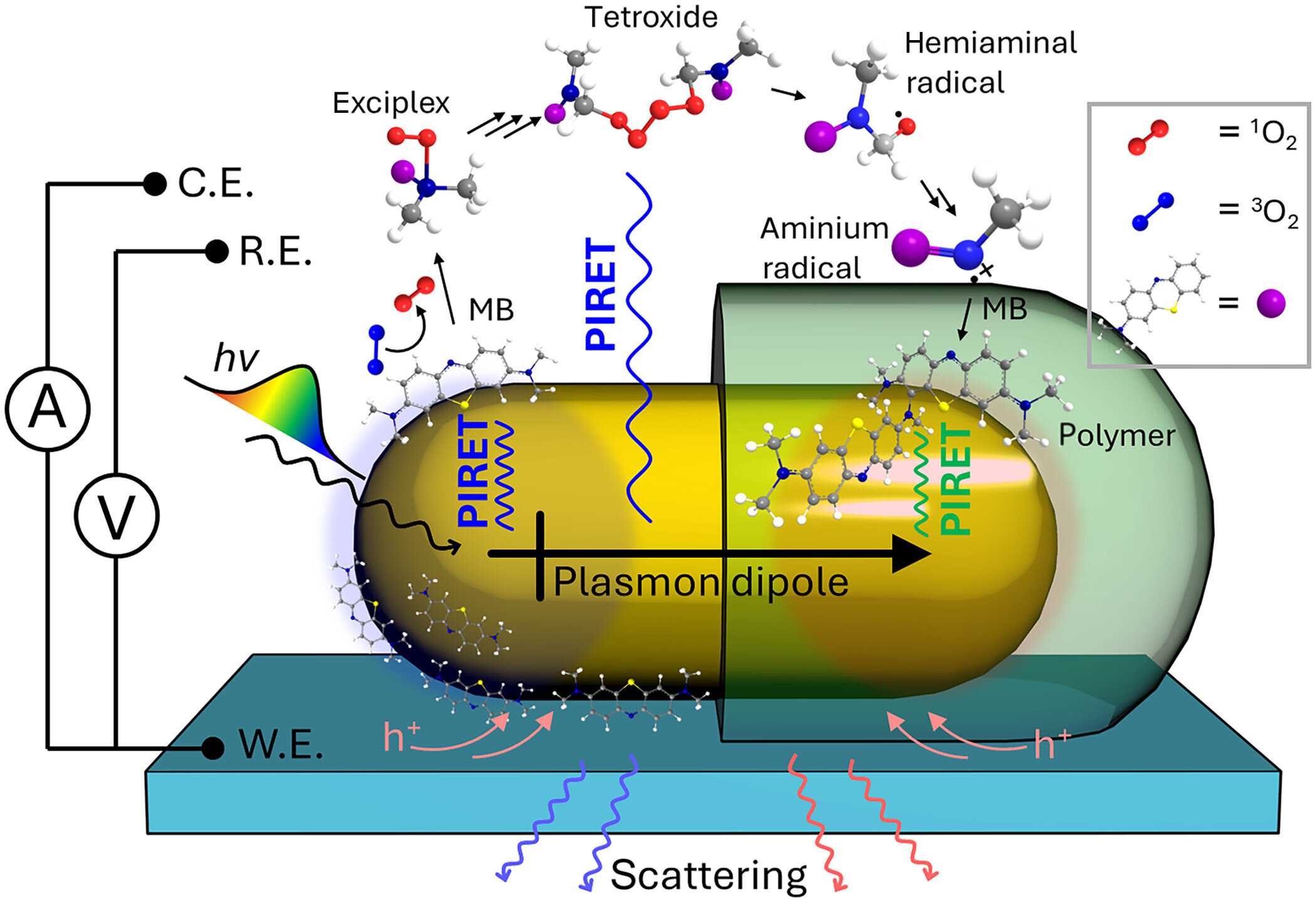
A team of chemistry researchers at the University of Illinois Urbana-Champaign has been studying plasmon-induced resonance energy transfer (PIRET)—conveying energy from a tiny metal particle to a semiconductor or molecule without the need for any physical contact.
“If you’d like to do chemistry with light, then your first step would be to use that light as efficiently as possible,” said Illinois chemistry professor Christy Landes, who co-leads the research team exploring this innovative research. “And one of the most efficient ways to use light is to use plasmonic metal nanoparticles, because they are better than just about any other material at absorbing and scattering light.”
In a paper published in Science Advances, the research team demonstrates how this resonant transfer of energy from a gold nanorod to a molecule, in this case a synthetic blue dye, can efficiently convert light energy into different forms until it becomes part of the final product of the reaction, in this case, a polymer hybrid.
Their proof-of-concept study shows PIRET’s potential for reshaping the future of light-driven chemical reactions and its potential as an energy-efficient way to do new chemical reactions while allowing the creation of advanced hybrid nanomaterials in a way that is distinct from traditional charge-transfer catalysis.
“We can do a new type of polymerization chemistry that goes through a completely different intermediate route than the bulk polymerization reaction,” Landes said. “It doesn’t happen at all the same way that a heat or pressure-initiated reaction would go. And that’s a really special part of this work.”
Illinois chemistry professor Stephan Link, co-leader of the research team, said the potential of this method in creating new reactions and different materials is equally exciting.
“We’re learning the mechanisms behind it so that potentially we could design reactions that are otherwise not possible,” Link said.
Several challenges have limited the practical application of PIRET, including maximizing the efficiency of the energy transfer and clearly understanding how it works. Another challenge is whether it can initiate a light-driven reaction.
The research team shed new light on those questions by applying a variety of methods to deeply explore their specific PIRET-assisted polymerization reaction and confirm their conclusions.
They used in-operando single-particle spectroelectrochemistry, a cutting-edge technique that allowed for the real-time observation of energy transfer at the nanoscale.
Their conclusions are supported by spectroscopic data, electrochemistry, and density functional theory calculations. Through that combination of data, the researchers detailed in their study a cascading energy transfer process from photon to plasmon to exciton that culminated in a unique, light-initiated chemical transformation.
“We basically showed all pieces of that chain—our particles can absorb light very strongly; the energy can be transferred out very efficiently into molecules that are outside the nanoparticle; and we can do a new type of polymerization chemistry,” Landes explained.
According to the study, the PIRET-assisted reaction demonstrated energetic spontaneity, and started working at a lower energy than bulk electropolymerization, the typical method of making polymers with electricity. They also report that their reaction achieved a maximum PIRET efficiency of 40%, a benchmark that underscores the potential of PIRET in next-generation photocatalytic systems.
“The route is different, the mechanism is different, but also the reason why we know it’s different is that in the bulk process we have to apply a much larger electrochemical potential, but with the nanoparticles and the light, we have to only apply a very small potential,” Link said. “I think that was a very important demonstration that we’ve gone with a reaction that’s known, but shown how this gives us a different, in a way, non-equilibrium route by taking out the energy from the particles through energy transfer to do the chemistry.”
Link and Landes said this paper evolved from previous work by Hyuncheol Oh, a postdoctoral researcher in the Landes research group, who was initially studying energy transfer between the nanoparticle and methylene blue, the molecule, when he found that he could initiate oligomerization, the first step towards a polymer.
“That was the first exciting moment—observing optical signals that revealed photon energy extraction and its storage in the oligomer structures through PIRET, and at the same time, we recognized an opportunity to increase the energy conversion efficiency and drive a larger scale chemical transformation into polymer hybrids,” Oh said.
“He really dug into the chemistry and the mechanism of this reaction, and I think a bunch of credit needs to go to him. He’s been very passionate about this,” Link said.
Since then, Link said he has made a polymer, figured out the chemistry, and put it all together, showing how the light is the critical factor and showing that singlet oxygen is a reactive intermediate that is very important.
According to the researchers, this work not only deepens the understanding of PIRET mechanisms but also opens new avenues for designing efficient, light-driven materials and reactions. Link said those potential avenues are exciting.
“I think that could really open up the idea of using photons for catalysis and for different ways of doing chemistry. To me that’s something that could open up possibilities that we’re not even thinking about yet,” Link said.
Going forward, the researchers would like to explore doing other polymerization reactions with this approach.
“This is a polymerization reaction that happens by this super complicated multi-step process, so this demonstrates that you can do really complicated chemistry using nanoparticles as light harvesters and for antennas to do the reactions. So definitely we’d like to try some more complicated polymerization reactions,” Landes said.
Researchers in the Landes and Link groups who also contributed to this work include postdoctoral researcher Subhojyoti Chatterjee; Zhenyang Jia, a graduate student in chemical and biomolecular engineering; Eric Gomez, a graduate student in chemistry; former postdoctoral researcher Stephen A. Lee; and Jiamu Lin and Ojasvi Verma, graduate students in chemistry.
More information:
Hyuncheol Oh et al, Plasmonic pathway to hybrid nanomaterials through energy transfer, Science Advances (2025). DOI: 10.1126/sciadv.ady7016
Citation:
Light-driven reaction leads to advanced hybrid nanomaterial (2025, October 13)
retrieved 13 October 2025
from https://phys.org/news/2025-10-driven-reaction-advanced-hybrid-nanomaterial.html
This document is subject to copyright. Apart from any fair dealing for the purpose of private study or research, no
part may be reproduced without the written permission. The content is provided for information purposes only.