
A research team including members from the University of Michigan have unveiled a new observational technique that’s sensitive to the dynamics of the intrinsic quantum jiggles of materials, or phonons.
This work will help scientists and engineers better design metamaterials—substances that possess exotic properties that rarely exist in nature—that are reconfigurable and made from solutions containing nanoparticles that self-assemble into larger structures, the researchers said. These materials have wide-ranging applications, from shock absorption to devices that guide acoustic and optical energy in high-powered computer applications.
“This opens a new research area where nanoscale building blocks—along with their intrinsic optical, electromagnetic and chemical properties—can be incorporated into mechanical metamaterials, enabling emerging technologies in multiple fields from robotics and mechanical engineering to information technology,” said Xiaoming Mao, U-M professor of physics and co-author of the new study.
Phonons are natural phenomena that can be thought of as discrete packets of waves that move through the building blocks of materials, whether they are atoms, particles or 3D-printed hinges, causing them to vibrate and transfer energy. This is a quantum mechanical description of common properties observed in various contexts, including the transfer of heat, the flow of sound and even seismic waves formed by earthquakes.
Some materials, both artificial and natural, are designed to move phonons along specific paths, imparting specific mechanical attributes. Two real-life examples of this include materials used in structures to resist seismic waves during earthquakes and the evolution of the rugged, yet lightweight skeletons of deep-sea sponges that enable the organisms to withstand the extreme pressures of deep-water environments.

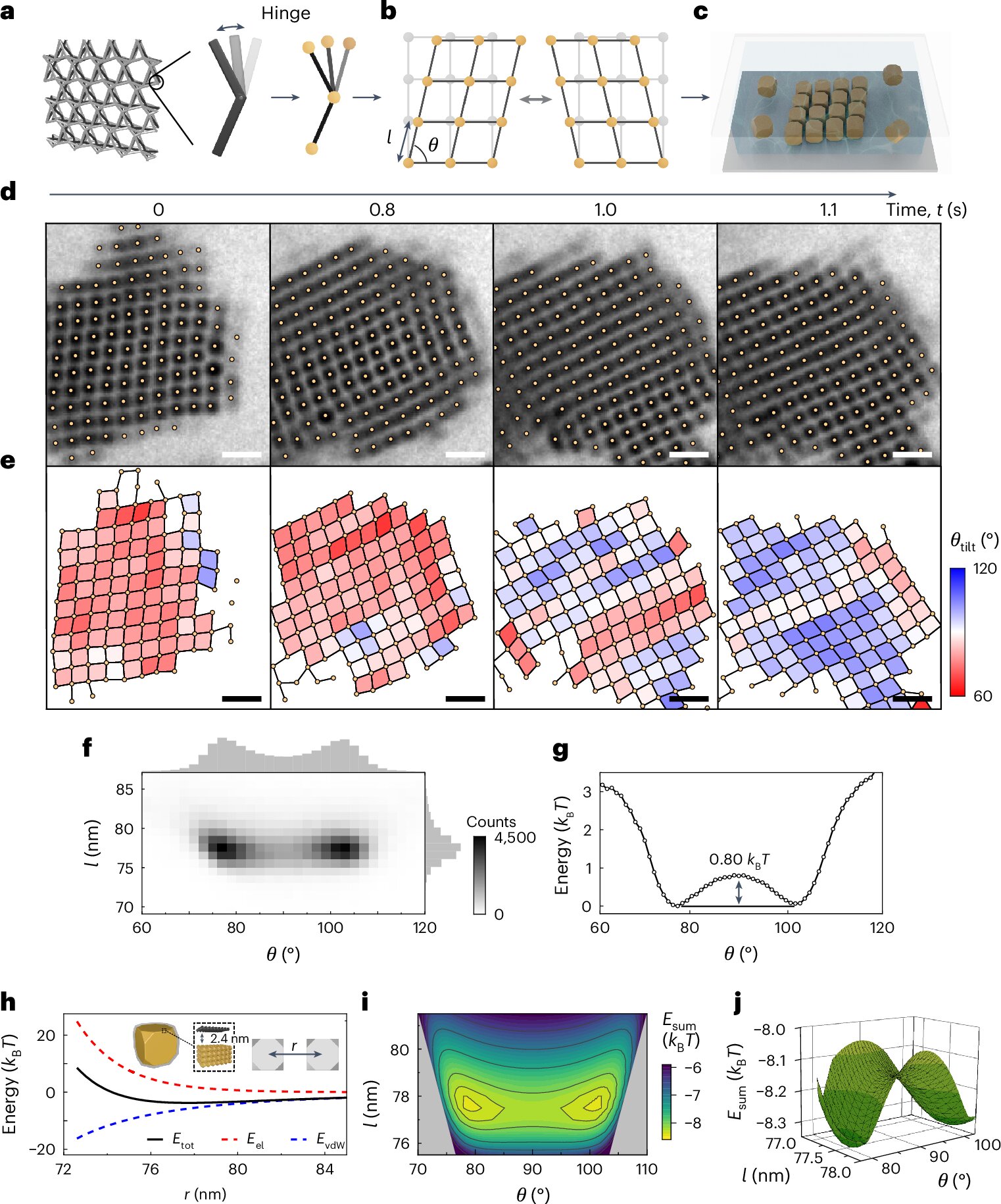
“Using the liquid-phase electron microscopy technique developed in our lab at Illinois, the new study marks the first time we’ve been able to observe phonon dynamics in nanoparticle self-assemblies, acting as a new type of mechanical metamaterials,” said Qian Chen, professor of materials science and engineering at the University of Illinois.
Published in the journal Nature Materials, the study combines nanoparticle assembly with mechanical metamaterial principles, enabling the engineering of mechanical properties through structural design. The project is the result of a four-year collaboration between Chen, who led the materials science and experimental portion, Mao at U-M, who led the theory and mechanical metamaterials portions, and Wenxiao Pan, assistant professor of mechanical engineering at the University of Wisconsin who led the simulation portion.
“Metamaterials design is a very active field,” Chen said. “Most research has focused on the macroscale realm, where it is easier to control the geometry and structure, as well as measure and model the phonon properties.”
But Chen and her collaborators work at the nanoscale, where both engineering and theoretical approaches to phonon control are tough. To address this problem, the team employed precise theoretical modeling in conjunction with experiments, observational techniques and machine learning-accelerated simulations to develop a new framework for metamaterials design.
In the lab, using liquid-phase electron microscopy, the team examined the vibrational trajectories of gold nanoparticles to determine the phonon band structures, and then matched these structures to a discrete mechanical model to extract nanoscale springs.
“This work also demonstrates the potential of machine learning to advance the study of complex particle systems, making it possible to observe their self-assembly pathways governed by complex dynamics,” Pan said. “It opens new avenues for data-driven inverse design of reconfigurable colloidal metamaterials using machine learning and artificial intelligence.”
“We feel we are at a great intersection between disciplines, collaboration and the need for advancement in materials science,” Chen said. “With nanoparticle assembly, we can design structures with very controlled geometry, and then with mechanical metamaterials, adapt the theoretical framework in material design.”
More information:
Chang Qian et al, Nanoscale phonon dynamics in self-assembled nanoparticle lattices, Nature Materials (2025). DOI: 10.1038/s41563-025-02253-3
Citation:
Electron microscopy technique captures nanoparticle organizations to forge new materials (2025, June 18)
retrieved 19 September 2025
from https://phys.org/news/2025-06-electron-microscopy-technique-captures-nanoparticle.html
This document is subject to copyright. Apart from any fair dealing for the purpose of private study or research, no
part may be reproduced without the written permission. The content is provided for information purposes only.